
No special tools or replacement parts are required to check the belt condition.
Checking the status
Turn off the ignition.
Mark the belt with a chalk line in a clearly visible place.
Slowly turn the engine crankshaft with stops and check the condition of the poly V-belt. Turning the engine crankshaft stated here.
Check the poly V-belt for the following damage:
Traces of oil and grease.
Hardening of the belt material.
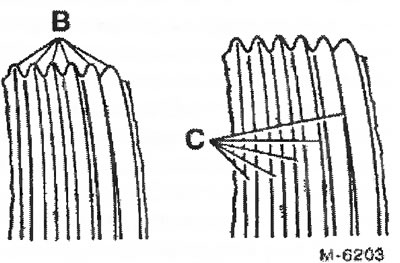
Wear of the side surfaces of the wedges: the wedges are worn to a pointed state "B", the wedges of the new belt have a trapezoidal shape in cross-section.
At the base of the belt ribs, the cord is visible, appearing as light spots "C".
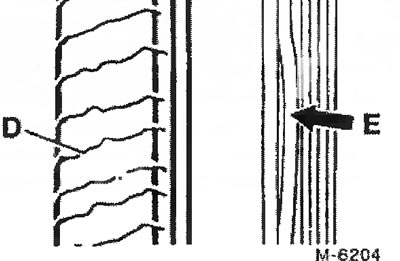
Transverse "D" cracks on the back of the belt.
Individual "E" ribs have come away from the base of the belt.
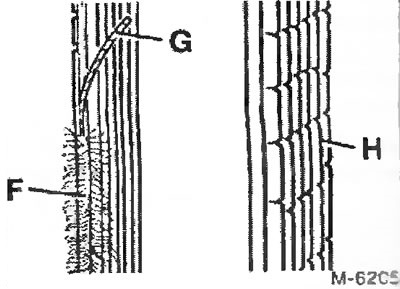
Fringe "F" on the outside of the belt.
Longitudinal cracks and breaks in the "G" cord threads on the sides of the belt.
Transverse "H" cracks on many ribs.
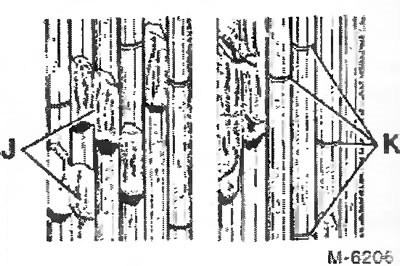
"J" rib fractures.
Individual transverse cracks of the "K" ribs.
Dirt and stone deposits between the ribs.
Rubber pellets at the base of the ribs.
If one of these several types of damage is detected, then again replace belt.
Check the poly V-belt for hardening and cracks. Otherwise, the poly V-belt does not require maintenance. There is no need to tighten the belt.