
Table of contents: Oil application/viscosity grades ↓ Engine Oil Specification ↓
- Home
- BMW 3 Series
- E46
- Power unit
- Engine repair
- Description of the engine lubrication system
Description of the engine lubrication system (BMW 3 Series E46)
The engine is lubricated with all-season oil, which eliminates the need to change the oil when changing the season (summer/winter). The basis of this oil is low-viscosity seasonal oil (for example, 10 W), which becomes more viscous when hot with the help of a so-called "viscosity stabilizer". This ensures effective lubrication of both cold and hot engines.
Light oils can also be used (high power oils). They are all-season oils, in which friction coefficient reducers are introduced as additives along with others. Light oils use so-called synthetic oils as a base.
The SAE designation indicates the viscosity of the engine oil.
For example: SAE 10 W 40:
10 the viscosity of the oil when cold. The lower the number, the thinner the oil when cold.
W the oil is suitable for use in winter.
40 viscosity of the oil when hot. The higher the number, the thicker the oil when hot.
Special oils BMW long life p/n 07 511470 407
X can take values 30, 40, 50
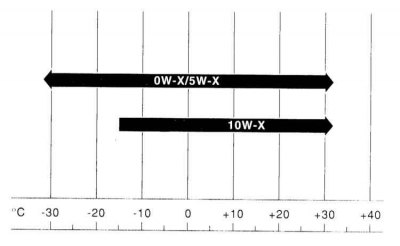
The illustration shows the viscosity of engine oil depending on the outside temperature. These oils can be used for almost all outside temperatures. It is clear from the illustration that the areas of application of adjacent SAE classes have common areas, which allows for short-term temperature deviations. However, at very low outside temperatures, engine starting characteristics may deteriorate.
It is not permitted to introduce additional lubricating additives of any kind into either fuel or oil.
The quality of engine oil is characterized by the standards of the vehicle and oil manufacturer.
European manufacturers classify their oils according to the specification "ACEA" (Association des Constucteurs Europeens de l'Automobile), which takes into account, first of all, European engine production technology. According to the ACEA specification, oils for gasoline engines of passenger cars have quality classes from A1-96 to A3-96, diesel engine oils have classes from B1-96 to B3-96. The highest quality oils are A3 for gasoline engines and B3 for diesel engines.
Classification of motor oils by American manufacturers is carried out according to the API system (API: American Petroleum Institut). The designation consists of two letters. The first letter indicates the area of application: S - Service, intended for gasoline engines; C - Commercial, intended for diesel engines. The second letter indicates the quality in alphabetical order. The highest quality oils are API specification SJ for gasoline and CF for diesel engines.
BMW has set different standards for its engines and classifies engine oils as "Longlife-Öle" and "Spezialöle".
The article text was copied from an online resource: BMWMAN.ru
Light oils can also be used (high power oils). They are all-season oils, in which friction coefficient reducers are introduced as additives along with others. Light oils use so-called synthetic oils as a base.
The terms "mineral", "semi-synthetic" or "synthetic" are only an indication of the composition of the oil base. Depending on the complete composition, different oil qualities can be obtained.
Oil application/viscosity grades
The SAE designation indicates the viscosity of the engine oil.
For example: SAE 10 W 40:
10 the viscosity of the oil when cold. The lower the number, the thinner the oil when cold.
W the oil is suitable for use in winter.
40 viscosity of the oil when hot. The higher the number, the thicker the oil when hot.
Special oils BMW long life p/n 07 511470 407
X can take values 30, 40, 50
The illustration shows the viscosity of engine oil depending on the outside temperature. These oils can be used for almost all outside temperatures. It is clear from the illustration that the areas of application of adjacent SAE classes have common areas, which allows for short-term temperature deviations. However, at very low outside temperatures, engine starting characteristics may deteriorate.
It is permissible to mix oils of different viscosity classes if it becomes necessary to add oil and the outside temperature does not correspond to the viscosity class of the oil in the engine.
It is not permitted to introduce additional lubricating additives of any kind into either fuel or oil.
Engine Oil Specification
The quality of engine oil is characterized by the standards of the vehicle and oil manufacturer.
European manufacturers classify their oils according to the specification "ACEA" (Association des Constucteurs Europeens de l'Automobile), which takes into account, first of all, European engine production technology. According to the ACEA specification, oils for gasoline engines of passenger cars have quality classes from A1-96 to A3-96, diesel engine oils have classes from B1-96 to B3-96. The highest quality oils are A3 for gasoline engines and B3 for diesel engines.
Classification of motor oils by American manufacturers is carried out according to the API system (API: American Petroleum Institut). The designation consists of two letters. The first letter indicates the area of application: S - Service, intended for gasoline engines; C - Commercial, intended for diesel engines. The second letter indicates the quality in alphabetical order. The highest quality oils are API specification SJ for gasoline and CF for diesel engines.
Engine oils that are intended by the manufacturer exclusively for use in diesel engines should not be used in gasoline engines. There are oils that are intended for use in both gasoline and diesel engines. In this case, both specifications (for example: ACEA A3-96/B3-96 or API SH/CD) indicated on the oil container.
BMW has set different standards for its engines and classifies engine oils as "Longlife-Öle" and "Spezialöle".
The article text was copied from an online resource: BMWMAN.ru
This article is available at russian, bulgarian, belarusian, ukrainian, serbian, croatian, romanian, polish, slovak, hungarian
Article verified: Sevastyanov Nikolay
Share information:
Previous articles
БМВ E46: Engine repair
Next articles
Similar articles on other types of BMW cars:
Engine lubrication system. General information BMW 5 Series E34 (1988-1996)
Engine cooling system parts BMW 5 Series E12 (1972-1981)
Diagnostics of lubrication system faults BMW 7 Series E32 (1986-1994)
Replacing the sensors of the engine management system BMW 7 Series E38 (1994-2001)
Exhaust system assembly (Engine M54 and N52 K) BMW X3 E83 (2003-2010)
Lubrication system — design description BMW X5 E53 (1999-2006)
Engine lubrication system. General information BMW 5 Series E34 (1988-1996)
Engine cooling system parts BMW 5 Series E12 (1972-1981)
Diagnostics of lubrication system faults BMW 7 Series E32 (1986-1994)
Replacing the sensors of the engine management system BMW 7 Series E38 (1994-2001)
Exhaust system assembly (Engine M54 and N52 K) BMW X3 E83 (2003-2010)
Lubrication system — design description BMW X5 E53 (1999-2006)
Link in different formats to this page
Visitor comments
No comments yet
- General information
- Manual
- Maintenance
- Power unit
- Engine repair
- Cooling system
- Power system (gasoline)
- Injection system (gasoline)
- Fuel system (diesel)
- Exhaust system
- Ignition system
- Charge and launch systems
- Transmission
- Car gearbox
- Clutch and drive shafts
- Chassis
- Brake system
- Suspension front and rear
- Steering
- Body
- Body care and repair
- Exterior
- Interior
- Electrical equipment
- Troubleshooting
- Lighting and signaling
- Equipment and devices
- Heater and air conditioner
- Electrical circuits
- General information
- Manual
- Repair on the road
- Weekly checks
- Maintenance
- Troubleshooting
- Power unit
- 4 cylinder engines
- 6 cylinder engines
- Engine overhaul
- Cooling and heating
- Fuel and exhaust system
- Starting and charging system
- Ignition system
- Transmission
- Clutch
- Mechanical gearbox
- Automatic gearbox
- Cardan and drive shafts
- Chassis
- Brake system
- Wheel suspension
- Steering
- Body
- Exterior
- Interior
- Electrical equipment
- Equipment and devices
- Electrical circuits
- General information
- Maintenance
- Power unit
- Engine repair
- Cooling system
- Ignition system
- Supply system
- Fuel injection system
- Exhaust system
- Transmission
- Clutch
- Car gearbox
- Front and rear axle
- Chassis
- Steering
- Brake system
- Body
- Exterior
- Interior
- Electrical equipment
- Heating system
- Equipment and devices
- Power devices
- Electrical circuits
- Power unit
- M10/M20 engine
- M40 engine
- Ignition system
- Lubrication system
- Cooling system
- Supply system
- Fuel injection
- Exhaust system
- Transmission
- Clutch
- Manual gearbox
- Front axle
- Rear axle
- Chassis
- Steering
- Brake system
- Body
- Exterior
- Interior
- Electrical equipment
- Heating system
- Equipment and devices
- Electrical circuits
- General information
- Specifications
- Operation and maintenance
- 4-cylinder engine
- Engine repair
- Cooling and lubrication system
- Supply system
- Ignition system
- 6-cylinder engine
- Engine repair
- Cooling and lubrication system
- Supply system
- Fuel injection system
- Ignition system
- Transmission
- Clutch
- 4-speed manual gearbox
- 5-speed manual gearbox
- Automatic gearbox
- Cardan and rear axle
- Chassis
- Steering
- Front suspension
- Rear suspension
- Brake system
- Electrical equipment
- Equipment and devices
- Electrical circuits