
Cars Mazda Cars Mitsubishi Cars Toyota Cars Chevrolet Cars AvtoVAZ Cars Kia Cars Nissan
English Русский
Български
Беларускі
Український
Српски
Hrvatski
Română
Polski
Slovenský
Magyar
| Articles | Contacts | Sitemap |   
BMWman.ru


3 series   5 series   7 series   BMW X3   BMW X5   BMW X6

E39 (1995-2003) E34 (1988-1996) E28 (1981-1988) E12 (1972-1981)
  • Home
  • BMW 5 Series
  • E28
  • General information
  • Maintenance
  • Checking and replacing spark plugs

Checking and replacing spark plugs (BMW 5 Series E28)

            0

Annually or every 20,000 km.

Annually or every 20,000 km.


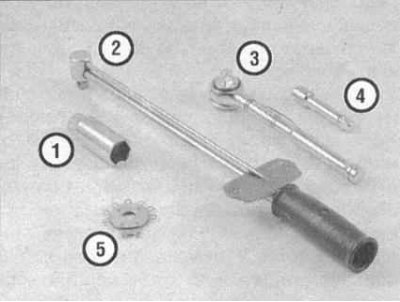
Tools needed to replace spark plugs.

1 — Spark plug wrench head - equipped with a special soft insert to protect the porcelain insulator of the spark plug

2 — Torque wrench - although it is not an absolutely necessary tool, it provides the maximum guarantee of the correct tightening force of the spark plugs

3 — Ratchet drive - comes standard with the spark plug wrench

4 — Extension - depending on the car model and its accessories, you may need special extensions and universal joints to provide access to the spark plugs

5 — Spark plug gap gauge - this device for checking the spark plug gap is available in various modifications. Make sure that you have a gauge specifically for the gap of your car. You can use the blades of a feeler gauge instead

Before you begin, gather all the necessary tools, which include a replacement spark plug wrench head and a set of feeler gauge blades. Some spark plug manufacturers supply special tools for measuring the spark plug gap.

The best way to replace spark plugs is to first purchase new plugs, adjust their gap, and replace each plug one at a time. When purchasing spark plugs, it is very important to choose the correct spark plugs for your vehicle's engine. Information about these can be found in Table of sizes and adjustment data at the end of the Guide.


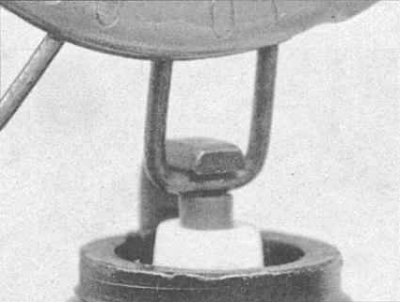
1. With new spark plugs on hand, allow the engine to cool completely before removing the old ones. During this time, you can inspect the new spark plugs for defects and check the spark plug gaps.
1. With new spark plugs on hand, allow the engine to cool completely before removing the old ones.…


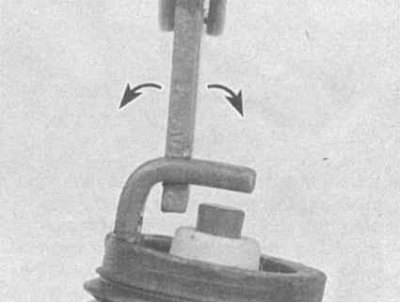
2. The spark plug gap is checked by inserting a gauge of the required thickness between the electrodes at the end of the spark plug. The gap should correspond to that specified in Table of sizes and adjustment data at the end of the Manual. The wire should just touch each of the electrodes. If the gap is not correct, slightly bend the curved part of the electrode using the knurled adjuster until the desired gap is achieved.
2. The spark plug gap is checked by inserting a gauge of the required thickness between the…


When adjusting the gap of a new spark plug, bend only the base of the ground electrode, not the end. If the ground electrode is offset from the center electrode, use a notched adjuster to align them. Check the porcelain insulator for cracks, indicating that the spark plug should be replaced.


When adjusting the gap of a new spark plug, bend only the base of the ground electrode, not the…


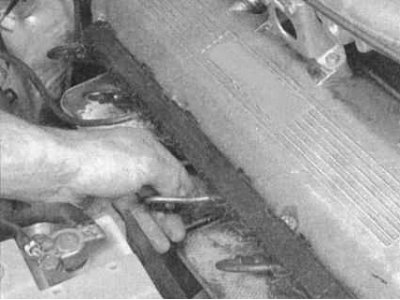
3. With the engine cool, disconnect the high-voltage wire from one of the spark plugs. Do not pull the wire itself, but hold the connector at its end. Sometimes you need to use a twisting motion to disconnect the connector.

4. If possible, use compressed air to blow out dirt and debris from around the spark plugs. You can use a regular bicycle pump for this. This is done to avoid the possibility of debris getting into the cylinder after the spark plugs are removed.
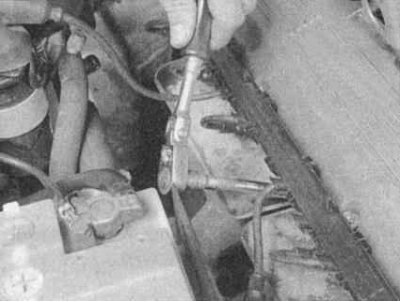
4. If possible, use compressed air to blow out dirt and debris from around the spark plugs. You can…


5. Place the spark plug wrench head on the spark plug and remove the spark plug from the engine by turning it counterclockwise.

6. Compare the removed spark plug with those shown in the pictures, this will give you useful information about the general condition of the engine.


7. Apply a small amount of copper anti-seize compound to the threads of the new spark plug. Insert the spark plug into the cylinder head and screw it in with your fingers until it stops, then tighten it with the socket of a spark plug wrench. If possible, use a torque wrench to tighten the spark plug to ensure that it is installed correctly. The tightening torque for the spark plugs is included in Table of sizes and adjustment data at the end of the Guide.

To avoid the possibility of screwing the spark plug in incorrectly, place a small piece of rubber hose or plastic tube on its tailpiece. The flexible tube will act as a universal joint, ensuring alignment of the spark plug with the spark plug socket, and if the spark plug starts to warp, the hose will slide on it, preventing the thread from being stripped.


8. Before connecting the high-voltage (HV) wire to the spark plug, carefully inspect it as described in Section Checking and replacing spark plug wires, cover and distributor rotor.

9. Connect the wire to the installed new spark plug, again using a twisting motion and holding the connector until it is fully seated on the spark plug.

10. Repeat the above procedure for the remaining spark plugs in sequence to avoid incorrect connection of the spark plug wires.

This article is available at russian, bulgarian, belarusian, ukrainian, serbian, croatian, romanian, polish, slovak, hungarian
Article verified: Zhuravleva Isolda

Share information:
Previous articles
БМВ E28: Maintenance
Next articles

Checking battery condition, care and charging
Checking and adjusting engine idle speed and CO levels
Checking the condition, adjusting the tension and replacing the drive…
Checking the condition and replacing the engine compartment hoses
Wheel rotation
Checking and replacing spark plug wires, cover and distributor rotor
Checking the oil level in a manual transmission
Checking the differential fluid level
Checking and adjusting valve clearances
Checking and lubricating the throttle linkage


Similar articles on other types of BMW cars:
Replacing spark plugs/checking electrical connections BMW 3 Series E36 (1990-2000)
Checking and replacing spark plugs BMW 3 Series E46 (1998-2006)
Replacing spark plugs BMW 7 Series E38 (1994-2001)
Valve guides — checking and replacing BMW 7 Series E32 (1986-1994)
Identifying engine faults by the condition of spark plugs BMW X3 E83 (2003-2010)
Checking and replacing spark plugs BMW X5 E53 (1999-2006)
Link in different formats to this page


Visitor comments

No comments yet


How much 48 + 19 =


BMW E39 (1995-2003) 
  • General information
  • Governing bodies
  • Manual
  • Maintenance
  • Power unit
  • Engine repair
  • Lubrication system
  • Cooling system
  • Ignition system
  • Supply system
  • Injection system (gasoline)
  • Injection system (diesel)
  • Exhaust system
  • Transmission
  • Clutch
  • Car gearbox
  • Front axle
  • Rear axle
  • Chassis
  • Steering
  • Brake system
  • Wheels and tires
  • Body
  • Interior
  • Exterior
  • Heating system
  • Electrical equipment
  • Equipment and devices
  • Power devices
  • Windscreen wipers
  • Electrical circuits
BMW E34 (1988-1996) 
  • General information
  • Manual
  • Maintenance
  • Power unit
  • Engine repair
  • Ignition system
  • Engine lubrication system
  • Cooling system
  • Fuel system (gasoline)
  • Fuel system (diesel)
  • Exhaust system
  • Transmission
  • Clutch
  • Car gearbox
  • Chassis
  • Front and rear suspension
  • Steering
  • Brake system
  • Body
  • Exterior
  • Interior
  • Electrical equipment
  • Heating system
  • Equipment and devices
  • Power devices
  • Electrical circuits
BMW E28 (1981-1988) 
  • General information
  • Manual
  • Maintenance
  • Power unit
  • Engine in a car
  • Engine overhaul
  • Cooling system
  • Supply system
  • Ignition system
  • Control system
  • Transmission
  • Clutch
  • Manual gearbox
  • Automatic gearbox
  • Transmission line
  • Chassis
  • Steering
  • Front suspension
  • Rear suspension
  • Brake system
  • Body
  • Body elements
  • Car care and painting
  • Electrical equipment
  • Heater and air conditioner
  • Equipment and devices
  • Starter and generator
  • Electrical circuits
BMW E12 (1972-1981) 
  • General information
  • Operation and maintenance
  • Specifications
  • Power unit
  • Engine repair
  • Cooling and lubrication system
  • Supply system
  • Ecotronic power supply system
  • Fuel injection system
  • Ignition system
  • Transmission
  • Clutch
  • Gearbox BMW 242/4
  • Gearbox Getrag 262/8
  • Gearbox Getrag 265/6
  • Automatic gearbox
  • Cardan gear
  • Rear axle
  • Chassis
  • Steering
  • Front suspension
  • Rear suspension
  • Brake system
  • Electrical equipment
  • Equipment and devices
  • Electrical circuits
BMWman.ru © 2017-2026 · Mobile version · News and articles · Sitemap: EN BG BY UA RS HR RO PL SK HU · Feedback · Site search
3er E21 · 3er E30 · 3er E36 · 3er E46 [petrol] · 3er E46 · 5er E12 · 5er E28 · 5er E34 · 5er E39 · 7er E32 · 7er E38 · X3 E83 · X5 E53 ·
This site uses cookies 🍪, without them some features simply would not work.