



Table of contents: Examination ↓ Replacement ↓
- Home
- BMW 5 Series
- E28
- Power unit
- Supply system
- Checking the operation and replacing the fuel pressure regulator
Checking the operation and replacing the fuel pressure regulator (BMW 5 Series E28)
Fuel is extremely flammable, so take extra precautions when working on any part of the fuel system. Do not smoke or allow open flames or unshaded lamps near the work area. Do not work in a garage where natural gas equipment is installed (such as water heaters or clothes dryers) with a wick. If fuel gets on your skin, wash it off immediately with soap and water. When working on the fuel system, wear safety glasses and keep a fire extinguisher handy.
If your vehicle's radio is equipped with an anti-theft system, make sure you know the correct activation code before disconnecting the battery. Before disconnecting the wire, refer to Section Anti-theft audio system and instrument cluster language.
If a message in another language appears on the instrument panel display after connecting the battery, refer to Section 1 for the language setting procedure Anti-theft audio system and instrument cluster language.
Examination
1. Relieve the pressure in the fuel system (see section Relieving pressure in the fuel injection system).
2. Disconnect the negative battery cable.
3. Disconnect the fuel line and connect a fuel pressure gauge (see section Checking fuel pressure/fuel pump). Connect the battery.
4. Create pressure in the fuel system (install the fuel pump fuse and turn on the ignition) and check the meter connections for leaks.
5. Connect a vacuum pump to the fuel pressure regulator.
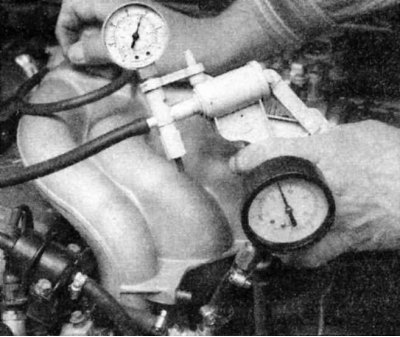
6. Turn on the fuel pump (see section Checking fuel pressure/fuel pump). Read the fuel pressure gauge readings with and without vacuum applied to the pressure regulator. The fuel pressure should decrease as the vacuum increases.
7. Turn off the fuel pump and connect a vacuum hose to the regulator. Start the engine and check the fuel pressure at idle, comparing it with the value given in Table of sizes and adjustment data at the end of the manual. Disconnect the vacuum hose and watch the gauge - when you disconnect the hose, the pressure should suddenly increase to the maximum.
8. If the fuel pressure is low, close the fuel return line and monitor the pressure. If the pressure does not increase, the fuel pump is faulty or the fuel line is clogged. If the pressure does not increase abruptly, replace the pressure regulator.
9. If the measured fuel pressure is very high, stop the engine, disconnect the fuel return line and blow through it to check for blockage. If the line is not blocked, replace the fuel pressure regulator.
10. If the pressure value does not change as described in item 7, connect a vacuum gauge to the vacuum hose of the pressure regulator and measure the vacuum (the engine is idling).
11. If vacuum is present, replace the fuel pressure regulator.
12. If the meter does not register a vacuum, check for a leak or blockage in the hose and inlet.
Replacement
1. Relieve the pressure in the fuel system (see section Relieving pressure in the fuel injection system).
2. Disconnect the negative battery cable.
If your vehicle's radio has an anti-theft system, make sure you know the correct activation code before disconnecting the battery. Before disconnecting the wire, refer to Section Anti-theft audio system and instrument cluster language.
If a message in another language appears on the instrument cluster display after connecting the battery, refer to Section 1 for the language setting procedure Anti-theft audio system and instrument cluster language.
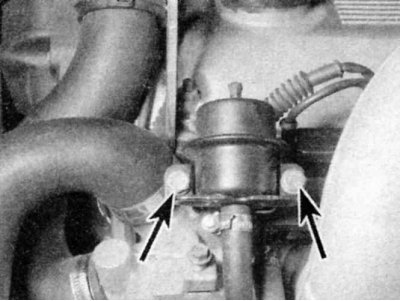
3. Disconnect the vacuum hose and fuel return hose from the pressure regulator, then unscrew the mounting bolts (shown by arrows).
4. Remove the pressure regulator.
5. Installation is the reverse of removal. Make sure to install a new O-ring. Apply a thin coat of engine oil to the ring before installation.
6. After installing the pressure regulator, check for fuel leaks.
(The original article is posted on the resource BMWMAN.RU)
This article is available at russian, bulgarian, belarusian, ukrainian, serbian, croatian, romanian, polish, slovak, hungarian
Article verified: Zhuravleva Isolda
Share information:
Previous articles
БМВ E28: Supply system
Next articles
Similar articles on other types of BMW cars:
Checking the fuel system, replacing the fuel filter. Operation of a… BMW 3 Series E46 (1998-2006)
Checking the control pressure regulator BMW 3 Series E21 (1975-1983)
Replacing the fuel pressure regulator BMW 7 Series E38 (1994-2001)
Removal water/replacing the fuel filter BMW 7 Series E32 (1986-1994)
Checking the fuel supply pressure (M57 TU, M57 T2, M47 T2) BMW X3 E83 (2003-2010)
Fuel pressure regulator BMW X5 E53 (1999-2006)
Checking the fuel system, replacing the fuel filter. Operation of a… BMW 3 Series E46 (1998-2006)
Checking the control pressure regulator BMW 3 Series E21 (1975-1983)
Replacing the fuel pressure regulator BMW 7 Series E38 (1994-2001)
Removal water/replacing the fuel filter BMW 7 Series E32 (1986-1994)
Checking the fuel supply pressure (M57 TU, M57 T2, M47 T2) BMW X3 E83 (2003-2010)
Fuel pressure regulator BMW X5 E53 (1999-2006)
Link in different formats to this page
Visitor comments
No comments yet
- General information
- Governing bodies
- Manual
- Maintenance
- Power unit
- Engine repair
- Lubrication system
- Cooling system
- Ignition system
- Supply system
- Injection system (gasoline)
- Injection system (diesel)
- Exhaust system
- Transmission
- Clutch
- Car gearbox
- Front axle
- Rear axle
- Chassis
- Steering
- Brake system
- Wheels and tires
- Body
- Interior
- Exterior
- Heating system
- Electrical equipment
- Equipment and devices
- Power devices
- Windscreen wipers
- Electrical circuits
- General information
- Manual
- Maintenance
- Power unit
- Engine repair
- Ignition system
- Engine lubrication system
- Cooling system
- Fuel system (gasoline)
- Fuel system (diesel)
- Exhaust system
- Transmission
- Clutch
- Car gearbox
- Chassis
- Front and rear suspension
- Steering
- Brake system
- Body
- Exterior
- Interior
- Electrical equipment
- Heating system
- Equipment and devices
- Power devices
- Electrical circuits
- General information
- Manual
- Maintenance
- Power unit
- Engine in a car
- Engine overhaul
- Cooling system
- Supply system
- Ignition system
- Control system
- Transmission
- Clutch
- Manual gearbox
- Automatic gearbox
- Transmission line
- Chassis
- Steering
- Front suspension
- Rear suspension
- Brake system
- Body
- Body elements
- Car care and painting
- Electrical equipment
- Heater and air conditioner
- Equipment and devices
- Starter and generator
- Electrical circuits
- General information
- Operation and maintenance
- Specifications
- Power unit
- Engine repair
- Cooling and lubrication system
- Supply system
- Ecotronic power supply system
- Fuel injection system
- Ignition system
- Transmission
- Clutch
- Gearbox BMW 242/4
- Gearbox Getrag 262/8
- Gearbox Getrag 265/6
- Automatic gearbox
- Cardan gear
- Rear axle
- Chassis
- Steering
- Front suspension
- Rear suspension
- Brake system
- Electrical equipment
- Equipment and devices
- Electrical circuits