
- Home
- BMW 5 Series
- E28
- Power unit
- Supply system
- Checking the operation, adjusting and replacing the idle air stabilization valve
Checking the operation, adjusting and replacing the idle air stabilization valve (BMW 5 Series E28)
The air-cooled idling stabilization system ensures that the idling speed is maintained within the 200 rpm range, regardless of the idling load changes on the engine. To increase the idle speed whenever it drops below approximately 750 rpm, an electric valve is used that provides a direct supply of a small amount of air bypassing the throttle valve. If the idle speed increases approximately above 950 rpm, the speed control air valve closes and stops the supply of additional air bypassing the throttle valve, thereby reducing the idle speed.
The L-Jetronic system is equipped with a separate idle speed control unit (computer), located under the dashboard. The idle speed stabilization air valve has an adjustment screw. Early models are equipped with plastic valves, however, they also have an adjustment, for which it is necessary to disconnect the hose and insert a very thin screwdriver inside.
Early Motronic models also have a separate idle speed control unit (computer) located under the instrument panel. The air stabilization valve has an adjusting screw.
On later Motronic systems the air stabilization valve is controlled by the ECU and is not adjustable.
Before performing any tests on the idle air control valve, ensure that the following conditions are met:
The idle speed control valve operates continuously when the ignition is on. Start the engine and check that the valve vibrates and hums slightly.
1. With the engine running, disconnect the electrical connector from the valve. The idle speed should increase to approximately 2000 rpm.
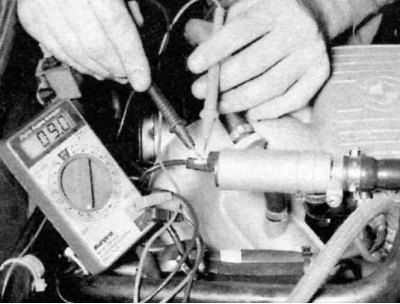
2. If the idle speed does not increase, turn off the engine. Check the resistance between the valve contacts with an ohmmeter. At an ambient temperature of about 20°C, the resistance should be from 9 to 10 ohms.
3. Using two jumpers, apply battery voltage to the valve and make sure the valve is tightly closed. When the voltage is removed, the valve should open.
4. If the idle air control valve fails at least one of the tests, it should be replaced.
5. If the idle speed control vacuum valve passes the tests, check the control current.
6. Disconnect the electrical connector from the valve. Connect one contact of the electrical connector to one of the valve contacts with a jumper. Connect an ammeter between the other contact of the electrical connector and the remaining contact of the valve (with a range from 0 to 1000 mA). Start the engine and let it idle. With the engine running, the current should be between 400 and 500 mA. If this value is not correct, adjust the valve (see p. 1).
7. If there is no current, have the idle speed control module checked by a BMW dealer or other qualified service representative.
1. With the ignition off, connect the tachometer in accordance with the manufacturer's instructions.
2. Make sure that the ignition timing is set correctly (see chapter Ignition system).
3. Connect an ammeter to the valve (see p. 6).
4. When the engine is running, the current should be 450-470 mA at 850-900 rpm (manual transmission) or 460-480 mA at 850-900 rpm (automatic transmission).
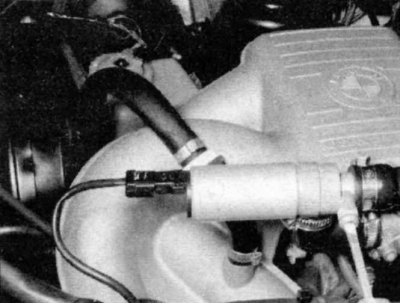
5. If the control current is not as required, rotate the adjusting screw to make the current value correct.
1. With the engine running, disconnect the electrical connector from the valve. The idle speed should increase to 2000 rpm.
2. If the idle speed has not increased:
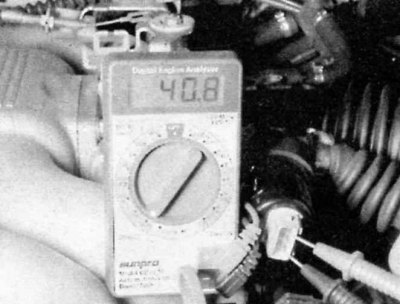
3. Check the resistance between the central and outer contacts of the valve. It should be about 20 Ohms.
4. If the idle air control valve fails any of the tests, replace the valve.
5. If the idle air control valve passes all tests, then check the control current (two-wire valve) or tension (three-way valve) as follows.
6. For two-wire valves, connect an ohmmeter (with a range from 0 to 1000 mA), as described in point 6. Start the engine and let it idle. With the engine running, the current should be within 400-500 mA. Adjust the valve if the readings do not meet the requirements.
7. If there is no current, the idle speed control unit (under the dashboard) should be sent to a BMW dealer or other specialist for inspection.
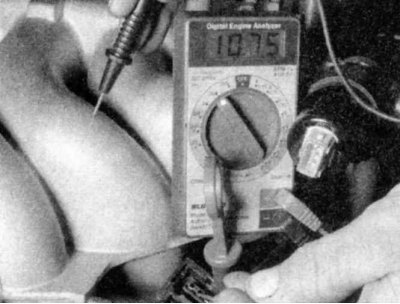
8. For three-wire valves, check the voltage at the electrical connector. With the ignition on, there should be battery voltage at the center contact. There should be about 10 V between the center contact and each of the outer contacts.
9. If there is no voltage, send the idle control unit (early models) or ECU (late models) for inspection by a BMW dealer or other specialist.
1. With the ignition off, connect the tachometer in accordance with the manufacturer's instructions.
2. Make sure that the ignition timing is set correctly (see chapter Ignition system).
3. Connect an ammeter to the valve as described in paragraph 6.
4. When the engine is running, the current should be 450-470 mA at 700-750 rpm.
5. If the current value is incorrect, turn the adjusting screw until it meets the requirements.
1. Disconnect the electrical connector and bracket from the idle air control valve. Remove the valve and disconnect the hoses.
2. Installation is the reverse of removal.
The L-Jetronic system is equipped with a separate idle speed control unit (computer), located under the dashboard. The idle speed stabilization air valve has an adjustment screw. Early models are equipped with plastic valves, however, they also have an adjustment, for which it is necessary to disconnect the hose and insert a very thin screwdriver inside.
Early Motronic models also have a separate idle speed control unit (computer) located under the instrument panel. The air stabilization valve has an adjusting screw.
On later Motronic systems the air stabilization valve is controlled by the ECU and is not adjustable.
Preliminary check
Before performing any tests on the idle air control valve, ensure that the following conditions are met:
- The engine must be at operating temperature (60°C)
- Electrical equipment must be switched off (air conditioner, heater, headlights, additional cooling fan and others)
- The throttle position sensor must be working properly (see chapter Engine management and emission control systems)
- There should be no leaks in the exhaust system
- There should be no vacuum leaks
- The oxygen sensor, if installed, must be in good condition (see chapter Engine management and emission control systems)
- Connect the tachometer according to the manufacturer's instructions.
Before making any electrical connections, turn off the ignition.
The idle speed control valve operates continuously when the ignition is on. Start the engine and check that the valve vibrates and hums slightly.
L-Jetronic system
Examination
1. With the engine running, disconnect the electrical connector from the valve. The idle speed should increase to approximately 2000 rpm.
2. If the idle speed does not increase, turn off the engine. Check the resistance between the valve contacts with an ohmmeter. At an ambient temperature of about 20°C, the resistance should be from 9 to 10 ohms.
3. Using two jumpers, apply battery voltage to the valve and make sure the valve is tightly closed. When the voltage is removed, the valve should open.
4. If the idle air control valve fails at least one of the tests, it should be replaced.
5. If the idle speed control vacuum valve passes the tests, check the control current.
6. Disconnect the electrical connector from the valve. Connect one contact of the electrical connector to one of the valve contacts with a jumper. Connect an ammeter between the other contact of the electrical connector and the remaining contact of the valve (with a range from 0 to 1000 mA). Start the engine and let it idle. With the engine running, the current should be between 400 and 500 mA. If this value is not correct, adjust the valve (see p. 1).
The idle speed regulator current varies between 400 and 1100 mA when the engine is too cold, if the coolant temperature sensor is faulty, if idle speed adjustment is required, if the engine has a vacuum leak, or if additional electrical equipment is turned on.
7. If there is no current, have the idle speed control module checked by a BMW dealer or other qualified service representative.
Idle speed stabilizer control unit (located under the dashboard) may not work properly due to the electrical connector that periodically connects and disconnects the valve. Check the connector carefully before replacing any parts. Sometimes a new control unit will only temporarily fix the problem.
Adjustment
1. With the ignition off, connect the tachometer in accordance with the manufacturer's instructions.
2. Make sure that the ignition timing is set correctly (see chapter Ignition system).
3. Connect an ammeter to the valve (see p. 6).
4. When the engine is running, the current should be 450-470 mA at 850-900 rpm (manual transmission) or 460-480 mA at 850-900 rpm (automatic transmission).
5. If the control current is not as required, rotate the adjusting screw to make the current value correct.
On metal valves, the adjusting screw is installed on the outside. On plastic valves, the adjusting screw is located inside and to access it, you need to disconnect the hose from the valve.
Motronic systems
Examination
This system uses two types of air idle speed control valves; early models are usually equipped with a two-wire valve, while later models are equipped with three-wire valves.
1. With the engine running, disconnect the electrical connector from the valve. The idle speed should increase to 2000 rpm.
2. If the idle speed has not increased:
- Two-wire valve - Apply battery voltage to the valve with two jumpers and make sure the valve closes tightly. When the voltage is removed, the valve should open. Also check the resistance of the valve (see the picture below). The resistance should be about 9-10 ohms.
- Three-wire valve - Turn off the engine and disconnect the electrical connector from the valve. Check the resistance between the two outer contacts of the valve with an ohmmeter. It should be about 40 ohms.
3. Check the resistance between the central and outer contacts of the valve. It should be about 20 Ohms.
4. If the idle air control valve fails any of the tests, replace the valve.
5. If the idle air control valve passes all tests, then check the control current (two-wire valve) or tension (three-way valve) as follows.
6. For two-wire valves, connect an ohmmeter (with a range from 0 to 1000 mA), as described in point 6. Start the engine and let it idle. With the engine running, the current should be within 400-500 mA. Adjust the valve if the readings do not meet the requirements.
The stabilizer current will vary from 400-1100 mA if the engine is very cold, if the coolant temperature sensor is faulty, if the engine has a vacuum leak, or if additional electrical equipment is turned on.
7. If there is no current, the idle speed control unit (under the dashboard) should be sent to a BMW dealer or other specialist for inspection.
8. For three-wire valves, check the voltage at the electrical connector. With the ignition on, there should be battery voltage at the center contact. There should be about 10 V between the center contact and each of the outer contacts.
9. If there is no voltage, send the idle control unit (early models) or ECU (late models) for inspection by a BMW dealer or other specialist.
Adjustment (early models only)
1. With the ignition off, connect the tachometer in accordance with the manufacturer's instructions.
2. Make sure that the ignition timing is set correctly (see chapter Ignition system).
3. Connect an ammeter to the valve as described in paragraph 6.
4. When the engine is running, the current should be 450-470 mA at 700-750 rpm.
5. If the current value is incorrect, turn the adjusting screw until it meets the requirements.
When the air valve screw is turned clockwise, the current increases; when turned counterclockwise, it decreases.
Replacement
1. Disconnect the electrical connector and bracket from the idle air control valve. Remove the valve and disconnect the hoses.
2. Installation is the reverse of removal.
This article is available at russian, bulgarian, belarusian, ukrainian, serbian, croatian, romanian, polish, slovak, hungarian
Article verified: Zhuravleva Isolda
Share information:
Previous articles
БМВ E28: Supply system
Next articles
Checking the operation and replacing fuel injectors
Checking the operation and replacing the cold start injector and…
Checking the operation and replacing the fuel pressure regulator
Checking the operation, removing and installing the throttle body
Checking the operation, removing and installing the air flow meter
Checking the operation and replacing the cold start injector and…
Checking the operation and replacing the fuel pressure regulator
Checking the operation, removing and installing the throttle body
Checking the operation, removing and installing the air flow meter
Similar articles on other types of BMW cars:
Checking/adjusting valve clearances BMW 3 Series E30 (1982-1994)
Removal and installation, checking of the idle speed control valve BMW 3 Series E36 (1990-2000)
Valve guides — checking and replacing BMW 7 Series E32 (1986-1994)
Checking the condition and replacing hoses and tubes in the engine… BMW 7 Series E38 (1994-2001)
Adjusting the valve timing BMW X3 E83 (2003-2010)
Checking and adjusting idle speed and CO levels BMW X5 E53 (1999-2006)
Checking/adjusting valve clearances BMW 3 Series E30 (1982-1994)
Removal and installation, checking of the idle speed control valve BMW 3 Series E36 (1990-2000)
Valve guides — checking and replacing BMW 7 Series E32 (1986-1994)
Checking the condition and replacing hoses and tubes in the engine… BMW 7 Series E38 (1994-2001)
Adjusting the valve timing BMW X3 E83 (2003-2010)
Checking and adjusting idle speed and CO levels BMW X5 E53 (1999-2006)
Link in different formats to this page
Visitor comments
No comments yet
- General information
- Governing bodies
- Manual
- Maintenance
- Power unit
- Engine repair
- Lubrication system
- Cooling system
- Ignition system
- Supply system
- Injection system (gasoline)
- Injection system (diesel)
- Exhaust system
- Transmission
- Clutch
- Car gearbox
- Front axle
- Rear axle
- Chassis
- Steering
- Brake system
- Wheels and tires
- Body
- Interior
- Exterior
- Heating system
- Electrical equipment
- Equipment and devices
- Power devices
- Windscreen wipers
- Electrical circuits
- General information
- Manual
- Maintenance
- Power unit
- Engine repair
- Ignition system
- Engine lubrication system
- Cooling system
- Fuel system (gasoline)
- Fuel system (diesel)
- Exhaust system
- Transmission
- Clutch
- Car gearbox
- Chassis
- Front and rear suspension
- Steering
- Brake system
- Body
- Exterior
- Interior
- Electrical equipment
- Heating system
- Equipment and devices
- Power devices
- Electrical circuits
- General information
- Manual
- Maintenance
- Power unit
- Engine in a car
- Engine overhaul
- Cooling system
- Supply system
- Ignition system
- Control system
- Transmission
- Clutch
- Manual gearbox
- Automatic gearbox
- Transmission line
- Chassis
- Steering
- Front suspension
- Rear suspension
- Brake system
- Body
- Body elements
- Car care and painting
- Electrical equipment
- Heater and air conditioner
- Equipment and devices
- Starter and generator
- Electrical circuits
- General information
- Operation and maintenance
- Specifications
- Power unit
- Engine repair
- Cooling and lubrication system
- Supply system
- Ecotronic power supply system
- Fuel injection system
- Ignition system
- Transmission
- Clutch
- Gearbox BMW 242/4
- Gearbox Getrag 262/8
- Gearbox Getrag 265/6
- Automatic gearbox
- Cardan gear
- Rear axle
- Chassis
- Steering
- Front suspension
- Rear suspension
- Brake system
- Electrical equipment
- Equipment and devices
- Electrical circuits