
Uneven tire wear is mainly due to too low or too high tire pressure, and may also indicate deficiencies in the adjustment of the front wheel mounting angles, in the operation of shock absorbers, in wheel unbalance, or in the deformation of the discs.
First of all, you need to monitor the tire pressure. The pressure should only be checked on cold tires. The pressure can increase significantly when the tires heat up from fast driving, so under no circumstances should you release the pressure in heated tires.
At higher pressures, the center of the tire wears out more, i.e. due to the high pressure, it becomes more convex.
When the tire pressure is low, the edges of the tire are more in contact with the road, and the center of the tire is bent inward. Because of this, the edges of the tire wear more. The wear of the tire pattern in the form of teeth is usually a consequence of overloading the car.
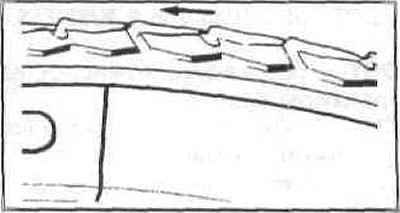
Incorrect installation of the front wheels and their imbalance give typical tire wear patterns, which are described in the section "Troubleshooting" this chapter.