
Note: The first cylinder is located closest to the radiator. The following procedure assumes that the distributor (if any) set to the appropriate position. If you are trying to find TDC to orient the distributor correctly, the piston position must be determined by the compression in the first cylinder and then aligning the ignition timing marks or installing a special tool on the flywheel.
Top dead center (TDC) is the highest point of the piston's stroke in the cylinder. Each piston reaches TDC on the compression stroke and on the exhaust stroke.
Setting the piston to TDC is an essential part of many procedures, such as removing the chain and distributor.
Before beginning this procedure, make sure the gearshift lever is in neutral, apply the handbrake or block the rear wheels. Disable the ignition system by disconnecting the ignition coil wire from the center terminal of the distributor cap and grounding it to the engine block with a jumper wire. Remove the spark plugs.
To set either piston to TDC, rotate the crankshaft using one of the methods described below. When viewed from the front of the engine, the crankshaft rotates clockwise.
Have an assistant turn the ignition key to the start position for a short time and signal when the crankshaft is close to the desired position. Then install the key and adjust the crankshaft position.
Method 1
Turning is carried out using an open-end wrench installed on the bolt of the front end of the crankshaft.
Method 2
The crankshaft is turned using a spanner installed on the central nut of the generator pulley (via V-belt transmission). Locate the terminal of the spark plug wire for cylinder 1 on the distributor cap. If the terminal is not marked, trace the wire from the spark plug to the distributor cap (the first cylinder is located closest to the radiator).
Mark the terminal with a felt-tip pen or chalk on the distributor housing or drive cover.
Remove the distributor cap.
Turn the crankshaft so that the timing marks are aligned (located at the front of the engine).
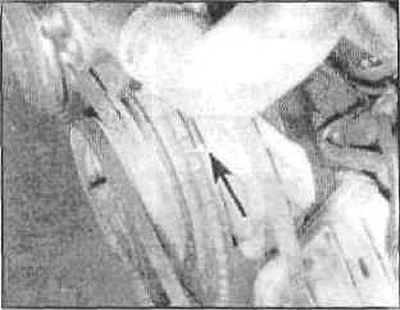
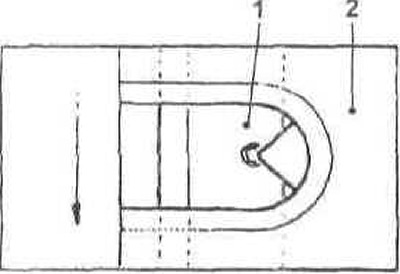
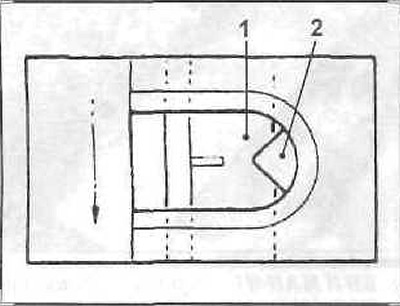
Some engines do not have these timing marks, but instead have a timing hole or mark in the flywheel that must align with a hole or pointer in the rear flange of the cylinder block. On this engine, rotate the crankshaft until the distributor rotor approaches the spark plug terminal of cylinder number one, then rotate the crankshaft a little more until the timing holes or marks are aligned and a suitable drill can be inserted into them (if possible).
Variants of installation marks of the flywheel (1) and rear flange (2) of the cylinder block
Option 1 (early models of cars)
Option 2 (later model cars)
The distributor rotor (if any) should now point exactly to the mark you made on the distributor housing or drive cover.
If the runner is 180° from the mark, the piston of the first cylinder is at TDC in the exhaust stroke.
To move the piston to TDC in the compression stroke, turn the crankshaft a full turn (360°) clockwise. The slider should now point to the mark on the distributor or drive cover, and the setting marks of the ignition timing should be aligned.
Note: When the cylinder head cover is removed, both valve rocker arms of the first cylinder should be free and have a noticeable gap.
Caution: When the runner points to the correct terminal and the timing marks cannot be aligned, the drive chain may have slipped off the sprocket teeth or was not installed correctly to begin with.
Once the first cylinder piston is at TDC on the compression stroke, the TDC for any of the remaining pistons can be found by simply rotating the crankshaft and following the firing order of the cylinders. Mark the locations of the remaining spark plug wire terminals using the same method. When the distributor rotor points to one of these marks, the piston for that cylinder is at TDC on the compression stroke.