



Caution: Under no circumstances should changes in axle geometry caused by an accident be corrected by adjusting the camber angle.
Note:
- The camber and toe angles of the wheels are interconnected.
- Adjustment can be made easier by first setting the wheel toe angle.
- Knocking out or unscrewing the centering pin is only permitted if, after adjusting the toe-in, the camber angle is outside the tolerance range.
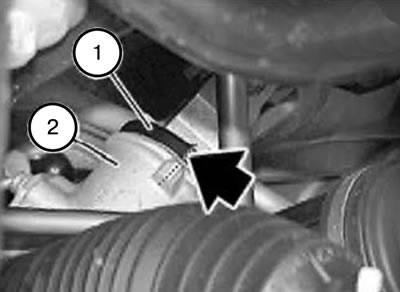
1. Adjust the front wheel toe-in angle.
1) Remove the steering gear side cover.
2) Set the steering control to the straight-ahead position according to the marks on the cap (1) and steering gear (2).
3) Align the steering wheel and secure it with the lock.
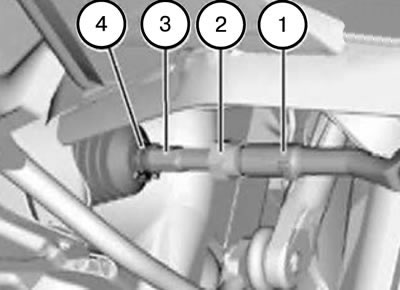
4) Clean the tie rod threads.
5) Loosen the clamp nut (2) while holding the steering rod end (1).
6) Remove the clamp (4).
7) Rotate the rod (3) to adjust the toe-in in accordance with the specified value.
8) Tighten the clamping nut (2).
Tightening torque: 51 Nm.
9) Install the clamp (4).
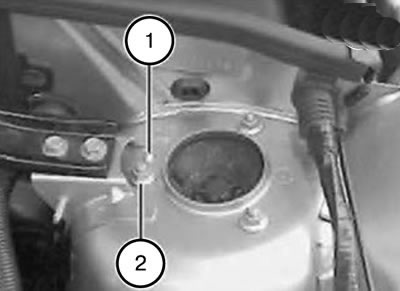
2. Adjust the camber angle of the front wheels.
1) Remove the protective cap.
2) Knock out the centering pin (1) downwards.
3) Use compressed air to remove dirt from the area of the upper shock absorber strut support on the underside of the wheel arch.
4) Loosen the nut (2) by 1-1.5 turns.
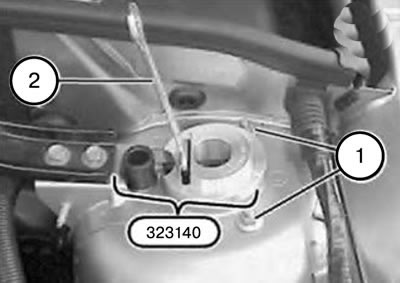
5) Insert tool 323140 into the hole in the wheel arch over the nut.
6) Replace the nuts (1). Screw on the new nuts until they touch the contact surface, without tightening.
7) Using the key (2), turn the nut on the 232140 tool to set the camber in accordance with the specified value.
8) Tighten the nuts (1).
Tightening torque: 34 Nm.
9) Remove tool 232140.
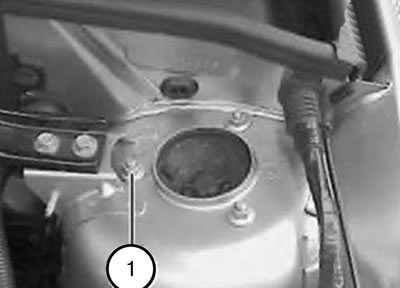
10) Install the new nut (1) and tighten it.
Tightening torque: 34 Nm.
3. Check the straightness of the vehicle's movement. If necessary, repeat the toe-in adjustment.