
Attention! It is strictly forbidden to replace fuses with wire ("bug").
To protect consumers from short-circuit current and overloads, fuses are installed in individual electrical circuits. The main fuses are located in a block mounted in the glove box (in the glove box).
Replacement of fuses must be carried out in the following order.
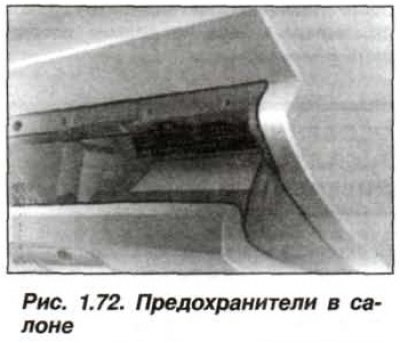
De-energize the consumer protected by this fuse. Open the glove compartment by grasping it by the lugs (see fig. 1.72) left and right. Tilt down the panel with the installed fuses. The location of the fuses and their purpose are shown on the shelf of the fuse box.
A sign of a blown fuse is the melting of the metal plate. Using tweezers (red bracket), remove the defective fuse. Install a fuse of similar amperage. Spare fuses are installed in special sockets. The fuse rating is indicated on its body.
If the fuse blows again, check the electrical circuit from the power source to the consumer.
Additional fuses are located in the trunk behind its right side trim (see fig. 1.73). The fuse links AB are located on it, in a separate box.
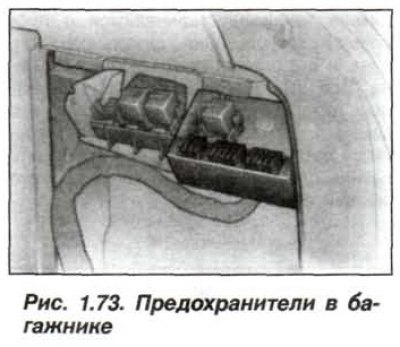
On vehicles equipped for towing a trailer, an additional fuse box for the trailer light circuits is installed behind the right-hand trim panel of the trunk.
You can find the original version on the portal: «BMWMAN.RU»