



Annually or every 20,000 km.
Many serious engine malfunctions are related to cooling system malfunctions. If the car is equipped with an automatic transmission, its operation and service life are also directly related to the operation of the cooling system.
The cooling system should be checked when the engine is cold, so it is best to do this before the first trip of the day or no earlier than three hours after turning off the engine.
1. Slowly, being careful in case the engine is not yet completely cool, remove the radiator cap. Rinse it thoroughly inside and out with clean water. Also rinse the radiator filler neck. The presence of traces of corrosion in the filler neck means that the coolant should be replaced (see section Draining, flushing and filling the cooling system). The coolant inside the radiator should be relatively clean and transparent. If it is brownish in color, drain the system and fill it with new coolant.
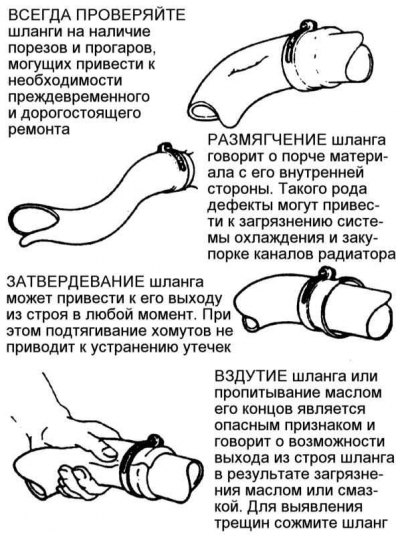
2. Carefully inspect the radiator hoses, as well as the heater hoses, which have a smaller diameter. Check the entire length of the coolant hoses, replacing any cracked, bulging or worn hoses. Cracks are easier to spot if you squeeze the hose with your hand. Pay special attention to the clamps that hold the hoses to the cooling system components. These clamps can cut or puncture the hoses, causing coolant to leak.
3. Make sure all hose connections are securely fastened. Coolant leaks usually show up as white or rusty deposits in the area of the leak. If your vehicle uses wire-type clamps, it may make sense to replace them with screw-type clamps.
4. Using compressed air or a soft brush, clean the front of the radiator (and also the air conditioner condenser, where available). Remove any insects, leaves, or other foreign objects that may have gotten onto the radiator fins. Be very careful not to damage the fins or cut your fingers on them.
5. If the coolant level is constantly dropping and you have not found any leaks, you should pressure test the radiator cap and the entire cooling system.