
Cars Mazda Cars Mitsubishi Cars Toyota Cars Chevrolet Cars AvtoVAZ Cars Kia Cars Nissan
English Русский
Български
Беларускі
Український
Српски
Hrvatski
Română
Polski
Slovenský
Magyar
| Articles | Contacts | Sitemap |   
BMWman.ru


3 series   5 series   7 series   BMW X3   BMW X5   BMW X6

E39 (1995-2003) E34 (1988-1996) E28 (1981-1988) E12 (1972-1981)
  • Home
  • BMW 5 Series
  • E28
  • Power unit
  • Engine overhaul
  • Checking the compression ratio

Checking the compression ratio (BMW 5 Series E28)

            0

Checking the compression ratio shows what the mechanical condition of the top end of the engine is (pistons, rings, valves, head gaskets). In particular, the test may show that the compression ratio is low due to leakage caused by worn piston rings, faulty valves and seats, or a blown head gasket.

During this check, the engine must be warmed up to normal operating temperature and the battery must be fully charged


1. Before removing the spark plugs, clean the area around them (if available, compressed air should be used, otherwise a bicycle pump or a small brush can be used). The goal is to prevent dirt from getting inside the cylinders during the inspection.

2. Remove all spark plugs from the engine (see chapter Routine car maintenance).

3. Lock the throttle in the fully open position or have an assistant hold the pedal depressed.
3. Lock the throttle in the fully open position or have an assistant hold the pedal depressed.


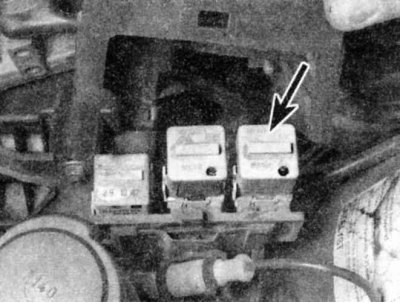
4. On carbureted models, disconnect the low voltage wire from the ignition coil. On fuel injected models, disconnect the fuel pump and ignition circuit by removing the main relay (indicated by the arrow).

5. This is to prevent any fuel that may have been injected into the engine compartment from igniting. The main relay is usually located under the hood near the fuse panel, but for the exact location on your model, refer to Chapter On-board electrical equipment system.


6. Install a compression gauge into the hole of spark plug No.1 (cylinder No.1 is located on the radiator side).

7. Crank the engine through at least seven compression strokes using the starter and watch the compressor readings. On a healthy engine, the compression ratio will increase rapidly. A low compression ratio on the first stroke with a gradual increase in subsequent strokes indicates worn piston rings. A low compression ratio on the first stroke that does not increase in subsequent strokes indicates leaking valves or a burnt-out cylinder head gasket (a crack in the cylinder head can also be the cause). Carbon deposits on the inside surfaces of the valve heads can also cause low compression. Record the highest reading.

8. Repeat the operation for the remaining cylinders and compare the results with the compression ratio values in Table of sizes and adjustment data at the end of the Guide.

9. If the compression ratio is low, pour a small amount of engine oil into each cylinder through the spark plug holes (by pressing the plunger type oiler approximately three times) and check again.

10. If the compression ratio has increased after adding oil, the piston rings are definitely worn. If the compression ratio has not increased significantly, there is a leak in the valves or through the cylinder head gasket. Valve leakage can be caused by burnt valve seats and/or chamfers, as well as warped valves and the presence of cracks and dents.

11. If two adjacent cylinders have the same low compression ratio, then it is likely that the cylinder head gasket between them has burned out. The presence of coolant in the combustion chambers or crankcase will confirm this suggestion.


12. If the compression ratio in one of the cylinders is 20% lower than in the others, and the engine runs slightly unevenly at idle; then the exhaust cam of the camshaft may be worn out.

13. If the compression ratio is unusually high, the combustion chambers are probably covered with carbon deposits.

14. In this case, you should remove the cylinder head and remove the carbon deposits.

15. If the compression ratio is below normal or varies greatly between cylinders, it is a good idea to have a leak test performed at a workshop. This test will accurately indicate the cause of the leak and its extent.

This article is available at russian, bulgarian, belarusian, ukrainian, serbian, croatian, romanian, polish, slovak, hungarian
Article verified: Zhuravleva Isolda

Share information:
Previous articles
БМВ E28: Engine overhaul
Next articles

General information about engine overhaul
Engine Removal Methods and Precautions
Removal and installation the engine
Engine Overhaul Options
The procedure for disassembling the engine during major repairs
Disassembling the cylinder head


Similar articles on other types of BMW cars:
Checking the level and replacing the oil in the automatic transmission BMW 3 Series E21 (1975-1983)
Checking the compression in the cylinders BMW 7 Series E32 (1986-1994)
Checking the compression pressure BMW 7 Series E38 (1994-2001)
Bleeding the cooling system and checking it for leaks (M54, N46, N47,… BMW X3 E83 (2003-2010)
Checking the compression in the cylinders BMW X5 E53 (1999-2006)
Link in different formats to this page


Visitor comments

No comments yet


How much 30 + 30 =


BMW E39 (1995-2003) 
  • General information
  • Governing bodies
  • Manual
  • Maintenance
  • Power unit
  • Engine repair
  • Lubrication system
  • Cooling system
  • Ignition system
  • Supply system
  • Injection system (gasoline)
  • Injection system (diesel)
  • Exhaust system
  • Transmission
  • Clutch
  • Car gearbox
  • Front axle
  • Rear axle
  • Chassis
  • Steering
  • Brake system
  • Wheels and tires
  • Body
  • Interior
  • Exterior
  • Heating system
  • Electrical equipment
  • Equipment and devices
  • Power devices
  • Windscreen wipers
  • Electrical circuits
BMW E34 (1988-1996) 
  • General information
  • Manual
  • Maintenance
  • Power unit
  • Engine repair
  • Ignition system
  • Engine lubrication system
  • Cooling system
  • Fuel system (gasoline)
  • Fuel system (diesel)
  • Exhaust system
  • Transmission
  • Clutch
  • Car gearbox
  • Chassis
  • Front and rear suspension
  • Steering
  • Brake system
  • Body
  • Exterior
  • Interior
  • Electrical equipment
  • Heating system
  • Equipment and devices
  • Power devices
  • Electrical circuits
BMW E28 (1981-1988) 
  • General information
  • Manual
  • Maintenance
  • Power unit
  • Engine in a car
  • Engine overhaul
  • Cooling system
  • Supply system
  • Ignition system
  • Control system
  • Transmission
  • Clutch
  • Manual gearbox
  • Automatic gearbox
  • Transmission line
  • Chassis
  • Steering
  • Front suspension
  • Rear suspension
  • Brake system
  • Body
  • Body elements
  • Car care and painting
  • Electrical equipment
  • Heater and air conditioner
  • Equipment and devices
  • Starter and generator
  • Electrical circuits
BMW E12 (1972-1981) 
  • General information
  • Operation and maintenance
  • Specifications
  • Power unit
  • Engine repair
  • Cooling and lubrication system
  • Supply system
  • Ecotronic power supply system
  • Fuel injection system
  • Ignition system
  • Transmission
  • Clutch
  • Gearbox BMW 242/4
  • Gearbox Getrag 262/8
  • Gearbox Getrag 265/6
  • Automatic gearbox
  • Cardan gear
  • Rear axle
  • Chassis
  • Steering
  • Front suspension
  • Rear suspension
  • Brake system
  • Electrical equipment
  • Equipment and devices
  • Electrical circuits
BMWman.ru © 2017-2026 · Mobile version · News and articles · Sitemap: EN BG BY UA RS HR RO PL SK HU · Feedback · Site search
3er E21 · 3er E30 · 3er E36 · 3er E46 [petrol] · 3er E46 · 5er E12 · 5er E28 · 5er E34 · 5er E39 · 7er E32 · 7er E38 · X3 E83 · X5 E53 ·
This site uses cookies 🍪, without them some features simply would not work.