
- Home
- BMW X5
- E53
- Diesel engine M57
- Engine repair
- Pistons and connecting rods — design description
Pistons and connecting rods — design description (BMW X5 E53)
The design of the piston group is shown in Figure 6.6.
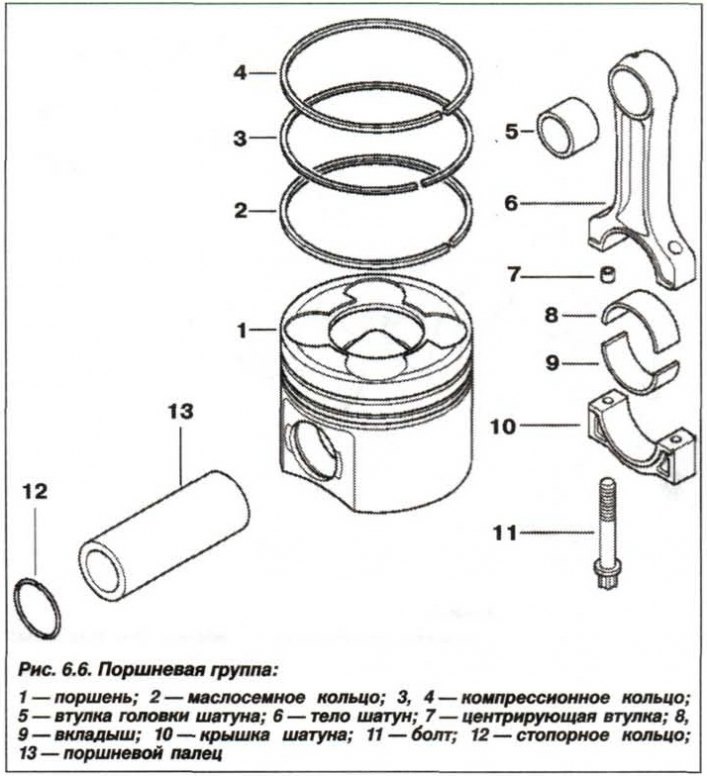
Pistons (1) are made of aluminum alloy (hypereutectic silumin) with steel inserts. Each piston has two compression rings and one oil scraper ring. For correct orientation of the piston when installed in the cylinder, there is an arrow on its bottom, which should face the camshaft drive, as well as a mark indicating its diameter. The piston diameter is measured at a distance "A" from the lower edge of the piston skirt at an angle of 90° relative to the axis of the piston pin. The piston parameters are given below.
Piston diameter:
Calculated clearance between piston and cylinder:
The permissible difference in weight between pistons for one engine is 10 g.
*The maximum permissible deviation of the piston diameter from the nominal size should not exceed ±0.009 mm.
Measure the piston diameter by stepping back from the lower edge of the piston skirt at a distance (A) equal to 12 mm.
The piston pin (13) is steel, ground, floating type. It is held from axial movement by two retaining rings in the piston holes for the piston pin. The pins are made in two classes, marked with color marks - black and white.
Piston pin length: 62 mm.
Piston pin diameter:
The nominal clearance between the piston pin and the piston boss is 0.001–0.005 mm.
Clearance between piston pin and connecting rod upper head bushing:
The maximum permissible operating clearance between the piston pin and the connecting rod upper head bushing is 0.016 mm.
When repairing an engine, only pistons and pins of the same configuration should be installed.
The piston rings are installed in the grooves of the piston head: two compression rings (3, 4) and one oil scraper ring (2). The rings are installed on the piston with the "Top" mark ("Top") towards the piston bottom (fire belt). The upper compression ring is chrome-plated, with rounded edges, the lower compression ring is conical, the oil scraper ring has an expander.
Clearance between new piston ring and groove wall (vertical axial clearance):
The maximum allowable clearance for compression rings is 0.12 mm.
Clearance in the lock of the new piston ring:
Maximum allowable clearance in the lock:
Connecting rods (6) are forged, with an I-section rod made of heat-treated steel, with thin-walled trimetallic plain bearing liners. A bimetallic, collapsible bearing is pressed into the upper head of the connecting rod (rolled up) bushing. The lower connecting rod head undergoes final processing with its cover and is not subject to further disassembly.
The diameter of the lower connecting rod head hole is 48.000–48.016 mm.
The distance between the axes of the connecting rod heads is 135.0 mm.
The maximum permissible operating clearance between the connecting rod bearings and the crankshaft journals is 0.12 mm.
The permissible difference in weight between connecting rods on one engine is no more than ±4.0 g;
Permissible twisting of the connecting rod is no more than 30'.
The tolerance for non-parallelism and skew of the axes of holes over a length of 100 mm is no more than 0.04 mm.
The maximum axial clearance of the connecting rod on the crankshaft journal relative to its cheek, for all engine models, is 0.27 mm.
Pistons (1) are made of aluminum alloy (hypereutectic silumin) with steel inserts. Each piston has two compression rings and one oil scraper ring. For correct orientation of the piston when installed in the cylinder, there is an arrow on its bottom, which should face the camshaft drive, as well as a mark indicating its diameter. The piston diameter is measured at a distance "A" from the lower edge of the piston skirt at an angle of 90° relative to the axis of the piston pin. The piston parameters are given below.
Piston diameter
Piston diameter:
- nominal - 83.950 mm;
- intermediate - 84.030 mm;
- 1st repair size - 84.200 mm.
Calculated clearance between piston and cylinder:
- for new parts - 0.041–0.077 mm;
- maximum permissible - 0.15 mm.
The permissible difference in weight between pistons for one engine is 10 g.
*The maximum permissible deviation of the piston diameter from the nominal size should not exceed ±0.009 mm.
Measure the piston diameter by stepping back from the lower edge of the piston skirt at a distance (A) equal to 12 mm.
Piston pins
The piston pin (13) is steel, ground, floating type. It is held from axial movement by two retaining rings in the piston holes for the piston pin. The pins are made in two classes, marked with color marks - black and white.
Piston pin length: 62 mm.
Piston pin diameter:
- nominal size - 30.00 mm;
- manufacturing tolerance from -0.003 to -0.006 mm.
The nominal clearance between the piston pin and the piston boss is 0.001–0.005 mm.
Clearance between piston pin and connecting rod upper head bushing:
- fingers with a "white" mark - 0.005 - 0.013 mm:
- fingers with a "black" mark - 0.008 - 0.016 mm.
The maximum permissible operating clearance between the piston pin and the connecting rod upper head bushing is 0.016 mm.
When repairing an engine, only pistons and pins of the same configuration should be installed.
Piston rings
The piston rings are installed in the grooves of the piston head: two compression rings (3, 4) and one oil scraper ring (2). The rings are installed on the piston with the "Top" mark ("Top") towards the piston bottom (fire belt). The upper compression ring is chrome-plated, with rounded edges, the lower compression ring is conical, the oil scraper ring has an expander.
Clearance between new piston ring and groove wall (vertical axial clearance):
- upper compression is not controlled;
- lower compression - 0.050 - 0.090 mm;
- oil scraper - 0.030 – 0.070 mm.
The maximum allowable clearance for compression rings is 0.12 mm.
Clearance in the lock of the new piston ring
Clearance in the lock of the new piston ring:
- upper compression - 0.20 - 0.35 mm;
- lower compression - 0.30 - 0.45 mm;
- oil scraper - 0.20 - 0.40 mm.
Maximum allowable clearance in the lock:
- for compression rings - 0.80 mm;
- for oil scraper rings - 1.00 mm.
Connecting rods
Connecting rods (6) are forged, with an I-section rod made of heat-treated steel, with thin-walled trimetallic plain bearing liners. A bimetallic, collapsible bearing is pressed into the upper head of the connecting rod (rolled up) bushing. The lower connecting rod head undergoes final processing with its cover and is not subject to further disassembly.
The diameter of the lower connecting rod head hole is 48.000–48.016 mm.
The distance between the axes of the connecting rod heads is 135.0 mm.
The maximum permissible operating clearance between the connecting rod bearings and the crankshaft journals is 0.12 mm.
The permissible difference in weight between connecting rods on one engine is no more than ±4.0 g;
Permissible twisting of the connecting rod is no more than 30'.
The tolerance for non-parallelism and skew of the axes of holes over a length of 100 mm is no more than 0.04 mm.
The maximum axial clearance of the connecting rod on the crankshaft journal relative to its cheek, for all engine models, is 0.27 mm.
This article is available at russian, bulgarian, belarusian, ukrainian, serbian, croatian, romanian, polish, slovak, hungarian
Article verified: Zhuravleva Isolda
Share information:
Previous articles
БМВ E53: Engine repair
Next articles
Similar articles on other types of BMW cars:
Pistons and connecting rods — removal BMW 3 Series E46 (1998-2006, petrol)
Replacing connecting rods BMW 3 Series E21 (1975-1983)
Removal pistons/connecting rods BMW 5 Series E28 (1981-1988)
Disassembly and assembly of the connecting rod and piston group BMW 5 Series E12 (1972-1981)
Pistons and connecting rods — removal BMW 7 Series E32 (1986-1994)
Fuses — general description BMW X3 E83 (2003-2010)
Pistons and connecting rods — removal BMW 3 Series E46 (1998-2006, petrol)
Replacing connecting rods BMW 3 Series E21 (1975-1983)
Removal pistons/connecting rods BMW 5 Series E28 (1981-1988)
Disassembly and assembly of the connecting rod and piston group BMW 5 Series E12 (1972-1981)
Pistons and connecting rods — removal BMW 7 Series E32 (1986-1994)
Fuses — general description BMW X3 E83 (2003-2010)
Link in different formats to this page
Visitor comments
No comments yet
- General information
- Manual
- Maintenance
- M54 petrol engine
- Engine repair
- Lubrication system
- Cooling system
- Supply system
- Injection system
- Exhaust system
- Engine electrics
- M62 petrol engine
- Engine repair
- Lubrication system
- Cooling system
- Supply system
- Exhaust system
- Engine electrics
- N62 petrol engine
- Engine repair
- Cooling and lubrication system
- Power and exhaust system
- Engine electrics
- Diesel engine M57
- Engine repair
- Lubrication system
- Cooling system
- Power and exhaust system
- Engine electrics
- Turbocharging system
- Transmission
- Clutch
- Mechanical gearbox
- Automatic gearbox
- Transfer case and cardan
- Chassis
- Brake system
- Steering
- Front suspension
- Rear suspension
- Wheels and tires
- Body
- Exterior
- Interior
- Doors and windows
- Repair and maintenance
- Heater and air conditioner
- Electrical equipment
- Equipment and devices
- Levers and switches
- Electrical circuits