
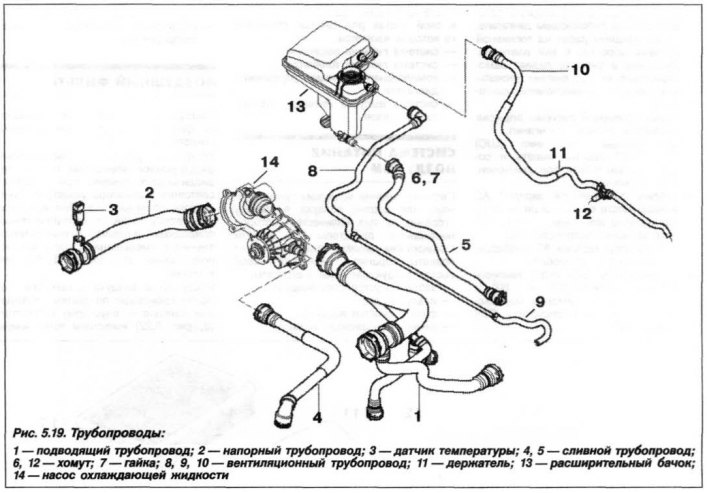
The engine cooling system is liquid, sealed with forced circulation. The cooling system includes:
- cooling jackets (cylinder heads and blocks);
- aluminum cross flow radiator;
- coolant pump;
- thermostat;
- coolant pump drive;
- expansion tank;
- nine blade fan with flexible coupling;
- the heat exchanger of the heating and ventilation system, the coolant temperature sensor and the coolant itself.
When installing an air conditioner on some car models, an additional electric fan is used.
The pressure for checking the tightness of the cooling system is 1.5 kgf/cm².
The radiator is designed to remove heat from the coolant and is made in the form of a horizontally located set of aluminum tubes with right and left tanks. The radiator is covered on the engine side by a casing in which a fan is mounted.
The coolant supply hoses are secured to the radiator pipes with screw clamps. The radiator mounting brackets to the body are rubber-metal.
On cars with an automatic transmission (AT), an oil cooler is built into the radiator. The operating pressure in the AT system is 8.0 kgf/cm².
The design of the coolant pump is shown in Figure 5.20.
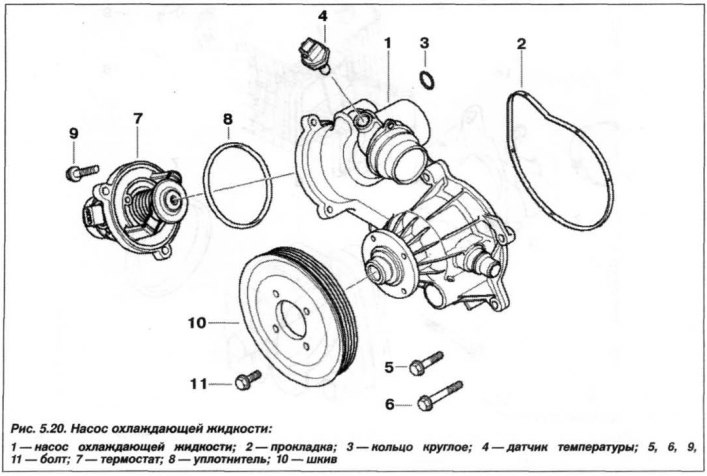
The coolant pump is a centrifugal type, mounted on the front end wall of the engine cylinder block. The pump shaft is driven by a multi-groove belt simultaneously with the generator, the power steering pump (and air conditioning compressor) from the crankshaft pulley. The fan is controlled by a viscous clutch. The engines are equipped with a brand belt "Hutchinson". The drive belt has a size of 5Kx1007, if there is an air conditioner - 7K-LBx1629. The required belt tension is provided automatically.
The thermostat (7) is designed to turn on and off the large circle of engine coolant circulation, depending on its temperature state. The temperature of the beginning of the opening of the main valve is 88±5°C. The temperature of the full opening of the main valve is 105°C. The full stroke of the main valve plate is 8.0 mm.
Expansion tank (13, see Fig. 5.19) serves to fill the system with coolant, a volume that ensures the expansion of the liquid as the temperature rises, and to connect the cooling system with the environment when the pressure in the cooling system increases or decreases.
The opening pressure of the pressure reducing valve in the expansion tank cap is 1.8–2.1 kgf/cm². The opening vacuum of the vacuum valve in the expansion tank plug is 0.1 kgf/cm².
The fan has nine blades, is mounted on the coolant pump shaft and is designed to create air flow through the radiator. The fan impeller has a diameter of 420 mm and is connected to the coolant pump drive via a viscous coupling manufactured by Holset or "Fichtel und Sachs". The switching on and off of the fan viscous clutch depends on the engine temperature and the rotation speed of its crankshaft.
The axial clearance of the viscous coupling rotor is no more than 0.4 mm.
The radial clearance of the viscous coupling rotor is no more than 0.45 mm.
Fan switch-on temperature is 88–96°C, fan switch-off temperature is 60–65°C.
The coolant temperature sensor (4) is a three-pin sensor, mounted on the fitting on the left side of the engine cylinder head. Signals from the sensor are sent to the engine ECU to calculate the required fuel consumption for the required power mode.
The cooling liquid is antifreeze, when replacing it, be sure to flush the cooling system with softened water or special compounds. Let the engine run for 3-5 minutes, drain the water and blow out the system with compressed air.
The capacity of the engine cooling system, including the interior heater, is 12.2 l. The coolant replacement frequency is every 2 years of operation.