
Cars Mazda Cars Mitsubishi Cars Toyota Cars Chevrolet Cars AvtoVAZ Cars Kia Cars Nissan
English Русский
Български
Беларускі
Український
Српски
Hrvatski
Română
Polski
Slovenský
Magyar
| Articles | Contacts | Sitemap |   
BMWman.ru


3 series   5 series   7 series   BMW X3   BMW X5   BMW X6

E46 (1998-2006) E46 (1998-2006, petrol) E36 (1990-2000) E30 (1982-1994) E21 (1975-1983)
  • Home
  • BMW 3 Series
  • E46
  • Power unit
  • Engine repair
  • Compression check

Compression check (BMW 3 Series E46)

            0

Compression testing allows you to draw conclusions about the condition of the engine. During the test, you can determine whether the valves and pistons are in good condition (piston rings) or they are worn out. In addition, the test results show whether the engine should be replaced or repaired. A compression tester is required for testing.

To check the compression of a diesel engine, a special compression tester is required, which is screwed into the threaded hole of the glow plugs. Checking the compression of a diesel engine is not described here.


The difference between the compression pressure values of individual cylinders should not exceed 1.0 bar for a petrol engine and 3.0 bar for a diesel engine.

If one or more cylinders have a higher pressure than the others, this indicates damaged valves, worn piston rings or damaged cylinder head gaskets. In this case, the engine must be repaired or replaced.

The pressure value is of secondary importance, as it depends, among other things, on the measuring device used. For petrol engines, it should not be less than 10 bar.

Examination


1. The condition for testing is a charged battery.

2. Turn off the ignition.

3. Disconnect the main relay of the electronic engine management system to prevent fuel injection during the test. The location of the control system relay is shown in the Specifications Chapter On-board electrical equipment.

If the engine control system relay does not disconnect, the output stage of the main control system relay may be damaged.


4. Remove all spark plugs, refer to Section Checking fluid levels.
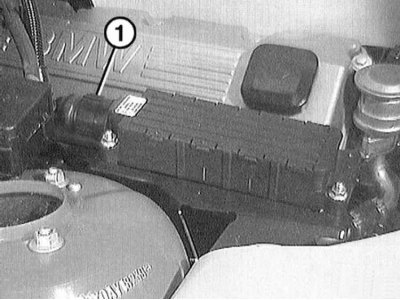
4. Remove all spark plugs, refer to Section Checking fluid levels.


5. Models 316i, 318i: Disconnect the multi-pin connector of the ignition coils by turning the knob "1" to the left.

6. Set the manual transmission to neutral, the automatic transmission to position "P". Apply the parking brake.

Do not lean over the engine if it is turning over with the spark plugs removed. There is a risk of injury due to the soot particles ejected!


7. Insert or screw the compression tester into the spark plug hole according to the operating instructions.

8. Ask the assistant to fully depress the gas pedal and hold it in this position for the entire duration of the test.

9. Turn the engine over approximately 8 revolutions until the pressure on the compression gauge stops increasing.

10. Thus, check all cylinders in sequence.

11. If the compression in one or more cylinders is below the wear limit, pour some engine oil through the spark plug hole and measure the pressure again with a compression gauge. If the pressure increases after this, this indicates wear of the piston rings and/or the cylinder running surface. If the pressure does not increase, then, as a rule, the valve or cylinder head gasket is damaged


12. Install the spark plugs, refer to Section Checking fluid levels.

13. Models 316i, 318i: Connect the multi-pin connector of the ignition coils while turning the handle to the right.

14. Install the engine management system main relay, refer to Chapter Specifications On-board electrical equipment.

Information taken from this resource BMWman

This article is available at russian, bulgarian, belarusian, ukrainian, serbian, croatian, romanian, polish, slovak, hungarian
Article verified: Sevastyanov Nikolay

Share information:
Previous articles
БМВ E46: Engine repair
Next articles

Removal and installation the air intake box
Removal and installation the lower engine compartment cover
Design and characteristics of engines
Engine specifications
Removal and installation the intake manifold
Removal and installation the cylinder head / replacing the sealing…
Removal and installation camshafts
Removal and installation the vacuum pump (model 320d)
Removal, installation and tensioning the V-belt


Similar articles on other types of BMW cars:
Compression check BMW 5 Series E34 (1988-1996)
Compression check BMW 5 Series E39 (1995-2003)
Checking the compression in the cylinders BMW 7 Series E32 (1986-1994)
Brake booster check valve BMW X3 E83 (2003-2010)
Checking the compression in the cylinders BMW X5 E53 (1999-2006)
Link in different formats to this page


Visitor comments

No comments yet


How much 41 + 44 =


BMW E46 (1998-2006) 
  • General information
  • Manual
  • Maintenance
  • Power unit
  • Engine repair
  • Cooling system
  • Power system (gasoline)
  • Injection system (gasoline)
  • Fuel system (diesel)
  • Exhaust system
  • Ignition system
  • Charge and launch systems
  • Transmission
  • Car gearbox
  • Clutch and drive shafts
  • Chassis
  • Brake system
  • Suspension front and rear
  • Steering
  • Body
  • Body care and repair
  • Exterior
  • Interior
  • Electrical equipment
  • Troubleshooting
  • Lighting and signaling
  • Equipment and devices
  • Heater and air conditioner
  • Electrical circuits
BMW E46 (1998-2006, petrol) 
  • General information
  • Manual
  • Repair on the road
  • Weekly checks
  • Maintenance
  • Troubleshooting
  • Power unit
  • 4 cylinder engines
  • 6 cylinder engines
  • Engine overhaul
  • Cooling and heating
  • Fuel and exhaust system
  • Starting and charging system
  • Ignition system
  • Transmission
  • Clutch
  • Mechanical gearbox
  • Automatic gearbox
  • Cardan and drive shafts
  • Chassis
  • Brake system
  • Wheel suspension
  • Steering
  • Body
  • Exterior
  • Interior
  • Electrical equipment
  • Equipment and devices
  • Electrical circuits
BMW E36 (1990-2000) 
  • General information
  • Maintenance
  • Power unit
  • Engine repair
  • Cooling system
  • Ignition system
  • Supply system
  • Fuel injection system
  • Exhaust system
  • Transmission
  • Clutch
  • Car gearbox
  • Front and rear axle
  • Chassis
  • Steering
  • Brake system
  • Body
  • Exterior
  • Interior
  • Electrical equipment
  • Heating system
  • Equipment and devices
  • Power devices
  • Electrical circuits
BMW E30 (1982-1994) 
  • Power unit
  • M10/M20 engine
  • M40 engine
  • Ignition system
  • Lubrication system
  • Cooling system
  • Supply system
  • Fuel injection
  • Exhaust system
  • Transmission
  • Clutch
  • Manual gearbox
  • Front axle
  • Rear axle
  • Chassis
  • Steering
  • Brake system
  • Body
  • Exterior
  • Interior
  • Electrical equipment
  • Heating system
  • Equipment and devices
  • Electrical circuits
BMW E21 (1975-1983) 
  • General information
  • Specifications
  • Operation and maintenance
  • 4-cylinder engine
  • Engine repair
  • Cooling and lubrication system
  • Supply system
  • Ignition system
  • 6-cylinder engine
  • Engine repair
  • Cooling and lubrication system
  • Supply system
  • Fuel injection system
  • Ignition system
  • Transmission
  • Clutch
  • 4-speed manual gearbox
  • 5-speed manual gearbox
  • Automatic gearbox
  • Cardan and rear axle
  • Chassis
  • Steering
  • Front suspension
  • Rear suspension
  • Brake system
  • Electrical equipment
  • Equipment and devices
  • Electrical circuits
BMWman.ru © 2017-2026 · Mobile version · News and articles · Sitemap: EN BG BY UA RS HR RO PL SK HU · Feedback · Site search
3er E21 · 3er E30 · 3er E36 · 3er E46 [petrol] · 3er E46 · 5er E12 · 5er E28 · 5er E34 · 5er E39 · 7er E32 · 7er E38 · X3 E83 · X5 E53 ·
This site uses cookies 🍪, without them some features simply would not work.