
To perform the test, a device is required - a compression meter, with a measurement scale of up to 20 kgf/cm². The main indicator of compression is the pressure value, which should be 11-12 bar (kgf/cm²), while the difference in its values for individual cylinders of one engine should differ by more than 1.5 bar (kgf/cm²). If this value is found to be exceeded, the engine is subject to major repairs or replacement.
On gasoline engines, the compression gauge is installed in place of the removed spark plugs.
The test should be carried out with a fully charged battery, on a warmed-up engine in the following order. Start and warm up the engine to operating temperature (80°C). Read information from the fault memory of the DME system ECU and eliminate the faults. Erase information from the fault memory.
Disconnect the fuel pump relay, start the engine and let it run until the remaining fuel is used up. This will prevent fuel injection during the test, damage to the neutralizer and distortion of the test results.
Warning! High voltage ignition system - life-threatening!
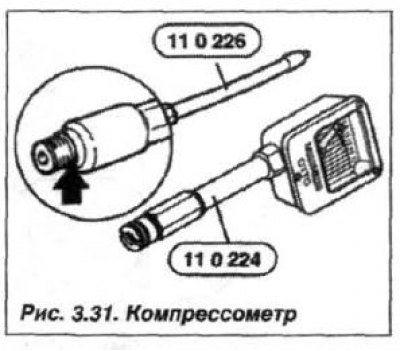
Set the automatic transmission selector lever to the "N" position (the manual transmission lever to the neutral position) and apply the parking brake. Disconnect the power supply wires from all ignition coils, unscrew the spark plugs. Turn the engine over several times with the starter, which will remove the remaining combustion waste from the engine cylinders. Check the condition of the sealing ring (arrow, Fig. 3.31.) on the device "11.0.226". Screw the device "11.0.226" by hand into the spark plug socket and connect the compression gauge (device "11.0.224").
Press the accelerator pedal and crank the engine with the starter (10-12 revolutions) until the pressure on the instrument stops increasing. Record the nominal compression pressure in each cylinder. Take measurements in all cylinders and compare the results. Make a decision on the technical condition of the engine.