
Attention! Valve seats cannot be replaced, as they are installed cooled to a temperature of -150°C.
Lapping of the valve seat is required if it has signs of wear, burning, or if the valve guide bushing has been processed. It is necessary to observe the values of the angles and width of the working chamfer. In this case, the outer diameter of the valve seat corresponds to the outer diameter of the valve itself. If the valve seats are processed correctly and new valves are installed, lapping of the seats in the cylinder head is not required.
Valves should be lapped only with fine-grained paste, using a suction cup placed on the valve plate for lapping. During lapping, it is necessary to periodically lift the valve while simultaneously rotating it in a circle. This will help to avoid the appearance of grooves on the lapped surface.
Attention! After finishing grinding, remove any remaining paste from the valve and seat with alcohol.
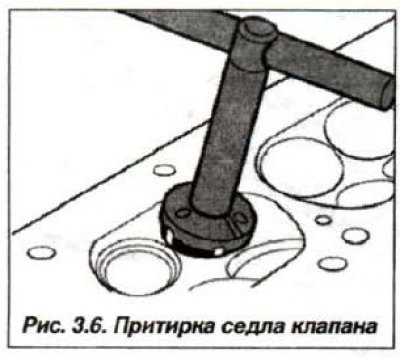
The valve seat grinding must be carried out in the following order. Remove and disassemble the cylinder head. Treat the surface of the cylinder head valve seat using the "00.3.520" device (see fig. 3.6) or "00.3.580" according to the engine manufacturer's instructions.
After machining the valve seat support surface, the outer and inner diameters should be ground with a correction cutter to the prescribed dimensions, until the width is obtained (5, see Fig. 3.5) working chamfer of the valve seat, see Technical Specifications.
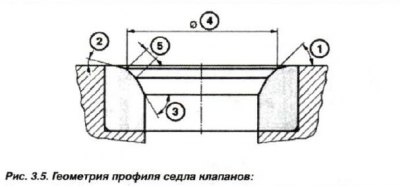
1 - working chamfer angle; 2 - external correction angle; 3 - internal correction angle, 4 - circumferential diameter of the valve seat support surface; 5-width of the working chamfer of the valve seat
The quality of the lapping is checked by its appearance and by pouring fuel (kerosene). For this, the valve is inserted into the cylinder head in a free position (the head is turned with the combustion chamber upwards). Fuel is poured from above, within one hour, it should not leak along the valve stem and appear from the guide. Otherwise, repeat the grinding.