
- Home
- BMW 5 Series
- E28
- Chassis
- Brake system
- Removal, major repair and installation of the disc brake caliper
Removal, major repair and installation of the disc brake caliper (BMW 5 Series E28)
Rear Brake Caliper Assembly Components (for the front wheels the same)
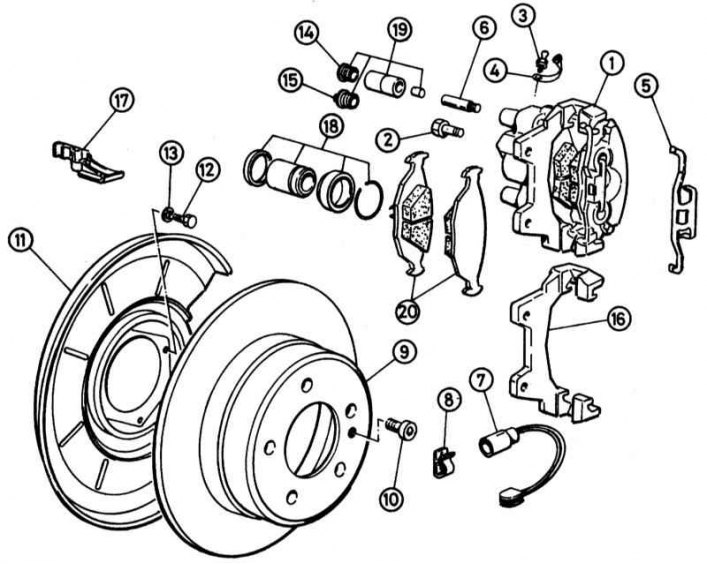
1 - Assembling the caliper
2 — Bracket mounting bolt
3 — Bleed valve
4 - Dust cap
5 - Anti-squeal spring
6 - Guide bolt
7 — Wire for brake pad wear indicator light
8 — Cable clamp
9 — Brake disc
10 - Hexagon socket head bolt
11 - Shield
12 - Bolt
13 — Washer
14 — Plug
15 — Plug
16 — Caliper bracket
17 — Cable clamp
18 - Piston seal, piston, dust cover and retaining ring
19 — Guide Bushing Repair Kit
20 — Brake pads
1. Loosen the wheel mounting bolts, jack up the front or rear of the car and securely place it on the axle supports. Remove the wheel.
2. If you are removing the caliper only to access other components, there is no need to disconnect the brake line. However, if you are removing the caliper for a major overhaul, disconnect the brake line from the caliper, preferably using a special open-end (brake) wrench to avoid damaging the fittings. Plug the tube to prevent contamination of the brake system and leakage of brake fluid.
3. Following the instructions in Section Replacing disc brake pads, remove the caliper - this is part of the procedure for replacing the brake pads.
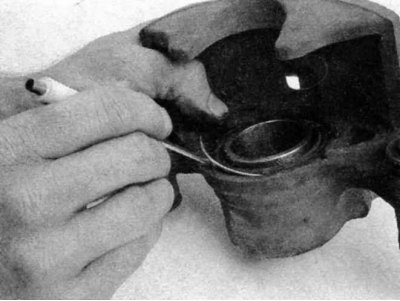
1. On all calipers, remove the dust boot retaining ring, then remove the dust boot. Before removing the piston, place a block of wood between the piston and caliper to prevent damage during removal.
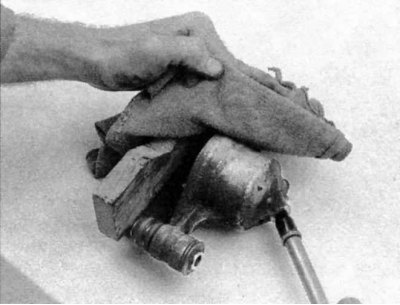
2. To remove the piston from the caliper, apply compressed air to the brake hose connection on the caliper body. Use only low pressure, such as from a foot pump, to remove the piston from the cylinder.
3. Inspect the surfaces of the piston and the walls of the caliper cylinder. If there are any scratches, cavities, rust or light spots, replace the entire caliper assembly.
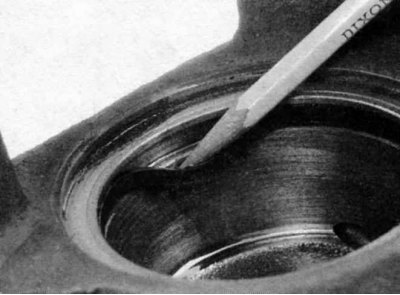
4. If these components are still in good condition, remove the piston cup from the caliper cylinder using a wooden or plastic tool. A metal tool may damage the cylinder surface.
5. Remove the caliper guide pins or bolts and then the rubber dust boots.
6. Wash all components in methyl alcohol or brake system cleaner.
7. Using the special repair kit from your vehicle, disassemble the caliper as described below.
8. Dip the new rubber seal into clean brake fluid and install it into the lower groove in the caliper cylinder, making sure it is not twisted.
9. On all calipers, apply clean brake fluid to the cylinder walls and piston and immediately install the piston in place. Do not press hard on the piston when installing, first make sure it is correctly positioned, and then press it firmly, but not too hard, until it stops. Install a new dust boot and snap ring.
10. Lubricate the sliding surfaces of the guide pins or bolts with silicone-based lubricant (it is usually included in the set), install them in the support. Install dust covers.
1. Installation repeats the removal procedure in reverse order (see section Replacing disc brake pads).
2. If the brake hose was disconnected from the caliper, bleed the brake system (see section Bleeding the hydraulic brake system).
1 - Assembling the caliper
2 — Bracket mounting bolt
3 — Bleed valve
4 - Dust cap
5 - Anti-squeal spring
6 - Guide bolt
7 — Wire for brake pad wear indicator light
8 — Cable clamp
9 — Brake disc
10 - Hexagon socket head bolt
11 - Shield
12 - Bolt
13 — Washer
14 — Plug
15 — Plug
16 — Caliper bracket
17 — Cable clamp
18 - Piston seal, piston, dust cover and retaining ring
19 — Guide Bushing Repair Kit
20 — Brake pads
The dust created by the brake system may contain asbestos, which is harmful to your health. Never remove it with compressed air or inhale it. When working with the brakes, wear a special filter mask. Never, under any circumstances, use gasoline-based solvents to clean brake parts. Use only brake system cleaner!
Brake fluid is poisonous. It is also a strong paint solvent. See Warning at the beginning of Section Bleeding the hydraulic brake system.
If there is a need for major repairs (usually due to a fluid leak), before you start working, examine all the parameters of the system. Many auto parts stores sell refurbished calipers on an exchange basis, which will make your work much easier. If you decide to repair the calipers, make sure you have a special repair kit before you start working. Always repair calipers in pairs - never do it with one of them.
Removal
1. Loosen the wheel mounting bolts, jack up the front or rear of the car and securely place it on the axle supports. Remove the wheel.
2. If you are removing the caliper only to access other components, there is no need to disconnect the brake line. However, if you are removing the caliper for a major overhaul, disconnect the brake line from the caliper, preferably using a special open-end (brake) wrench to avoid damaging the fittings. Plug the tube to prevent contamination of the brake system and leakage of brake fluid.
3. Following the instructions in Section Replacing disc brake pads, remove the caliper - this is part of the procedure for replacing the brake pads.
The rear wheel brake caliper has a design similar to the front wheel brake caliper.
Major repairs
1. On all calipers, remove the dust boot retaining ring, then remove the dust boot. Before removing the piston, place a block of wood between the piston and caliper to prevent damage during removal.
2. To remove the piston from the caliper, apply compressed air to the brake hose connection on the caliper body. Use only low pressure, such as from a foot pump, to remove the piston from the cylinder.
Be careful not to get your fingers caught between the piston and the caliper, as the piston can come out with considerable force.
3. Inspect the surfaces of the piston and the walls of the caliper cylinder. If there are any scratches, cavities, rust or light spots, replace the entire caliper assembly.
4. If these components are still in good condition, remove the piston cup from the caliper cylinder using a wooden or plastic tool. A metal tool may damage the cylinder surface.
5. Remove the caliper guide pins or bolts and then the rubber dust boots.
6. Wash all components in methyl alcohol or brake system cleaner.
7. Using the special repair kit from your vehicle, disassemble the caliper as described below.
8. Dip the new rubber seal into clean brake fluid and install it into the lower groove in the caliper cylinder, making sure it is not twisted.
9. On all calipers, apply clean brake fluid to the cylinder walls and piston and immediately install the piston in place. Do not press hard on the piston when installing, first make sure it is correctly positioned, and then press it firmly, but not too hard, until it stops. Install a new dust boot and snap ring.
10. Lubricate the sliding surfaces of the guide pins or bolts with silicone-based lubricant (it is usually included in the set), install them in the support. Install dust covers.
Installation
1. Installation repeats the removal procedure in reverse order (see section Replacing disc brake pads).
2. If the brake hose was disconnected from the caliper, bleed the brake system (see section Bleeding the hydraulic brake system).
This article is available at russian, bulgarian, belarusian, ukrainian, serbian, croatian, romanian, polish, slovak, hungarian
Article verified: Zhuravleva Isolda
Share information:
Previous articles
БМВ E28: Brake system
Next articles
Similar articles on other types of BMW cars:
Front Brake Caliper — Removal, Repair and Installation BMW 3 Series E46 (1998-2006, petrol)
Removal and installation the brake disc BMW 3 Series E21 (1975-1983)
Rear Brake Caliper — Removal and Installation BMW 7 Series E32 (1986-1994)
Removal and installation brake discs BMW 7 Series E38 (1994-2001)
Removal and installation the brake booster BMW X3 E83 (2003-2010)
Rear disc — removal and installation BMW X5 E53 (1999-2006)
Front Brake Caliper — Removal, Repair and Installation BMW 3 Series E46 (1998-2006, petrol)
Removal and installation the brake disc BMW 3 Series E21 (1975-1983)
Rear Brake Caliper — Removal and Installation BMW 7 Series E32 (1986-1994)
Removal and installation brake discs BMW 7 Series E38 (1994-2001)
Removal and installation the brake booster BMW X3 E83 (2003-2010)
Rear disc — removal and installation BMW X5 E53 (1999-2006)
Link in different formats to this page
Visitor comments
No comments yet
- General information
- Governing bodies
- Manual
- Maintenance
- Power unit
- Engine repair
- Lubrication system
- Cooling system
- Ignition system
- Supply system
- Injection system (gasoline)
- Injection system (diesel)
- Exhaust system
- Transmission
- Clutch
- Car gearbox
- Front axle
- Rear axle
- Chassis
- Steering
- Brake system
- Wheels and tires
- Body
- Interior
- Exterior
- Heating system
- Electrical equipment
- Equipment and devices
- Power devices
- Windscreen wipers
- Electrical circuits
- General information
- Manual
- Maintenance
- Power unit
- Engine repair
- Ignition system
- Engine lubrication system
- Cooling system
- Fuel system (gasoline)
- Fuel system (diesel)
- Exhaust system
- Transmission
- Clutch
- Car gearbox
- Chassis
- Front and rear suspension
- Steering
- Brake system
- Body
- Exterior
- Interior
- Electrical equipment
- Heating system
- Equipment and devices
- Power devices
- Electrical circuits
- General information
- Manual
- Maintenance
- Power unit
- Engine in a car
- Engine overhaul
- Cooling system
- Supply system
- Ignition system
- Control system
- Transmission
- Clutch
- Manual gearbox
- Automatic gearbox
- Transmission line
- Chassis
- Steering
- Front suspension
- Rear suspension
- Brake system
- Body
- Body elements
- Car care and painting
- Electrical equipment
- Heater and air conditioner
- Equipment and devices
- Starter and generator
- Electrical circuits
- General information
- Operation and maintenance
- Specifications
- Power unit
- Engine repair
- Cooling and lubrication system
- Supply system
- Ecotronic power supply system
- Fuel injection system
- Ignition system
- Transmission
- Clutch
- Gearbox BMW 242/4
- Gearbox Getrag 262/8
- Gearbox Getrag 265/6
- Automatic gearbox
- Cardan gear
- Rear axle
- Chassis
- Steering
- Front suspension
- Rear suspension
- Brake system
- Electrical equipment
- Equipment and devices
- Electrical circuits