
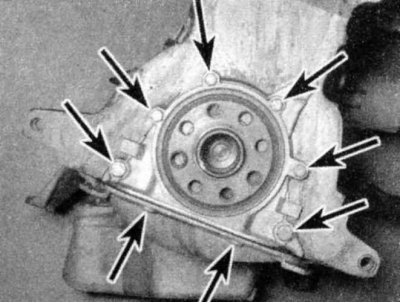
2. Remove the bolts and/or nuts securing the oil seal holder to the cylinder block. Don't forget to remove the two bolts (at the bottom) securing the rear of the oil pan to the bottom of the oil seal holder.
3. Run a thin, sharp knife between the oil pan gasket and the front cover, thus separating the gasket from the cover. Be very careful not to damage or stain the gasket so that you can reuse it later.
4. Break the sealant between the holder and the cylinder block by tapping the cover with a rubber-faced hammer or a regular hammer, using a wooden block. Do not insert anything between the cover and the block to avoid damaging the gasket surfaces.
5. Using a scraper, remove all traces of the old gasket material from the mating surfaces of the holder and cylinder block. Special solvents for removing gaskets are available and may be useful. After all gasket material has been removed, the gasket surfaces can be degreased by wiping them with a rag soaked in a suitable solvent.
Be extremely careful not to damage or scratch the soft aluminum surfaces. Also, be careful not to damage or stain the oil pan gasket.
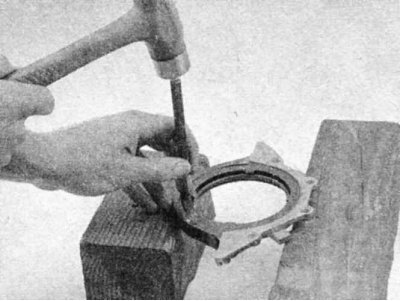
6. Support the holder with two wooden blocks and knock out the seal from the back side using a hammer and screwdriver.
7. Be careful not to damage the seal hole during operation.
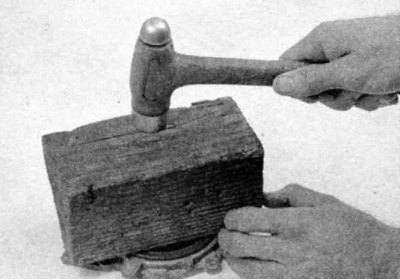
8. Coat the outside diameter and lips of the new seal with multi-purpose grease and install the seal into the holder using a hammer and wooden block.
9. Apply a thin bead of RTV type sealant to the oil pan gasket seal retainer mating surface. Apply more sealant to the edges where the gasket contacts the engine block.
If the oil pan gasket is damaged, instead of replacing the entire gasket, you can try cutting off the front of the gasket where it meets the engine block, then cutting off the front of the new gasket to exactly the same size. Cover the inside of the pan with a rag, then clean all traces of the old gasket material from the mating surfaces. Attach a piece of the new gasket to the pan with a special adhesive, then apply RTV sealant as described at the beginning of this section.
10. Coat both sides of the new gasket with RTV sealant, then connect the gasket to the seal retainer. Install the retainer onto the rear of the engine, then install the bolts and tighten them to the specified torque. Tighten the bolts one by one in a crisscross pattern to ensure even tightening.
First tighten the bracket-to-block mounting bolts, then the oil pan-to-cover bolts. If the gasket protrudes above the cover-to-block joint or forms folds in the cover-to-pan joint, trim it so that it sits correctly.
After applying the RTV sealant, assembly must be completed within 10 minutes to allow time for the sealant to cure.
11. Install the flywheel/drive plate (see section Removal and installation the flywheel/drive disc).
12. Install the transmission (for vehicles with manual transmission, see Chapter Manual transmission (MT); for vehicles with automatic transmission see Chapter Automatic transmission (AT)).