
Table of contents: Engines M10 and M30 (with…↓ Engines M20 and M40 (with timing…↓
- Home
- BMW 5 Series
- E28
- Power unit
- Engine in a car
- Replacing the front oil seals
Replacing the front oil seals (BMW 5 Series E28)
All seals are installed with the lips facing inward (to the engine).
Engines M10 and M30 (with distribution chain)
Front camshaft oil seal (only for M30 engines)
1. Remove only the upper timing chain cover (see section Removal and installation timing chain covers).
2. Support the cover with two wooden blocks and knock out the seal from the back using a hammer and screwdriver. Be careful not to damage the seal hole during the process.
3. Coat the outside diameter and lips of the new seal with multi-purpose grease and install the seal into the cover using a hammer and a socket with a diameter slightly smaller than the outside diameter of the seal.
4. Perform the rest of the installation in the reverse order of removal.
Front crankshaft oil seal (engines M10 and M30)
1. Remove the crankshaft pulley and vibration damper (see section Removal and installation timing chain covers).
2. Carefully pry the old oil seal out of the cover using a large screwdriver. Be extremely careful not to damage the oil seal hole or the crankshaft with the screwdriver. Wrap the tip of the screwdriver with electrical tape to prevent possible damage.
3. Clean the seal hole in the cover, coat the outer edge of the new seal with motor oil or multi-purpose grease. Also lubricate the seal lips with multi-purpose grease. Using a replacement socket with a diameter slightly smaller than the outer diameter of the seal, carefully install the new seal in place with a hammer.
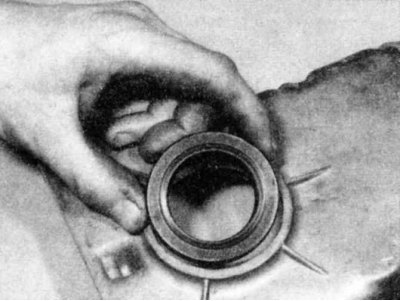
4. If a suitable replacement head is not available, a short piece of large diameter pipe will do.
5. Check the seal after installation to ensure that the spring around the inside of the seal lips has not popped out.
6. Perform the rest of the installation in the reverse order of removal.
Engines M20 and M40 (with timing belt)
Front camshaft oil seal (engines M20 and M40)
1. Remove the timing belt and camshaft sprocket (see section Removal, inspection and installation of the timing belt and its tensioner sprockets).
2. On the M20 engine only, loosen the two screws and remove the camshaft oil seal housing from the cylinder head by pulling it and simultaneously turning it back and forth.
3. On M20 engines only, support the housing with two wooden blocks and use a hammer and screwdriver to remove the seal. Be very careful not to damage the housing of the seal.
4. On M40 engines, remove the oil seal from the cylinder head using a screwdriver, being careful not to damage the camshaft surface or the oil seal hole.
5. Coat the lips and outside diameter of the new seal with general purpose grease.
6. On M40 engines, wrap tape around the end of the camshaft to protect the new seal from being damaged by the installation groove during installation.
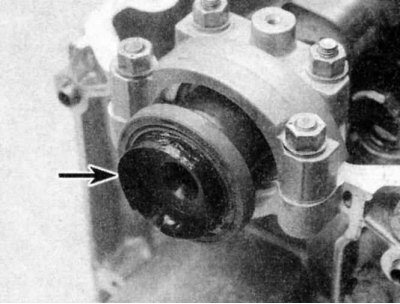
7. Carefully place the new seal in place and first press it in by hand to fit it into the hole. Install the seal into the housing or cylinder head (what is provided) using a hammer and a socket with a diameter slightly smaller than the outer diameter of the seal. On M40 engines, remove the adhesive tape from the end of the camshaft.
8. On M20 engines, replace the O-ring at the rear of the seal housing and pull the seal lips onto the end of the camshaft. Install the screws and tighten them to the required torque.
9. Perform the rest of the installation in the reverse order of removal.
Front crankshaft and intermediate shaft seals (m²0 engines)
1. Remove the timing belt and the crankshaft and intermediate shaft pulleys, if equipped (see section Removal, inspection and installation of the timing belt and its tensioner sprockets).
We recommend replacing the timing belt every time it is removed.
2. Remove the bolts and nuts securing the front cover to the cylinder block. Don't forget to remove the three bolts at the bottom holding the front of the oil pan to the bottom of the front cover.
3. Run a thin, sharp knife between the oil pan gasket and the front cover, thus separating the gasket from the cover. Be very careful not to damage or stain the gasket so that you can reuse it later.
4. Break the sealant between the front cover and the cylinder block by tapping the cover with a rubber-faced hammer or a regular hammer and a wooden block. Do not insert anything between the cover and the block to avoid damaging the gasket surfaces.
5. Using a scraper, remove all traces of the old gasket material from the mating surfaces of the covers and cylinder block.
Be extremely careful not to damage or scratch the soft aluminum surfaces. Also, be careful not to damage or stain the oil pan gasket. Special gasket remover solvents are available and may be helpful. Once the gasket material has been completely removed, the gasket surfaces can be degreased by wiping them with a cloth dampened with a suitable solvent.
6. Support the cover with two wooden blocks and knock out the seal from the back using a hammer and screwdriver. Be careful not to damage the seal hole during the process.
7. Coat the outside diameter and lips of the new seal with multi-purpose grease and install the seal into the cover using a hammer and a socket with a diameter slightly smaller than the outside diameter of the seal.
8. Apply a thin layer of RTV type sealant to the surface of the oil pan gasket that meets the front cover. Apply more sealant to the edges where the gasket contacts the engine block.
If the oil pan gasket is damaged, instead of replacing the entire gasket, you can try cutting off the front of the gasket where it meets the engine block, then cutting off the front of the new gasket to exactly the same size. Cover the inside of the pan with a rag, then clean all traces of the old gasket material from the mating surfaces. Attach a piece of the new gasket to the pan with a special adhesive, then apply RTV sealant as described at the beginning of this section.
9. Coat both sides of the new gasket with RTV sealant, attach the front cover to the front of the engine, carefully pushing the seals onto the crankshaft and intermediate shaft. Install the bolts and tighten them to the specified torque. Tighten the bolts one by one in a crisscross pattern to ensure even tightening.
First tighten the front cover to block bolts, then tighten the oil pan to cover bolts. If the gasket protrudes above the cover to block joint or forms folds in the cover to pan joint, trim it so that it sits correctly.
After applying the RTV sealant, assembly must be completed within 10 minutes to allow time for the sealant to cure.
10. Perform the rest of the installation in the reverse order of removal.
Front crankshaft oil seal (m40 engines)
1. Remove the timing belt and crankshaft sprocket (see section Removal, inspection and installation of the timing belt and its tensioner sprockets).
2. Remove the woodruff key from the groove at the end of the crankshaft.
3. Note the position of the oil seal, then remove it from the front cover with a screwdriver, but try not to damage the oil seal hole or the crankshaft surface. If the oil seal is stuck, drill two small holes in the metal part of the oil seal and remove the oil seal with two screws. Be sure to remove all metal shavings.
4. Coat the outside diameter and lips of the new seal with multi-purpose grease and install the seal into the cover using a hammer and a socket with a diameter slightly smaller than the outside diameter of the seal. Make sure the seal fits evenly into place.
5. Perform the rest of the installation in the reverse order of removal. Do not forget that it is recommended to replace the timing belt - see Section Removal, inspection and installation of the timing belt and its tensioner sprockets.
Examine the original source using the link on the website: «BMWMAN.ru»
This article is available at russian, bulgarian, belarusian, ukrainian, serbian, croatian, romanian, polish, slovak, hungarian
Article verified: Zhuravleva Isolda
Share information:
Previous articles
БМВ E28: Engine in a car
Next articles
Similar articles on other types of BMW cars:
Replacing the front crankshaft oil seal and intermediate shaft oil… BMW 3 Series E21 (1975-1983)
Replacing the front brake hose BMW 3 Series E46 (1998-2006)
Replacing crankshaft seals BMW 7 Series E38 (1994-2001)
Replacing the oil filter (center bolt design) BMW 7 Series E32 (1986-1994)
Front ashtray (optional) BMW X3 E83 (2003-2010)
Replacing valve stem seals BMW X5 E53 (1999-2006)
Replacing the front crankshaft oil seal and intermediate shaft oil… BMW 3 Series E21 (1975-1983)
Replacing the front brake hose BMW 3 Series E46 (1998-2006)
Replacing crankshaft seals BMW 7 Series E38 (1994-2001)
Replacing the oil filter (center bolt design) BMW 7 Series E32 (1986-1994)
Front ashtray (optional) BMW X3 E83 (2003-2010)
Replacing valve stem seals BMW X5 E53 (1999-2006)
Link in different formats to this page
Visitor comments
No comments yet
- General information
- Governing bodies
- Manual
- Maintenance
- Power unit
- Engine repair
- Lubrication system
- Cooling system
- Ignition system
- Supply system
- Injection system (gasoline)
- Injection system (diesel)
- Exhaust system
- Transmission
- Clutch
- Car gearbox
- Front axle
- Rear axle
- Chassis
- Steering
- Brake system
- Wheels and tires
- Body
- Interior
- Exterior
- Heating system
- Electrical equipment
- Equipment and devices
- Power devices
- Windscreen wipers
- Electrical circuits
- General information
- Manual
- Maintenance
- Power unit
- Engine repair
- Ignition system
- Engine lubrication system
- Cooling system
- Fuel system (gasoline)
- Fuel system (diesel)
- Exhaust system
- Transmission
- Clutch
- Car gearbox
- Chassis
- Front and rear suspension
- Steering
- Brake system
- Body
- Exterior
- Interior
- Electrical equipment
- Heating system
- Equipment and devices
- Power devices
- Electrical circuits
- General information
- Manual
- Maintenance
- Power unit
- Engine in a car
- Engine overhaul
- Cooling system
- Supply system
- Ignition system
- Control system
- Transmission
- Clutch
- Manual gearbox
- Automatic gearbox
- Transmission line
- Chassis
- Steering
- Front suspension
- Rear suspension
- Brake system
- Body
- Body elements
- Car care and painting
- Electrical equipment
- Heater and air conditioner
- Equipment and devices
- Starter and generator
- Electrical circuits
- General information
- Operation and maintenance
- Specifications
- Power unit
- Engine repair
- Cooling and lubrication system
- Supply system
- Ecotronic power supply system
- Fuel injection system
- Ignition system
- Transmission
- Clutch
- Gearbox BMW 242/4
- Gearbox Getrag 262/8
- Gearbox Getrag 265/6
- Automatic gearbox
- Cardan gear
- Rear axle
- Chassis
- Steering
- Front suspension
- Rear suspension
- Brake system
- Electrical equipment
- Equipment and devices
- Electrical circuits