
Table of contents: Removal ↓ Installation ↓
- Home
- BMW 5 Series
- E39
- Power unit
- Injection system (diesel)
- Removal and installation injectors — model 525tds
Removal and installation injectors — model 525tds (BMW 5 Series E39)
Injector defects can cause loud knocks in the engine and raise suspicions of bearing damage. If you suspect this, you should switch the engine to idle mode and loosen the union nuts of the high-pressure fuel lines one by one. If the knocking disappears after loosening the union nut, this indicates a defective injector. You can check the injector using a special device (workshop work).
The first signs of injector malfunction are detected by the following signs:
Remove the intake manifold.
Clean high pressure fuel lines using cleaning agent.
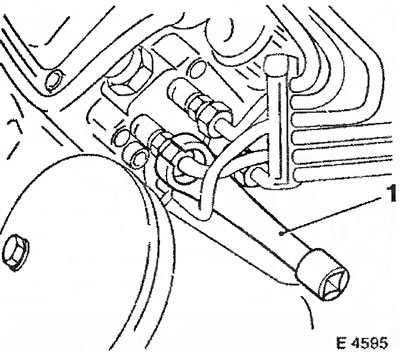
Remove the high-pressure fuel lines as a complete set, for which loosen the union nuts with an open-end ring spanner "1", for example, HAZET 4550.
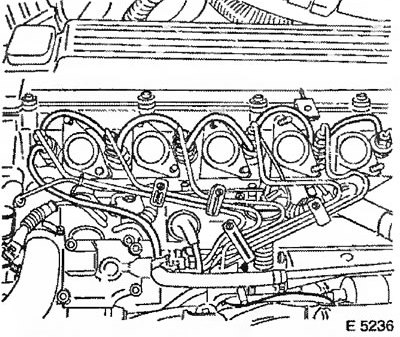
If the high pressure fuel line retaining clamps are removed, their installation position must first be marked with a felt-tip pen.
Carefully remove the fuel lines from the injectors to drain any leaked fuel.
Remove the injectors using a socket wrench with a SW 27 replaceable head, for example, HAZET 4555-1. Cover the injector nozzles with protective caps to prevent dirt from getting in.
Remove the heat-protective sealing gasket from the injector holes.
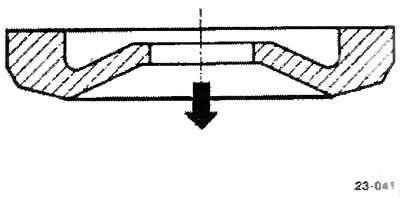
Be sure to install new heat-protective seals between the cylinder head and the injectors. The recess in the gasket must face upwards, the arrow points towards the cylinder head.
Tighten the injectors to a torque of 40 Nm.
Tighten the union nuts of the high-pressure fuel lines to a torque of 20 Nm.
Install fuel lines to drain leaking fuel.
Connect the wire going to the built-in needle lift sensor of injector 4.
If removed, reinstall the high pressure fuel line retaining clamps according to the previously applied marks.
Install the brake booster vacuum line into the holder on the cylinder head.
Install the intake manifold.
Start the engine and check the fuel system for leaks.
The first signs of injector malfunction are detected by the following signs:
- Flash intermittents.
- Knocking in one or more cylinders.
- Engine overheating.
- Loss of power and high fuel consumption of the engine.
- Excessive black smoke from the exhaust.
Removal
Remove the intake manifold.
Clean high pressure fuel lines using cleaning agent.
Remove the high-pressure fuel lines as a complete set, for which loosen the union nuts with an open-end ring spanner "1", for example, HAZET 4550.
Note: Do not change the shape of the bends. To prevent dirt from getting in, fit suitable protective caps to the nozzles and fuel injection pumps.
If the high pressure fuel line retaining clamps are removed, their installation position must first be marked with a felt-tip pen.
Carefully remove the fuel lines from the injectors to drain any leaked fuel.
Remove the injectors using a socket wrench with a SW 27 replaceable head, for example, HAZET 4555-1. Cover the injector nozzles with protective caps to prevent dirt from getting in.
Caution: Make sure that the injectors do not fall when removed. In addition, the wire leading to the built-in needle lift sensor must be disconnected from the cylinder 4 injector. During subsequent assembly, all injectors must be installed in their original places.
Remove the heat-protective sealing gasket from the injector holes.
Installation
Be sure to install new heat-protective seals between the cylinder head and the injectors. The recess in the gasket must face upwards, the arrow points towards the cylinder head.
Tighten the injectors to a torque of 40 Nm.
Tighten the union nuts of the high-pressure fuel lines to a torque of 20 Nm.
Install fuel lines to drain leaking fuel.
Connect the wire going to the built-in needle lift sensor of injector 4.
If removed, reinstall the high pressure fuel line retaining clamps according to the previously applied marks.
Install the brake booster vacuum line into the holder on the cylinder head.
Install the intake manifold.
Start the engine and check the fuel system for leaks.
This article is available at russian, bulgarian, belarusian, ukrainian, serbian, croatian, romanian, polish, slovak, hungarian
Article verified: Ilyinsky Matvey
Share information:
Previous articles
БМВ E39: Injection system (diesel)
Next articles
Similar articles on other types of BMW cars:
Removal and installation injectors BMW 3 Series E36 (1990-2000)
Door glass, window lifters and rear vent window (coupe model) —… BMW 3 Series E46 (1998-2006, petrol)
Injectors — removal and installation BMW 7 Series E32 (1986-1994)
Removal and installation of fuel distribution line and injectors BMW 7 Series E38 (1994-2001)
Pistons — removal and installation BMW X3 E83 (2003-2010)
Removal and installation of injectors BMW X5 E53 (1999-2006)
Removal and installation injectors BMW 3 Series E36 (1990-2000)
Door glass, window lifters and rear vent window (coupe model) —… BMW 3 Series E46 (1998-2006, petrol)
Injectors — removal and installation BMW 7 Series E32 (1986-1994)
Removal and installation of fuel distribution line and injectors BMW 7 Series E38 (1994-2001)
Pistons — removal and installation BMW X3 E83 (2003-2010)
Removal and installation of injectors BMW X5 E53 (1999-2006)
Link in different formats to this page
Visitor comments
No comments yet
- General information
- Governing bodies
- Manual
- Maintenance
- Power unit
- Engine repair
- Lubrication system
- Cooling system
- Ignition system
- Supply system
- Injection system (gasoline)
- Injection system (diesel)
- Exhaust system
- Transmission
- Clutch
- Car gearbox
- Front axle
- Rear axle
- Chassis
- Steering
- Brake system
- Wheels and tires
- Body
- Interior
- Exterior
- Heating system
- Electrical equipment
- Equipment and devices
- Power devices
- Windscreen wipers
- Electrical circuits
- General information
- Manual
- Maintenance
- Power unit
- Engine repair
- Ignition system
- Engine lubrication system
- Cooling system
- Fuel system (gasoline)
- Fuel system (diesel)
- Exhaust system
- Transmission
- Clutch
- Car gearbox
- Chassis
- Front and rear suspension
- Steering
- Brake system
- Body
- Exterior
- Interior
- Electrical equipment
- Heating system
- Equipment and devices
- Power devices
- Electrical circuits
- General information
- Manual
- Maintenance
- Power unit
- Engine in a car
- Engine overhaul
- Cooling system
- Supply system
- Ignition system
- Control system
- Transmission
- Clutch
- Manual gearbox
- Automatic gearbox
- Transmission line
- Chassis
- Steering
- Front suspension
- Rear suspension
- Brake system
- Body
- Body elements
- Car care and painting
- Electrical equipment
- Heater and air conditioner
- Equipment and devices
- Starter and generator
- Electrical circuits
- General information
- Operation and maintenance
- Specifications
- Power unit
- Engine repair
- Cooling and lubrication system
- Supply system
- Ecotronic power supply system
- Fuel injection system
- Ignition system
- Transmission
- Clutch
- Gearbox BMW 242/4
- Gearbox Getrag 262/8
- Gearbox Getrag 265/6
- Automatic gearbox
- Cardan gear
- Rear axle
- Chassis
- Steering
- Front suspension
- Rear suspension
- Brake system
- Electrical equipment
- Equipment and devices
- Electrical circuits