- Home
- BMW X5
- E53
- General information
- Manual
- Control signals and indicators
Control signals and indicators (BMW X5 E53)
Control and signal lamps (indicators) BMW X5 E53, marked with the "[1]" icon, when the ignition key is turned to position "2" they light up for a while and go out almost immediately after the engine is started.
If a malfunction occurs in one of the systems, its indicator does not go out after the engine is started or lights up again while the car is moving.
[1] Start the donor vehicle engine and bring it to a stable idle speed.
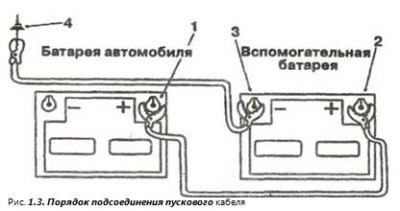
Check the reliability of the clamps and the integrity of the insulation of the starting cable and connect the starting cable (Fig. 1.3) in the following sequence:
Towing of the vehicle must be carried out on roads with hard surfaces in the following order.
Red indicators signal that you must stop immediately, fix the problem, or call a tow truck and urgently go to a service station.
 Battery charging current
The control indicator (red) lights up when the ignition is turned on. It goes out immediately after the engine starts. If the indicator does not go out and lights up periodically while driving, this indicates a malfunction in the charging current circuit of the generator, drive belt or voltage regulator. In this case, the storage battery (AB) does not charge.
If there is a defect in the drive belt, then movement is impossible due to battery discharge, engine overheating, and the vehicle must be evacuated.
Engine oil pressure
When the ignition is turned on, the control indicator (red) lights up and goes out after the engine starts. The indicator lights up while driving, with the message appearing on the CAD display at the same time "Stop! Oldruck Motor" ("Stop! Engine oil pressure"). This indicates a drop in oil pressure or a malfunction in the lubrication system. You must stop driving, turn off the engine and restore the oil level.
 Parking brake, brake system hydraulics
The indicator (red) lights up when the parking brake lever is raised (on) and briefly when the ignition is turned on. When the parking brake drive lever is moved down to the stop, the light goes out. The parking brake control indicator is located on the instrument panel in the right corner.
If the indicator lights up when the parking brake is released, stop driving immediately and check the brake fluid level in the reservoir. The free travel of the brake pedal increases sharply.
If it is impossible to fix the fault on the spot, it is allowed to drive to the service station taking into account the driving style. The indicator also lights up if there is a message from the automatic diagnostic system "Check brake linings" ("Check brake pads").
Tire Pressure Monitoring System (RDC)
The indicator is red, and the tire damage warning signal sounds at the same time. Stop the car immediately and smoothly, avoiding sudden actions on the steering and brakes.
 The red brake system indicator came on in combination with the yellow ABS and "DSC/xDrive". Additionally, a sound signal is heard.
Systems "ABS", "DSC" and "xDrive" are out of order. Torque is probably transmitted only to the rear wheels.
Driving is only possible if you are careful in choosing your driving style, especially when turning and overtaking. At the same time, you must strictly monitor the traffic situation.
If in the described combination of indicators the brake system indicator lights up yellow, this means that the electronic brake force distribution (EBV) system is still operational.
i Please fasten your seat belt
The indicator is red and lights up shortly after starting off and remains lit until the driver and front passenger fasten their seat belts. At the same time, a warning signal sounds. At the same time, information can be displayed on the automatic diagnostics system display in the form of a message - "Gurt anlelegen" ("Put on the belt").
These signals are also given when the belt is unfastened while driving. The indicator goes out after the belt is fastened.
Inflatable airbags
When the ignition is switched on, the control indicator (red) lights up and goes out. If the indicator does not light up or does not go out after starting the engine when the ignition is turned on, but periodically flashes or constantly lights up while driving, this indicates a malfunction in the inflatable airbag system (NPB). You must immediately contact the service station for verification.
The yellow indicators shown below indicate that you need to contact a service station.
Dynamic Brake Control (DBC)
The indicator lights up when you turn the ignition key and goes out after the engine starts. The DBC indicator lights up during sudden braking and signals that the system is involved in the braking process. When you press the brake pedal sharply, this system increases the braking effect even with little effort on the pedal.
Engine oil level
When the ignition is turned on, the control indicator (red) lights up and goes out after the engine starts. Lighting of the indicator (yellow) while driving
If the indicator lights up after the engine has stopped, you need to check the engine oil level and, if necessary, restore it.
Tire Damage Indicator
The indicator lights up when the pressure in one or more tires drops.
Torque may be transmitted only to the rear wheels. Flashing indicator indicates that the system is activated and is in the mode of regulating engine torque and brake pressure.
Dynamic stability control system (DSC/xDrive)
If the indicator lights up continuously and a sound signal is emitted, a fault has been detected in the DSC/xDrive system. However, the stabilizing effect of the DSC/xDrive system is absent.
When the indicator is on, you can continue driving to the service station, being careful and predicting the situation on the road.
Green and blue indicators (high beam) the colors signal that the information they convey must be taken into account.
Direction indicators
The indicator lights (arrows) flash when the turn signal is on. If one of the turn signal lights is not lit, the indicator light will flash more quickly. When the hazard warning lights are on, all the turn signals flash simultaneously. When the vehicle is used as a trailer tow vehicle, there is an additional indicator. If any of the turn signals on the vehicle and trailer are not working, this indicator will not light.
Fog lights
The indicator lights up only after the fog lights are turned on using the switch located on the left side of the front panel of the car body, to the left of the steering column.
High beam headlights
Control indicator (blue), lights up when the high beam headlights are on and flashes when the headlights are signaling. It is activated by the upper left lever switch on the steering column.
[The website served as the basis for the text: www.bmwman.ru]
If a malfunction occurs in one of the systems, its indicator does not go out after the engine is started or lights up again while the car is moving.
[1] Start the donor vehicle engine and bring it to a stable idle speed.
Check the reliability of the clamps and the integrity of the insulation of the starting cable and connect the starting cable (Fig. 1.3) in the following sequence:
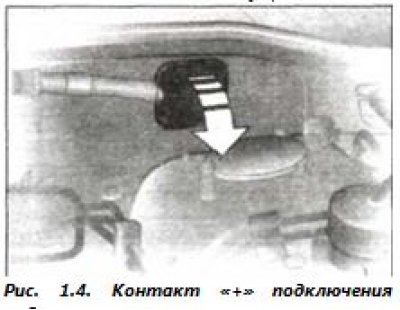
- clamp "+" cable to the discharged battery, terminal "+" (Fig. 1.4) is located under the hood;
- clamp "+" cable to auxiliary battery;
- clamp "-" cable to auxiliary battery;
- clamp the "-" cable to the "ground" of the car body, for this purpose use
Towing of the vehicle must be carried out on roads with hard surfaces in the following order.
- Turn the ignition key to position "1" to unlock the steering wheel and supply voltage to the hazard warning lights.
- Install an elastic towing rope made of synthetic material or a composite rope with an intermediate link made of similar material. The towing eyes of both vehicles must be located on the same side.
Red color indicators
Red indicators signal that you must stop immediately, fix the problem, or call a tow truck and urgently go to a service station.
Battery charging current
The control indicator (red) lights up when the ignition is turned on. It goes out immediately after the engine starts. If the indicator does not go out and lights up periodically while driving, this indicates a malfunction in the charging current circuit of the generator, drive belt or voltage regulator. In this case, the storage battery (AB) does not charge.
If there is a defect in the drive belt, then movement is impossible due to battery discharge, engine overheating, and the vehicle must be evacuated.
Engine oil pressure
When the ignition is turned on, the control indicator (red) lights up and goes out after the engine starts. The indicator lights up while driving, with the message appearing on the CAD display at the same time "Stop! Oldruck Motor" ("Stop! Engine oil pressure"). This indicates a drop in oil pressure or a malfunction in the lubrication system. You must stop driving, turn off the engine and restore the oil level.
Warning! If the malfunction is not eliminated by restoring the oil level, the indicator continues to light, driving is prohibited. Engine damage due to oil starvation is possible. The vehicle must be towed away.
Parking brake, brake system hydraulics
The indicator (red) lights up when the parking brake lever is raised (on) and briefly when the ignition is turned on. When the parking brake drive lever is moved down to the stop, the light goes out. The parking brake control indicator is located on the instrument panel in the right corner.
If the indicator lights up when the parking brake is released, stop driving immediately and check the brake fluid level in the reservoir. The free travel of the brake pedal increases sharply.
If it is impossible to fix the fault on the spot, it is allowed to drive to the service station taking into account the driving style. The indicator also lights up if there is a message from the automatic diagnostic system "Check brake linings" ("Check brake pads").
Tire Pressure Monitoring System (RDC)
The indicator is red, and the tire damage warning signal sounds at the same time. Stop the car immediately and smoothly, avoiding sudden actions on the steering and brakes.
Combination of indicators
The red brake system indicator came on in combination with the yellow ABS and "DSC/xDrive". Additionally, a sound signal is heard.
Systems "ABS", "DSC" and "xDrive" are out of order. Torque is probably transmitted only to the rear wheels.
Driving is only possible if you are careful in choosing your driving style, especially when turning and overtaking. At the same time, you must strictly monitor the traffic situation.
If in the described combination of indicators the brake system indicator lights up yellow, this means that the electronic brake force distribution (EBV) system is still operational.
i Please fasten your seat belt
The indicator is red and lights up shortly after starting off and remains lit until the driver and front passenger fasten their seat belts. At the same time, a warning signal sounds. At the same time, information can be displayed on the automatic diagnostics system display in the form of a message - "Gurt anlelegen" ("Put on the belt").
These signals are also given when the belt is unfastened while driving. The indicator goes out after the belt is fastened.
Inflatable airbags
When the ignition is switched on, the control indicator (red) lights up and goes out. If the indicator does not light up or does not go out after starting the engine when the ignition is turned on, but periodically flashes or constantly lights up while driving, this indicates a malfunction in the inflatable airbag system (NPB). You must immediately contact the service station for verification.
Yellow indicators
The yellow indicators shown below indicate that you need to contact a service station.
Dynamic Brake Control (DBC)
The indicator lights up when you turn the ignition key and goes out after the engine starts. The DBC indicator lights up during sudden braking and signals that the system is involved in the braking process. When you press the brake pedal sharply, this system increases the braking effect even with little effort on the pedal.
Engine oil level
When the ignition is turned on, the control indicator (red) lights up and goes out after the engine starts. Lighting of the indicator (yellow) while driving
- The modern appearance of the message on the SAD display "Olstand Motor prufen" ("Check the engine oil level") indicate that the oil level has dropped to a minimum or there is a malfunction in the lubrication system. Turn off the engine and restore the oil level. The level must be restored no later than after 50 km.
If the indicator lights up after the engine has stopped, you need to check the engine oil level and, if necessary, restore it.
Tire Damage Indicator
The indicator lights up when the pressure in one or more tires drops.
Torque may be transmitted only to the rear wheels. Flashing indicator indicates that the system is activated and is in the mode of regulating engine torque and brake pressure.
Dynamic stability control system (DSC/xDrive)
If the indicator lights up continuously and a sound signal is emitted, a fault has been detected in the DSC/xDrive system. However, the stabilizing effect of the DSC/xDrive system is absent.
When the indicator is on, you can continue driving to the service station, being careful and predicting the situation on the road.
Green and blue indicators
Green and blue indicators (high beam) the colors signal that the information they convey must be taken into account.
Direction indicators
The indicator lights (arrows) flash when the turn signal is on. If one of the turn signal lights is not lit, the indicator light will flash more quickly. When the hazard warning lights are on, all the turn signals flash simultaneously. When the vehicle is used as a trailer tow vehicle, there is an additional indicator. If any of the turn signals on the vehicle and trailer are not working, this indicator will not light.
Fog lights
The indicator lights up only after the fog lights are turned on using the switch located on the left side of the front panel of the car body, to the left of the steering column.
High beam headlights
Control indicator (blue), lights up when the high beam headlights are on and flashes when the headlights are signaling. It is activated by the upper left lever switch on the steering column.
[The website served as the basis for the text: www.bmwman.ru]
This article is available at russian, bulgarian, belarusian, ukrainian, serbian, croatian, romanian, polish, slovak, hungarian
Article verified: Zhuravleva Isolda
Share information:
Previous articles
БМВ E53: Manual
Next articles
Similar articles on other types of BMW cars:
Checking the control pressure regulator BMW 3 Series E21 (1975-1983)
Removal and installation the control unit BMW 3 Series E30 (1982-1994)
On-Board Control System (OBCS) Unit BMW 5 Series E12 (1972-1981)
Control dimensions and adjustment data. Cars produced since 1986 BMW 7 Series E32 (1986-1994)
Checking fluid levels, leak control BMW 7 Series E38 (1994-2001)
Control and signal lamps BMW X3 E83 (2003-2010)
Checking the control pressure regulator BMW 3 Series E21 (1975-1983)
Removal and installation the control unit BMW 3 Series E30 (1982-1994)
On-Board Control System (OBCS) Unit BMW 5 Series E12 (1972-1981)
Control dimensions and adjustment data. Cars produced since 1986 BMW 7 Series E32 (1986-1994)
Checking fluid levels, leak control BMW 7 Series E38 (1994-2001)
Control and signal lamps BMW X3 E83 (2003-2010)
Link in different formats to this page
Visitor comments
No comments yet
- General information
- Manual
- Maintenance
- M54 petrol engine
- Engine repair
- Lubrication system
- Cooling system
- Supply system
- Injection system
- Exhaust system
- Engine electrics
- M62 petrol engine
- Engine repair
- Lubrication system
- Cooling system
- Supply system
- Exhaust system
- Engine electrics
- N62 petrol engine
- Engine repair
- Cooling and lubrication system
- Power and exhaust system
- Engine electrics
- Diesel engine M57
- Engine repair
- Lubrication system
- Cooling system
- Power and exhaust system
- Engine electrics
- Turbocharging system
- Transmission
- Clutch
- Mechanical gearbox
- Automatic gearbox
- Transfer case and cardan
- Chassis
- Brake system
- Steering
- Front suspension
- Rear suspension
- Wheels and tires
- Body
- Exterior
- Interior
- Doors and windows
- Repair and maintenance
- Heater and air conditioner
- Electrical equipment
- Equipment and devices
- Levers and switches
- Electrical circuits