
Table of contents: Main fuses ↓ Relay ↓
- Home
- BMW 3 Series
- E46
- Electrical equipment
- Equipment and devices
- Fuses and Relays — Basic Information
Fuses and Relays — Basic Information (BMW 3 Series E46)
Main fuses
1. Most of the fuses are located behind the glove box on the passenger side, with the remaining fuses installed in a box located in the left corner of the engine compartment.
2. To remove the main fuse box cover, open the glove box, turn the two white tabs and lower the cover. To access the engine compartment fuses, remove the cover mounting screws.
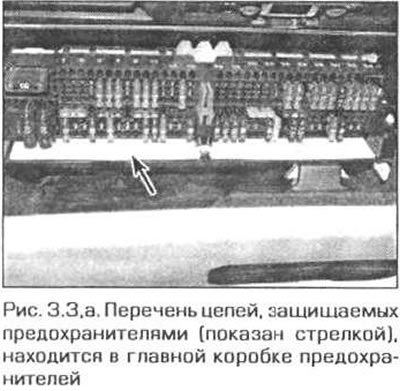
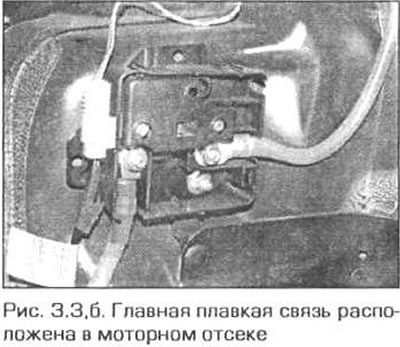
3. The list of circuits protected by each fuse is indicated on the cover of the main fuse box (fig. 3.3, a). In addition, the box has a device for extracting fuses. Keep in mind that fuses installed vertically protect a circuit, and fuses located horizontally are spares. At the top of the box are the "fuse links". The main fuse link is located next to the battery in the engine compartment (fig. 3.3, b).
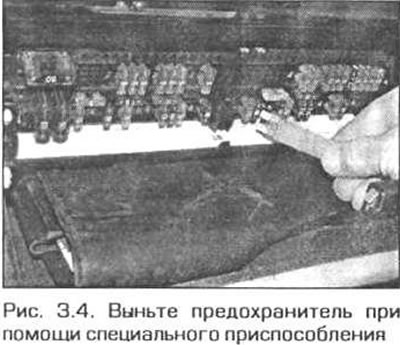
4. To remove a fuse, first disconnect the corresponding circuit (or ignition), and then pull the fuse out of its clips using the tool attached to the fuse box cover (Fig. 3.4). Inspect the wiring inside the fuse - if it is broken or melted, then the fuse is blown.
5. When replacing a fuse, always install a fuse of the same rating. Never use a fuse with different parameters or replace it with a "bug". Do not replace a fuse more than once until you find out the cause of the malfunction. The fuse parameters are indicated on its head. Fuses are colored differently for easy identification.
6. If a new fuse blows immediately, you need to find the cause of the malfunction before replacing it. The most common cause is a short circuit to ground due to faulty insulation. If the fuse protects several circuits, try to identify the malfunction by disconnecting its circuits one by one (if possible), until it blows again. Your car should always have a set of spare fuses of all ratings, which should be attached inside the fuse box on the bottom.
Relay
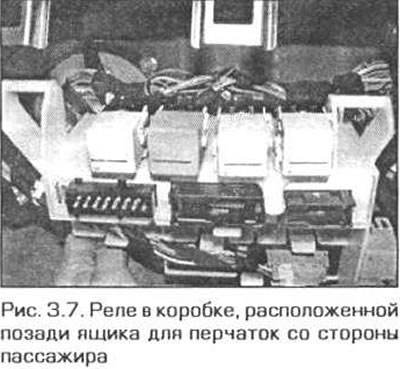
7. Most of the relays are installed in the fuse box located behind the glove box on the passenger side (Fig. 3.7), and the remaining relays are located in the engine compartment box installed in its left corner.
8. If you suspect that the relay itself is the cause of a fault in a circuit or system controlled by a relay, turn the system on. If you hear a click when you energize the relay, the fault is due to system components or wiring. If the relay does not operate, it is not receiving main or control voltage, or the relay itself is faulty. To check, replace the relay with a working one. Keep in mind that some relays may look the same and have the same purpose, while others may be similar but perform different functions.
9. Before replacing the relay, turn off the ignition. Pull the relay out of the socket and insert a new one there.
This article is available at russian, bulgarian, belarusian, ukrainian, serbian, croatian, romanian, polish, slovak, hungarian
Article verified: Ilyinsky Matvey
Share information:
Previous articles
БМВ E46: Equipment and devices
Next articles
Similar articles on other types of BMW cars:
Composition of fuses and relays BMW 5 Series E34 (1988-1996)
General information about fuses BMW 5 Series E28 (1981-1988)
Basic information and safety precautions BMW 7 Series E38 (1994-2001)
Engine Overhaul. General Information BMW 7 Series E32 (1986-1994)
Fuses — general description BMW X3 E83 (2003-2010)
Fuses — general information and markings BMW X5 E53 (1999-2006)
Composition of fuses and relays BMW 5 Series E34 (1988-1996)
General information about fuses BMW 5 Series E28 (1981-1988)
Basic information and safety precautions BMW 7 Series E38 (1994-2001)
Engine Overhaul. General Information BMW 7 Series E32 (1986-1994)
Fuses — general description BMW X3 E83 (2003-2010)
Fuses — general information and markings BMW X5 E53 (1999-2006)
Link in different formats to this page
Visitor comments
No comments yet
- General information
- Manual
- Maintenance
- Power unit
- Engine repair
- Cooling system
- Power system (gasoline)
- Injection system (gasoline)
- Fuel system (diesel)
- Exhaust system
- Ignition system
- Charge and launch systems
- Transmission
- Car gearbox
- Clutch and drive shafts
- Chassis
- Brake system
- Suspension front and rear
- Steering
- Body
- Body care and repair
- Exterior
- Interior
- Electrical equipment
- Troubleshooting
- Lighting and signaling
- Equipment and devices
- Heater and air conditioner
- Electrical circuits
- General information
- Manual
- Repair on the road
- Weekly checks
- Maintenance
- Troubleshooting
- Power unit
- 4 cylinder engines
- 6 cylinder engines
- Engine overhaul
- Cooling and heating
- Fuel and exhaust system
- Starting and charging system
- Ignition system
- Transmission
- Clutch
- Mechanical gearbox
- Automatic gearbox
- Cardan and drive shafts
- Chassis
- Brake system
- Wheel suspension
- Steering
- Body
- Exterior
- Interior
- Electrical equipment
- Equipment and devices
- Electrical circuits
- General information
- Maintenance
- Power unit
- Engine repair
- Cooling system
- Ignition system
- Supply system
- Fuel injection system
- Exhaust system
- Transmission
- Clutch
- Car gearbox
- Front and rear axle
- Chassis
- Steering
- Brake system
- Body
- Exterior
- Interior
- Electrical equipment
- Heating system
- Equipment and devices
- Power devices
- Electrical circuits
- Power unit
- M10/M20 engine
- M40 engine
- Ignition system
- Lubrication system
- Cooling system
- Supply system
- Fuel injection
- Exhaust system
- Transmission
- Clutch
- Manual gearbox
- Front axle
- Rear axle
- Chassis
- Steering
- Brake system
- Body
- Exterior
- Interior
- Electrical equipment
- Heating system
- Equipment and devices
- Electrical circuits
- General information
- Specifications
- Operation and maintenance
- 4-cylinder engine
- Engine repair
- Cooling and lubrication system
- Supply system
- Ignition system
- 6-cylinder engine
- Engine repair
- Cooling and lubrication system
- Supply system
- Fuel injection system
- Ignition system
- Transmission
- Clutch
- 4-speed manual gearbox
- 5-speed manual gearbox
- Automatic gearbox
- Cardan and rear axle
- Chassis
- Steering
- Front suspension
- Rear suspension
- Brake system
- Electrical equipment
- Equipment and devices
- Electrical circuits