
Table of contents: Air supply to the rear seat* ↓ Important instructions for operating…↓
- Home
- BMW 5 Series
- E34
- General information
- Manual
- Heating, ventilation and air conditioning
Heating, ventilation and air conditioning (BMW 5 Series E34)
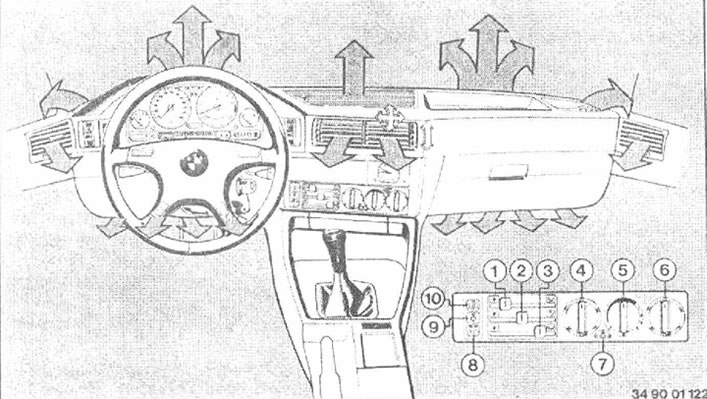
1 - Lever-regulator for air supply to the upper part of the cabin
2 - Lever for regulating air supply to the middle part of the cabin
3 - Lever for regulating air supply to the lower part of the passenger compartment
4 - Rotary temperature controller (left side)
5 - Fan air supply intensity control switch
6 - Rotary temperature control (right side)
7 - Switches for setting the fast glass heating mode
8 - Automatic air pollution control (AUC)* or air recirculation mode activation key
9 - Air conditioning switch
10 - Rear window heating switch
1-3 - Air supply control levers
With the help of these levers you can smoothly regulate the supply of warm water (or chilled) air.
The extreme left position of the lever means that the air supply is blocked. The extreme right position of the lever means that the air supply is completely open.
1 - Lever-regulator for air supply to the upper part of the cabin
Heated (cooled) air is supplied through air supply nozzles to the windshield and front side windows.
2 - Lever for regulating air supply to the middle part of the cabin
Outside air enters through guides and metering grilles in the middle of the instrument panel and in the front doors, as well as through a metering grille on the upper side of the instrument panel.
3 - Lever for regulating air supply to the lower part of the passenger compartment
Air enters through nozzles in the lower part of the cabin, at the front and at the rear.
Air supply to the rear seat*
The rear of the passenger compartment is ventilated or cooled via the guides and metering grilles in the rear of the centre console, regardless of the position of the control levers.
Only outside or cooled air can be supplied through these grilles (with the air conditioner on).
4, 6 - Left and right side temperature rotary controls
The temperature in the cabin is set by turning the regulator to the desired position (the temperature in degrees Celsius is indicated on the circular scale). The set temperature is quickly reached after the engine is started and usually remains unchanged, as it is maintained by an electronic regulator.
To avoid large temperature fluctuations and excessive load on the heating system, turn the regulators gradually.
In both extreme positions of the driver's side regulator, automatic temperature control does not occur on either the left or right side, and the heater operates at full power. If the electronic temperature sensor fails, also set the regulator to one of the extreme positions.
5 - Fan control switch
Position "0": the fan is off, there is no forced air supply.
Turn the switch to the right (with output from a fixed position) includes low fan speed and minimum air flow.
Further turning to the right increases air flow slightly without significantly increasing fan speed.
When you turn the regulator from position "2" to position "4", the fan speed increases.
For the electronic temperature sensor-regulator to operate correctly, the fan regulator must be set to at least the vertical position ("12 o'clock").
Your car has a quick-defrost feature for the windows.
7 - Switches for setting the fast heating mode of the windows
The maximum effect is achieved only when the engine is warm. Glass fogs up due to the difference in temperature outside and inside the car or due to high humidity in the cabin (condensation forms). In this case, the only way to quickly eliminate condensation is by intensively supplying hot air directly to the glass.
 Automatic Outdoor Air Control (AUC)* key
This system automatically monitors the level of harmful substances in the outside air and, if necessary, blocks its flow into the car interior.
Pressing the key in sequence allows you to select three operating modes:
- Indicator lights do not light: outside air is entering
- The left indicator lamp is on: the system sensors have registered an increased concentration of harmful substances in the outside air. If pollution increases, the air supply to the passenger compartment is automatically blocked and only the air in the passenger compartment will be used (recirculation mode).
- The right indicator lamp is on: air recirculation mode is on.
 Air recirculation mode activation key
This mode is recommended when the outside air is heavily polluted - the air in the cabin circulates and prevents outside air from entering.
The indicator lamp in the pressed button signals that the recirculation mode is switched on.
Although the air conditioner automatically switches to the dehumidification mode to improve air quality, it is not recommended to switch on the recirculation mode for a long time.
Note: If the windows start to fog up when the recirculation mode is on, turn off this mode (or AUC) and turn on the air conditioner by pressing button 9.
 Air conditioner on/off button
When you press the button, the air conditioner turns on, starting from a temperature of +1°C. The control lamp signals that the air conditioner is on.
The air is cooled and dried.
In some cases, when the air humidity is high, it is recommended to periodically turn on the air conditioner so that excess moisture condenses on the evaporator, and the air in the cabin is thus dried.
At maximum cooling capacity, the system automatically switches to air recirculation mode (with a small proportion of outside air).
 Rear window heating switch
The operation of the heater is described on page 30.
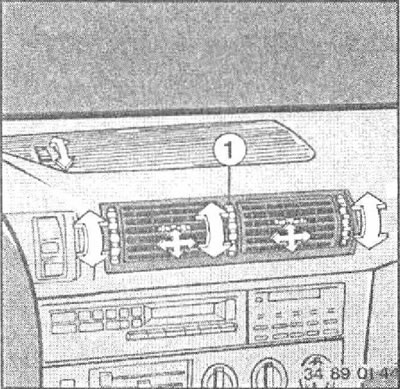
Temperature distribution in the passenger compartment for comfortable conditions: "warm feet - cool head". The air flow coming out through the grilles on the dashboard and in the front doors is adjusted by turning the knurled roller 1 (but not at maximum cooling capacity).
- Up: warmer.
- Down: colder.
Important instructions for operating the air conditioner
1. The condensate formed in the evaporator is discharged under the bottom of the car and, depending on the air humidity, can amount to up to 2 liters per hour.
2. The air conditioner should be turned on at least for a short time at least once a month (especially in the cold season), otherwise, there is a risk of the compressor shaft seals drying out and, as a result, the coolant evaporating.
3. In case of a malfunction - for example, if there is no cooling even after turning on the air conditioner at maximum power (the driver's side temperature control is set to the extreme left position) - turn off the air conditioner and contact BMW service.
This article is available at russian, bulgarian, belarusian, ukrainian, serbian, croatian, romanian, polish, slovak, hungarian
Article verified: Polikarpov Saveliy
Share information:
Previous articles
БМВ E34: Manual
Next articles
Similar articles on other types of BMW cars:
Heating and ventilation system elements — removal and installation BMW 3 Series E46 (1998-2006, petrol)
Heater, ventilation and air conditioning of the passenger compartment BMW 3 Series E46 (1998-2006)
Automatic ventilation, heating and air conditioning (HVAC) system BMW 7 Series E38 (1994-2001)
Heating/Air Conditioning Control Unit — Removal and Installation BMW 7 Series E32 (1986-1994)
Heating and air conditioning fan BMW X3 E83 (2003-2010)
Description of the heating and air conditioning design BMW X5 E53 (1999-2006)
Heating and ventilation system elements — removal and installation BMW 3 Series E46 (1998-2006, petrol)
Heater, ventilation and air conditioning of the passenger compartment BMW 3 Series E46 (1998-2006)
Automatic ventilation, heating and air conditioning (HVAC) system BMW 7 Series E38 (1994-2001)
Heating/Air Conditioning Control Unit — Removal and Installation BMW 7 Series E32 (1986-1994)
Heating and air conditioning fan BMW X3 E83 (2003-2010)
Description of the heating and air conditioning design BMW X5 E53 (1999-2006)
Link in different formats to this page
Visitor comments
No comments yet
- General information
- Governing bodies
- Manual
- Maintenance
- Power unit
- Engine repair
- Lubrication system
- Cooling system
- Ignition system
- Supply system
- Injection system (gasoline)
- Injection system (diesel)
- Exhaust system
- Transmission
- Clutch
- Car gearbox
- Front axle
- Rear axle
- Chassis
- Steering
- Brake system
- Wheels and tires
- Body
- Interior
- Exterior
- Heating system
- Electrical equipment
- Equipment and devices
- Power devices
- Windscreen wipers
- Electrical circuits
- General information
- Manual
- Maintenance
- Power unit
- Engine repair
- Ignition system
- Engine lubrication system
- Cooling system
- Fuel system (gasoline)
- Fuel system (diesel)
- Exhaust system
- Transmission
- Clutch
- Car gearbox
- Chassis
- Front and rear suspension
- Steering
- Brake system
- Body
- Exterior
- Interior
- Electrical equipment
- Heating system
- Equipment and devices
- Power devices
- Electrical circuits
- General information
- Manual
- Maintenance
- Power unit
- Engine in a car
- Engine overhaul
- Cooling system
- Supply system
- Ignition system
- Control system
- Transmission
- Clutch
- Manual gearbox
- Automatic gearbox
- Transmission line
- Chassis
- Steering
- Front suspension
- Rear suspension
- Brake system
- Body
- Body elements
- Car care and painting
- Electrical equipment
- Heater and air conditioner
- Equipment and devices
- Starter and generator
- Electrical circuits
- General information
- Operation and maintenance
- Specifications
- Power unit
- Engine repair
- Cooling and lubrication system
- Supply system
- Ecotronic power supply system
- Fuel injection system
- Ignition system
- Transmission
- Clutch
- Gearbox BMW 242/4
- Gearbox Getrag 262/8
- Gearbox Getrag 265/6
- Automatic gearbox
- Cardan gear
- Rear axle
- Chassis
- Steering
- Front suspension
- Rear suspension
- Brake system
- Electrical equipment
- Equipment and devices
- Electrical circuits