
- Home
- BMW 5 Series
- E39
- General information
- Maintenance
- Engine oil change
Engine oil change (BMW 5 Series E39)
To change the oil you will need the following tools:
The following parts are required for replacement:
Capacity of the lubrication system, including filter:
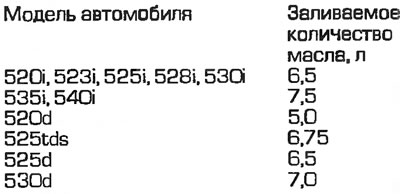
The difference in the amount of oil between the PLAH and MIN marks on the oil level indicator is approximately 1 l.
The oil must be changed in accordance with the specified maintenance intervals, respectively, for a gasoline engine every 15,000 km, and for a diesel engine - every 10,000 km. If the vehicle's mileage is insignificant, the oil should be changed once a year.
Under severe operating conditions such as short distance travel, frequent cold starts and heavy dust, the engine oil and oil filter should be replaced at shorter intervals.
Engine oil from the sump can also be sucked out using a probe (at the gas station) through the oil level indicator tube. Then, first of all, you need to buy new oil at the appropriate gas station.
Warm up the engine to operating temperature. To do this, warm up the engine in driving mode until the coolant temperature gauge shows the normal operating temperature. Finally, drive at least another five kilometers to ensure sufficient oil temperature.
Raise the car horizontally.
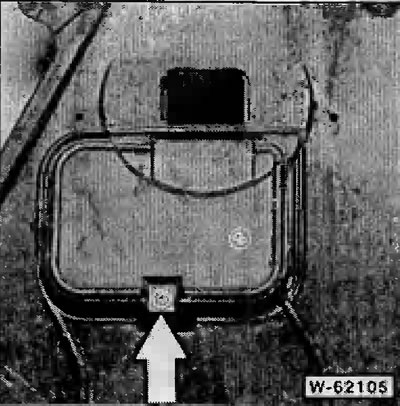
Using a Phillips-head screwdriver, open the cover under the oil pan, located in the lower casing of the engine compartment.
Place a container under the engine sump to drain the old oil.
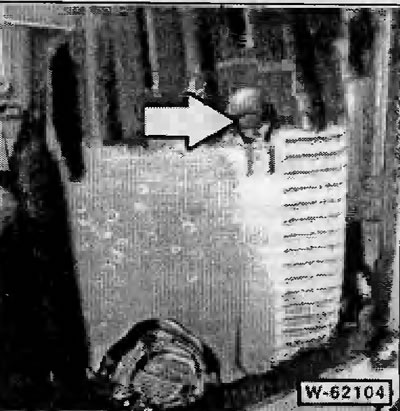
Remove the drain plug on the side of the oil pan and drain all the old oil.
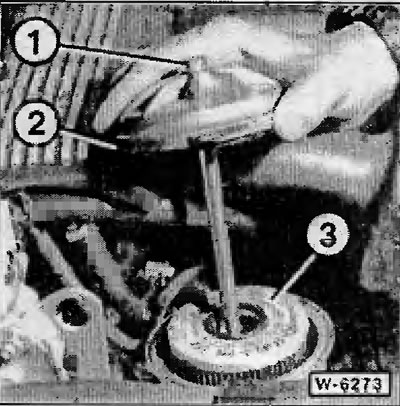
Unscrew the central bolt "1" in the middle of the oil filter cover.
Remove the oil filter cover "2" together with the central bolt "1".
Wait until the oil drains from the filter housing. Remove the replaceable filter element "3". Hold the dripping oil with a rag.
Insert a new filter element into the filter housing.
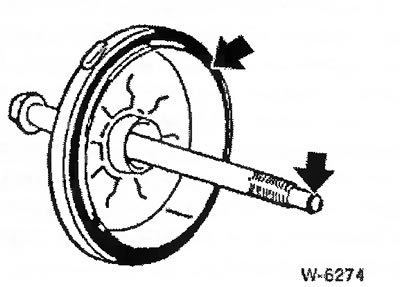
Clean the oil filter cover, replace and lubricate the rubber seals of the cover "arrow" and the central bolt with engine oil.
Place the filter cover together with the central bolt on top and press it down. The central bolt enters the corresponding threaded hole on the bottom of the filter housing.
Tighten the central bolt to 25 Nm.
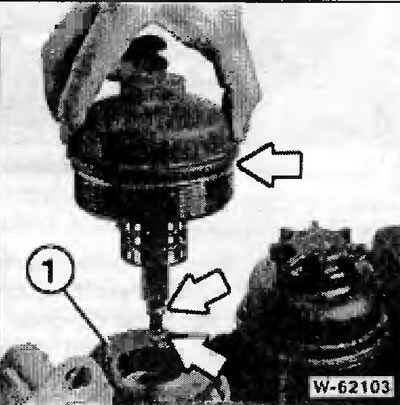
Unscrew the screw cap using a 36 mm socket head, for example, HAZET 2169-2. At BMW service stations, a special device is used to unscrew it, which is put on the outer diameter of the cap.
Wait until the oil drains from the filter housing. Remove the replaceable filter element "1". Hold the dripping oil with a rag.
Insert a new filter element into the filter housing.
Replace and lubricate with engine oil the rubber seals of the "arrow" cover and oil line
Place the filter cover together with the oil line on top and press it down. The oil line enters the corresponding threaded hole on the bottom of the filter housing.
Tighten the oil filter cover to 25 Nm.
Raise the car horizontally.
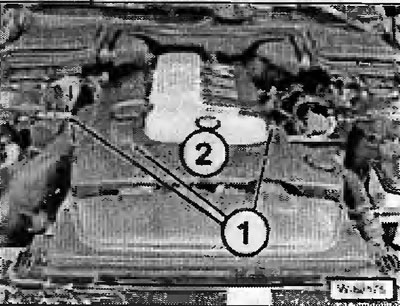
Remove bolts "1".
Remove the front cover of engine "2".
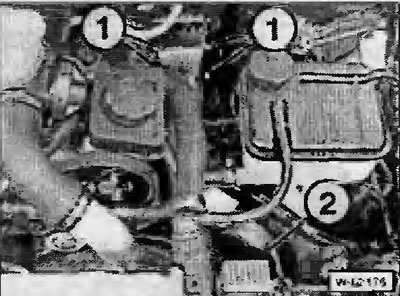
Remove bolts "1".
Press the air duct "2".
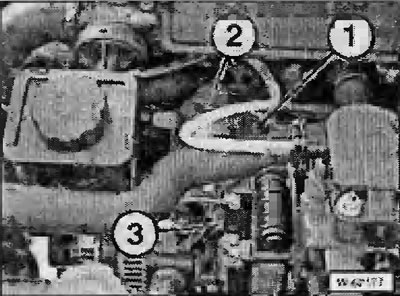
Remove bolt "1" from the return line.
Unscrew cover "2" using a 36 mm socket head, for example HAZET 2169-2.
Disconnect plug "3" from the hydraulic switch of the lubrication system.
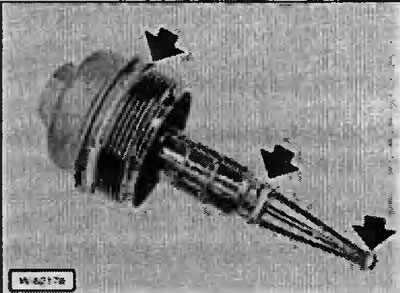
Replace and lubricate the rubber sealing rings "arrows" of the filter cover.
Subsequent installation is carried out in reverse order.
Screw the drain plug in with a new sealing ring, without applying much force. The tightening torque for the plug when using a 17 mm wrench is 30 Nm, and for a 19 mm wrench - 60 Nm.
Fill the cylinder head cover with the prescribed amount of new engine oil, see table on page 188.
Start the engine and let it idle until the oil pressure indicator goes out.
Stop the engine. After waiting for 10 minutes, check the oil level and top it up if necessary.
Close the cover in the lower casing of the engine compartment under the engine oil pan and use a Phillips-head screwdriver to turn the clamp securing it by ¼ turn.
After the test drive, check the tightness of the drain plug and the oil filter seal; if necessary, carefully tighten the seals.
Stop the engine after it has warmed up to operating temperature, check the oil level again after about 2 minutes and adjust the level if necessary.
If necessary, reset the service interval indicator to its original position. This requires an expensive electronic tool, which is sold through BMW repair shops. At the customer's request, repair shops can reset the indicator free of charge.
In order to have better control over the operating conditions of the engine, when changing the oil it is necessary to always use new oil of the same type and, if possible, the same brand. Therefore, it is advisable to attach a plate to the engine each time the oil is changed, indicating the brand and viscosity of the oil added.
Alternate use of different types of oils without interruption has an adverse effect on engine operation. Motor oils of the same type but different brands should not be mixed if possible. Motor oils of the same type and brand but different viscosity can be added at once during the off-season period if necessary.
- A pit or hydraulic jack with support trestles, a device for sucking out oil.
- Depending on the filter design, a key with a replaceable socket head of 13 or 36 mm for loosening the central bolt of the oil filter housing.
- A key with a 17 or 19 mm socket head for releasing the drain plug, as well as a container for oil (if the oil is not sucked out), which holds up to 8 liters.
The following parts are required for replacement:
- Only when oil is not sucked out: aluminum sealing ring for drain plug. The drain plug has a thread diameter of 12 mm, the aluminum sealing ring is A12x15.5 and is sometimes supplied with the oil filter.
- Oil filter element.
- Oil filter cover sealing ring and, depending on the filter design, one or two sealing rings for the central bolt. One of the two available oil filter designs can be installed on the same engine. This should be kept in mind when purchasing replacement parts.
- Depending on the engine 6.5-7.5 liters of engine oil. Use only approved bMW motor oils.
Capacity of the lubrication system, including filter:
The difference in the amount of oil between the PLAH and MIN marks on the oil level indicator is approximately 1 l.
The oil must be changed in accordance with the specified maintenance intervals, respectively, for a gasoline engine every 15,000 km, and for a diesel engine - every 10,000 km. If the vehicle's mileage is insignificant, the oil should be changed once a year.
Under severe operating conditions such as short distance travel, frequent cold starts and heavy dust, the engine oil and oil filter should be replaced at shorter intervals.
Engine oil from the sump can also be sucked out using a probe (at the gas station) through the oil level indicator tube. Then, first of all, you need to buy new oil at the appropriate gas station.
Attention: In any case, old oil must be handed over to special collection points for used oil. Oil sales points accept the appropriate amount of old oil free of charge, so when buying oil, you must keep the receipt and canister for subsequent delivery of old oil! In addition, district and city administrations inform about the location of the nearest collection point for used oil. In no case should old oil simply be drained or thrown away with household waste. This inevitably causes great harm to the environment by poisoning groundwater.
Draining engine oil
Warm up the engine to operating temperature. To do this, warm up the engine in driving mode until the coolant temperature gauge shows the normal operating temperature. Finally, drive at least another five kilometers to ensure sufficient oil temperature.
Raise the car horizontally.
Using a Phillips-head screwdriver, open the cover under the oil pan, located in the lower casing of the engine compartment.
Place a container under the engine sump to drain the old oil.
Remove the drain plug on the side of the oil pan and drain all the old oil.
Warning: Engine oil is hot! Fire hazard!
Caution: If large amounts of metal shavings and wear products are found in the engine oil, this indicates that, for example, the main or connecting rod bearings are seized. To avoid subsequent damage, after repairing the engine, it is necessary to thoroughly clean the oil passages and hoses. Additionally, if present, the oil cooler must be replaced.
Oil filter replacement, central bolt version
Unscrew the central bolt "1" in the middle of the oil filter cover.
Remove the oil filter cover "2" together with the central bolt "1".
Wait until the oil drains from the filter housing. Remove the replaceable filter element "3". Hold the dripping oil with a rag.
Insert a new filter element into the filter housing.
Caution: Follow the instructions on the filter housing.
Clean the oil filter cover, replace and lubricate the rubber seals of the cover "arrow" and the central bolt with engine oil.
Place the filter cover together with the central bolt on top and press it down. The central bolt enters the corresponding threaded hole on the bottom of the filter housing.
Tighten the central bolt to 25 Nm.
Oil filter replacement, screw cap version
Unscrew the screw cap using a 36 mm socket head, for example, HAZET 2169-2. At BMW service stations, a special device is used to unscrew it, which is put on the outer diameter of the cap.
Wait until the oil drains from the filter housing. Remove the replaceable filter element "1". Hold the dripping oil with a rag.
Insert a new filter element into the filter housing.
Caution: Follow the instructions on the filter housing.
Replace and lubricate with engine oil the rubber seals of the "arrow" cover and oil line
Place the filter cover together with the oil line on top and press it down. The oil line enters the corresponding threaded hole on the bottom of the filter housing.
Tighten the oil filter cover to 25 Nm.
Oil filter replacement, 530d engine
Raise the car horizontally.
Remove bolts "1".
Remove the front cover of engine "2".
Remove bolts "1".
Press the air duct "2".
Caution: Do not damage the filter cover, loosen and tighten only using a replaceable socket head. When the oil filter cover is loosened, the engine oil from the water-oil cooler flows back into the engine sump.
Remove bolt "1" from the return line.
Unscrew cover "2" using a 36 mm socket head, for example HAZET 2169-2.
Remove the replaceable filter element
Disconnect plug "3" from the hydraulic switch of the lubrication system.
Replace and lubricate the rubber sealing rings "arrows" of the filter cover.
Subsequent installation is carried out in reverse order.
Filling the engine with oil
Screw the drain plug in with a new sealing ring, without applying much force. The tightening torque for the plug when using a 17 mm wrench is 30 Nm, and for a 19 mm wrench - 60 Nm.
Fill the cylinder head cover with the prescribed amount of new engine oil, see table on page 188.
Start the engine and let it idle until the oil pressure indicator goes out.
Stop the engine. After waiting for 10 minutes, check the oil level and top it up if necessary.
Close the cover in the lower casing of the engine compartment under the engine oil pan and use a Phillips-head screwdriver to turn the clamp securing it by ¼ turn.
After the test drive, check the tightness of the drain plug and the oil filter seal; if necessary, carefully tighten the seals.
Stop the engine after it has warmed up to operating temperature, check the oil level again after about 2 minutes and adjust the level if necessary.
If necessary, reset the service interval indicator to its original position. This requires an expensive electronic tool, which is sold through BMW repair shops. At the customer's request, repair shops can reset the indicator free of charge.
In order to have better control over the operating conditions of the engine, when changing the oil it is necessary to always use new oil of the same type and, if possible, the same brand. Therefore, it is advisable to attach a plate to the engine each time the oil is changed, indicating the brand and viscosity of the oil added.
Alternate use of different types of oils without interruption has an adverse effect on engine operation. Motor oils of the same type but different brands should not be mixed if possible. Motor oils of the same type and brand but different viscosity can be added at once during the off-season period if necessary.
This article is available at russian, bulgarian, belarusian, ukrainian, serbian, croatian, romanian, polish, slovak, hungarian
Article verified: Ilyinsky Matvey
Share information:
Previous articles
БМВ E39: Maintenance
Next articles
Similar articles on other types of BMW cars:
Engine oil change BMW 3 Series E36 (1990-2000)
Starting the engine BMW 3 Series E21 (1975-1983)
Engine oil change BMW 7 Series E32 (1986-1994)
Starting the engine from an external power source BMW X3 E83 (2003-2010)
Features of winter operation of a diesel engine BMW X5 E53 (1999-2006)
Engine oil change BMW 3 Series E36 (1990-2000)
Starting the engine BMW 3 Series E21 (1975-1983)
Engine oil change BMW 7 Series E32 (1986-1994)
Starting the engine from an external power source BMW X3 E83 (2003-2010)
Features of winter operation of a diesel engine BMW X5 E53 (1999-2006)
Link in different formats to this page
Visitor comments
No comments yet
- General information
- Governing bodies
- Manual
- Maintenance
- Power unit
- Engine repair
- Lubrication system
- Cooling system
- Ignition system
- Supply system
- Injection system (gasoline)
- Injection system (diesel)
- Exhaust system
- Transmission
- Clutch
- Car gearbox
- Front axle
- Rear axle
- Chassis
- Steering
- Brake system
- Wheels and tires
- Body
- Interior
- Exterior
- Heating system
- Electrical equipment
- Equipment and devices
- Power devices
- Windscreen wipers
- Electrical circuits
- General information
- Manual
- Maintenance
- Power unit
- Engine repair
- Ignition system
- Engine lubrication system
- Cooling system
- Fuel system (gasoline)
- Fuel system (diesel)
- Exhaust system
- Transmission
- Clutch
- Car gearbox
- Chassis
- Front and rear suspension
- Steering
- Brake system
- Body
- Exterior
- Interior
- Electrical equipment
- Heating system
- Equipment and devices
- Power devices
- Electrical circuits
- General information
- Manual
- Maintenance
- Power unit
- Engine in a car
- Engine overhaul
- Cooling system
- Supply system
- Ignition system
- Control system
- Transmission
- Clutch
- Manual gearbox
- Automatic gearbox
- Transmission line
- Chassis
- Steering
- Front suspension
- Rear suspension
- Brake system
- Body
- Body elements
- Car care and painting
- Electrical equipment
- Heater and air conditioner
- Equipment and devices
- Starter and generator
- Electrical circuits
- General information
- Operation and maintenance
- Specifications
- Power unit
- Engine repair
- Cooling and lubrication system
- Supply system
- Ecotronic power supply system
- Fuel injection system
- Ignition system
- Transmission
- Clutch
- Gearbox BMW 242/4
- Gearbox Getrag 262/8
- Gearbox Getrag 265/6
- Automatic gearbox
- Cardan gear
- Rear axle
- Chassis
- Steering
- Front suspension
- Rear suspension
- Brake system
- Electrical equipment
- Equipment and devices
- Electrical circuits