
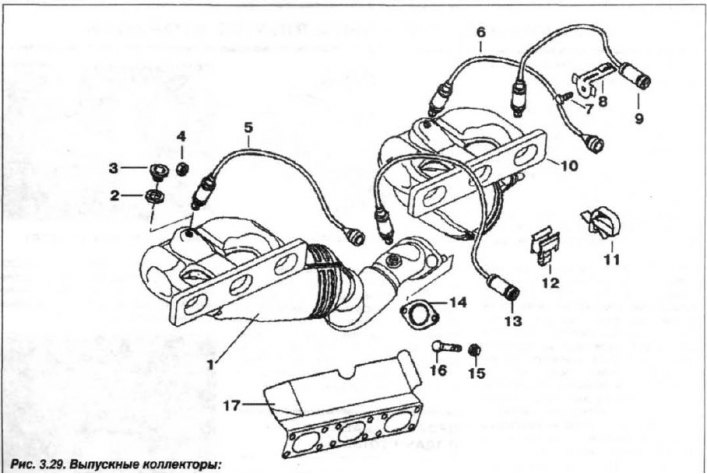
1, 10 - exhaust manifold with neutralizer; 2 - gasket; 3 - plug; 4 - nut (M10); 5, 6 - control sensor; 7 - bolt (M6x16); 8 - holder; 9; 13 - control sensor; 11 - terminal; 12 - bracket; 14 - sealing gasket; 15 - nut (M10); 16 - bolt (M10x40); 17 - heat shield with gasket
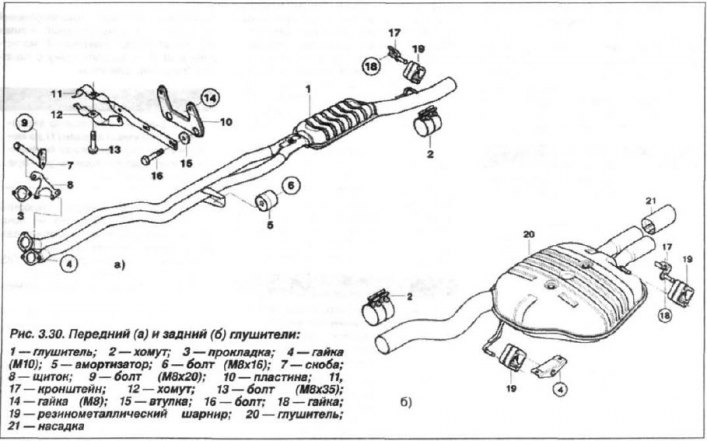
1 - muffler; 2 - clamp; 3 - gasket; 4 - nut (M10); 5 - shock absorber; 6 - bolt (M8x16); 7 - bracket; 8 - shield; 9 - bolt (M8x20); 10 - plate; 11, 17 - bracket; 12 - clamp; 13 - bolt (M8x35); 14 - nut (M8); 15 - bushing; 16 - bolt; 18 - nut; 19 - rubber-metal hinge; 20 - muffler; 21 - nozzle
Each exhaust manifold (from cylinders 1-2-3 and from cylinders 4-5-6) has a flange connection with the engine cylinder head on bolts. A sealing gasket with a heat shield is installed between the cylinder head and the exhaust manifold.
Oxygen sensors are installed in each of the exhaust manifolds, one before the neutralizer - for adjustment, the second after the neutralizer - for monitoring the oxygen concentration in the exhaust gas. When installing them, it is necessary to take into account the different length of the cable connection of the sensors. The regulation sensor has a cable length of 320 mm, the control - 990 mm.
The intake pipes of the intermediate muffler and additional mufflers are connected in the exhaust system by flange bolted connections. The fastening elements for the system are clamps, retaining rings and rubber shock absorbers, which must be replaced each time the system as a whole is disassembled or its individual elements are replaced.
The engine KSUD has a closed control system, since the final result of the combustion process is controlled by the amount of residual oxygen in the EG after the neutralizers. The connection between the ECU-KSUD and the oxygen content sensors in the EG allows for precise dosing of the amount of fuel supplied, which in turn reduces the emission of toxic compounds into the atmosphere.
The oxygen sensor is an electronic device that determines the oxygen content in the exhaust gas and transmits the result of its measurement in the form of a voltage drop to the ECU-KSUD. The obtained value allows you to regulate the composition of the fuel-air mixture at the stoichiometric level.
On the one hand, this is necessary due to the constant change in operating conditions (idling, acceleration, deceleration, constant speed driving), on the other hand, optimal combustion of residual fuel in the neutralizer requires the necessary combination of both oxygen and fuel.
The catalytic converters used are the so-called three-functional catalytic converter based on rare earth elements. Due to their presence, oxidation of carbon oxides (CO) and hydrocarbons (HC) occurs, and the concentration of nitrogen oxides (NOx) is reduced.