
- the cross-section of the supply pipe is narrowed or the fuel filter is clogged;
- the power supply circuit to the fuel pump is faulty due to high contact resistance due to corrosion in the wiring harness between the wiring harness and the fuel pump.
If the measured pressure is greater than 3.7 bar (kgf/cm), then turn off the engine and observe the change in pressure:
- if it has dropped to the nominal value (3.5±0.2 bar), it means that the cross-section of the return pipeline is narrowed or clogged:
- check the fuel lines for compression and kinks, replace any damaged lines.
If the measured pressure remains high, then there is a high probability that the pressure regulator is faulty and must be replaced along with the fuel filter.
Attention! If fuel starts to flow when the pressure regulator is removed, there is a high probability that the return line is clogged.
If starting the engine is difficult, let the engine idle and then turn it off. Take and record the instrument readings with the engine off. Take the readings again after about 20-30 minutes. If the measured pressure value has dropped by more than 0.5 bar, then:
- start the engine and let it idle to stabilize the pressure;
- turn off the engine and using the device "13.3.010" immediately pinch off the supply hose directly in front of the pressure gauge;
- measure and record the pressure gauge reading;
- after about 20-30 minutes, take the pressure gauge reading again with the engine turned off.
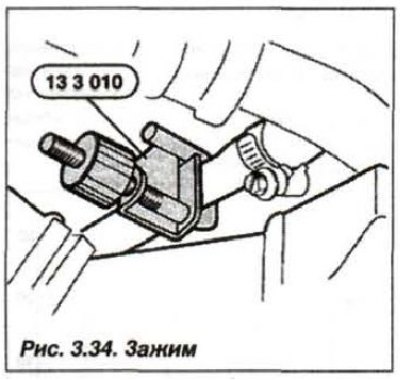
If the measured value has dropped by less than 0.5 bar, the following faults can be assumed:
- supply pipeline malfunction;
- faulty supply hose inside the fuel tank;
- the fuel pump check valve is faulty.
Replace the faulty elements. If after this the measured value has again dropped by more than 0.5 bar, the pressure regulator must be replaced.
Caution: All fuel hoses and clamps that were disconnected for inspection must be replaced.
After troubleshooting, read information from the fault storage device (memory) of the DME ECU-CSM system. Check the error messages and fix them. Erase information from the DME ECU-CSM fault management system memory.