
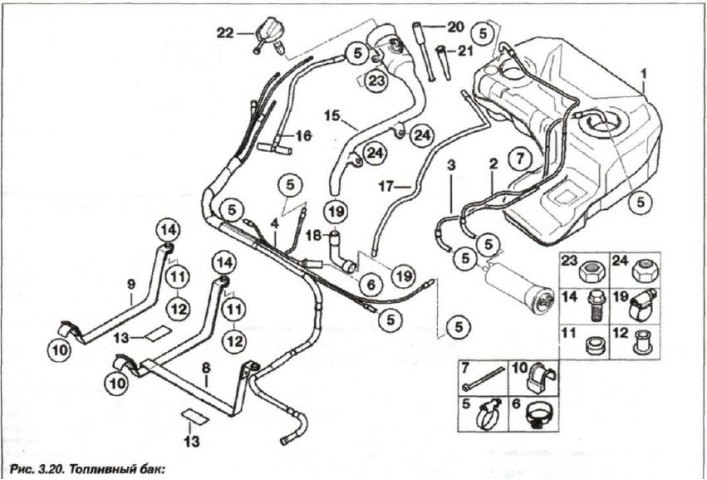
1 - fuel tank; 2 - supply pipeline; 3 - drain pipe; 4 - pipelines; 5, 19 - clamp; 6 - clamp; 7 - bandage; in, 9 - tape; 10 - damper; 11,12 - bushing; 13 - overlay; 14 - bolt; 15 - filling pipeline; 16 - pipeline; 17, 20 - drain pipe; 18 - hose; 21 - nozzle; 22 - filler cap; 23, 24 - nut; 25 - fuel filter with pressure regulator
The suction jet pump, located in the left reservoir of the fuel tank, pumps fuel to the right reservoir via the equalizing pipe. The suction jet pump is connected via the fuel return pipe from the injection system pressure regulator.
The pressure limiting valve sets the required pressure for the operation of the suction jet pump. The fuel return line has a drain relief valve. The valve closes when the pressure drops in the event of damage or disconnection of the fuel return line, which prevents fuel from leaking out of the tank in extreme situations (strong list, capsize).
A check valve installed in the filling line prevents fuel from splashing back into the filler neck pipe after the filling nozzle is disconnected. The fuel tank is equipped with a leak diagnostic module. The kingston on the lower side of the expansion tank protects the system from overfilling during refueling. Fuel rising in the filling vent line closes the kingston, thereby creating excess pressure in the tank, which prevents further filling.
The fuel tank is equipped with a ventilation system by collecting fuel vapors into the expansion tank and then into a container with activated carbon - an adsorber, which is blown with outside air. Fuel vapors entering the expansion tank are condensed and returned to the fuel tank. The remaining fuel vapors from the expansion tank are directed through a curtain valve to the adsorber, where activated carbon captures fuel vapors.
The purified air is discharged to the outside via a discharge pipe, a leak detection module in the tank and a dust filter. A curtain valve on the top of the expansion tank closes when the vehicle is overturned, preventing fuel from entering the activated carbon filter. The activated carbon filter is restored by blowing outside air through it.
The ECU-KSUD opens the fuel tank ventilation valve and the vacuum in the intake manifold is transferred to the purge line of the adsorber. Air is sucked in through the leak detection module in the tank and the dust filter. The activated carbon that has bound the fuel components is blown out. Air saturated with fuel vapors, through the fuel tank ventilation valve, enters the engine combustion chamber for subsequent combustion. The fuel tank ventilation valve and the fuel tank diagnostic module are controlled by the ECU-KSUD of the DME system.
The fuel tank capacity is 93 liters of unleaded gasoline with an octane rating of 95, the use of gasoline with an octane rating of 91 or 98 is allowed. The current fuel supply and fuel consumption are currently monitored by arrow-type indicators, the onset of reserve (critical) the fuel volume is indicated by an indicator on the instrument panel.