
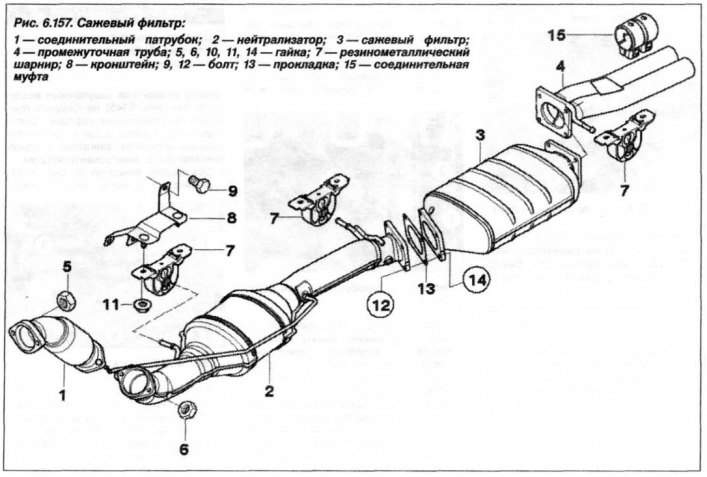
Attention! All work on the exhaust system must be carried out only on a cold engine and a cold exhaust system.
All elements of the exhaust system are connected to each other by bolted, flanged and coupling connections, so they can be replaced individually.
The exhaust system tightness test should be performed especially in cases where engine starting is difficult, the engine vibrates at idle, and increases its rotation speed in jerks. All this indicates a leak in the exhaust system.
The leak test must be carried out on a cold or slightly warm engine, in the following order.
Start the engine and cover the exhaust system with a rag.
Check for possible leaks (flange connections) by the noise of the exhaust gas outlet and by spraying suspicious areas with a special spray, by the formation of bubbles.
Attention! The main criterion for replacing exhaust system components is their leakage.
The catalytic converter does not withstand impact loads.
The exhaust system must be removed in the following order: Allow the exhaust system to cool completely, the temperature must be less than 35°C, apply the parking brake and block the wheels.
Support the exhaust system using the "31.2.220" tool (garage jack) and a wooden spacer. Remove the engine auxiliary unit protective cover.
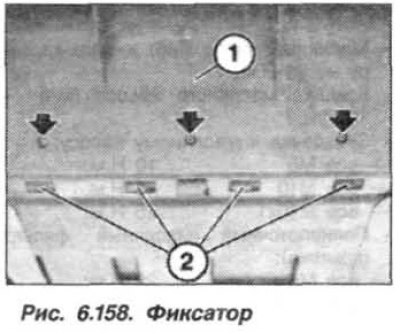
Unscrew the bolts (arrows), release the lower and side fasteners (2, Fig. 6.158) and remove the valve (1).
Loosen the inner rubber-metal hinges (5, see Fig. 6.19) both rear mufflers. Loosen the three front rubber-metal hinges (5) of the exhaust system.

Disconnect the exhaust gas oxygen sensor SS and remove the exhaust gas oxygen sensor from the exhaust system.
Wet the threaded connections of the exhaust system with a rust dissolving agent. The agent can be applied by spraying or with a brush. Wait for some time for the rust to dissolve.
While working with an assistant, loosen the threaded connection (nuts 2, 3) exhaust system between the TC, connecting pipe (1) and the neutralizer with pipelines (4) and remove the pipe (1).
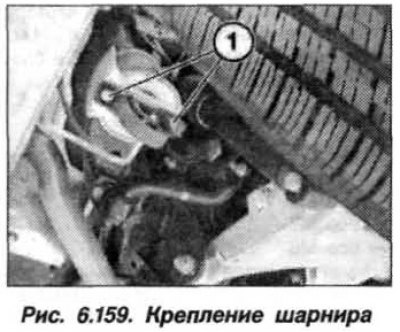
Loosen the bolts (1, Fig. 6.159) fastenings of rubber-metal hinges on the rear axle beam and the underbody, on the left and right sides. Disconnect the exhaust system from the holder and remove it from the car.
The installation of the exhaust system should be carried out in the reverse order, while it is necessary.
Replace all fastening elements, rings and gaskets with new ones. Replace the rubber-metal hinges on the rear muffler.
Check for deformation of the exhaust manifold flanges and corrosion of the pipelines. Straighten any deformed flanges.
Before installation, lubricate the threads of bolts and nuts with high-temperature copper-containing grease such as "Liqui Moly LM-50B-ASC" or "CRC" paste.
When installing the exhaust system on a vehicle, tighten the nuts by hand on the entire system. Adjust the exhaust system so that the gap between the body and the system is at least 25 mm at any point of its installation.
Secure the neutralizer with the inlet pipe to the connecting pipe using new self-locking nuts in two steps: the first with a torque of 30 N·m (3.0 kgf·m) and the second with a torque of 50 N·m (5.0 kgf·m). Tighten the bolts and nuts between the connecting pipe and the TC with a torque of 42 N·m (4.2 kgf·m).
Start the engine and check the tightness of the exhaust system by closing its outlet with a cloth gag.
If the stiffening plate was removed, replace its mounting bolts and tighten them to a torque of 56 N·m (5.6 kgf·m) and turn them further by an angle of 90°.