
- Home
- BMW X5
- E53
- M62 petrol engine
- Cooling system
- Engine cooling system — design description
Engine cooling system — design description (BMW X5 E53)
The design of the engine cooling system is shown in Fig. 4.15.
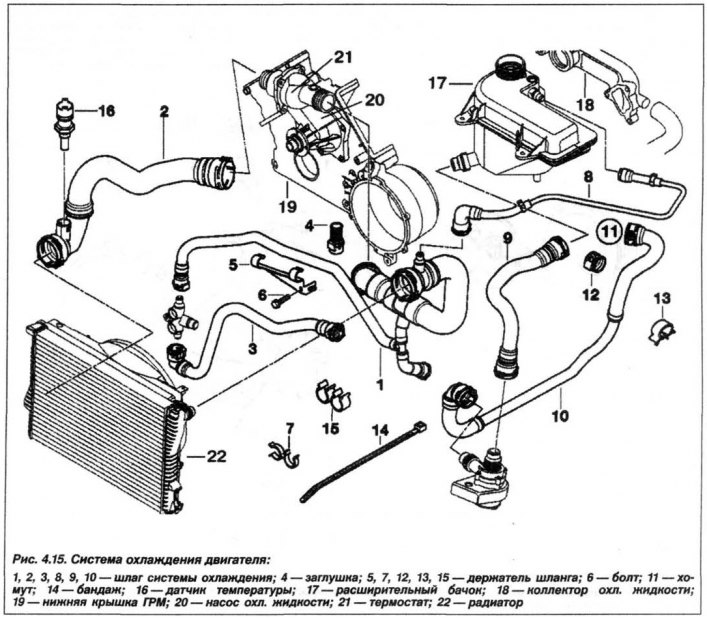
The engine cooling system is liquid, sealed with forced circulation. It includes: cooling jackets (cylinder heads and blocks); aluminum cross flow radiator; coolant pump; thermostat; coolant pump drive; expansion tank; nine-blade fan with viscous coupling; the heat exchanger of the heating and ventilation system, the coolant temperature sensor and the coolant itself.
The cylinder blocks are connected to each other by a single manifold – a coolant collector.
When installing an air conditioner on some car models, an additional electric fan is used.
The pressure for checking the tightness of the cooling system is 1.5 kgf/cm².
The radiator is designed to remove heat from the coolant and is made in the form of a horizontally located set of aluminum tubes with right and left tanks. The radiator is covered on the engine side by a casing in which a fan is mounted.
The coolant supply hoses are secured to the radiator pipes with screw clamps (or bandages). The brackets for fastening the radiator to the body are rubber-metal.
On cars with an automatic transmission (AT), an oil cooler is built into the radiator. The operating pressure in the AT system is 8.0 kgf/cm².
The thermostat is designed to turn on and off the large circle of engine coolant circulation, depending on its temperature state. The temperature of the beginning of the opening of the main valve is 88±5°C. The temperature of the full opening of the main valve is 105°C. The full stroke of the main valve plate is 8.0 mm.
The expansion tank serves to fill the system with coolant, to provide volume for storing the liquid that expands when the temperature rises, and to connect the cooling system with the environment when the pressure in the cooling system increases or decreases.
The opening pressure of the pressure reducing valve in the expansion tank cap is 1.8–2.1 kgf/cm².
The vacuum opening pressure of the vacuum valve in the expansion tank cap is 0.1 kgf/cm².
The coolant temperature sensor is a three-pin sensor, installed on the hose fitting on the left side of the engine cylinder head.
Signals from the sensor are sent to the engine's electronic control unit (ECU) to calculate the required fuel consumption for the desired power mode.
The engine cooling system is liquid, sealed with forced circulation. It includes: cooling jackets (cylinder heads and blocks); aluminum cross flow radiator; coolant pump; thermostat; coolant pump drive; expansion tank; nine-blade fan with viscous coupling; the heat exchanger of the heating and ventilation system, the coolant temperature sensor and the coolant itself.
The cylinder blocks are connected to each other by a single manifold – a coolant collector.
When installing an air conditioner on some car models, an additional electric fan is used.
The pressure for checking the tightness of the cooling system is 1.5 kgf/cm².
Radiator
The radiator is designed to remove heat from the coolant and is made in the form of a horizontally located set of aluminum tubes with right and left tanks. The radiator is covered on the engine side by a casing in which a fan is mounted.
The coolant supply hoses are secured to the radiator pipes with screw clamps (or bandages). The brackets for fastening the radiator to the body are rubber-metal.
On cars with an automatic transmission (AT), an oil cooler is built into the radiator. The operating pressure in the AT system is 8.0 kgf/cm².
Thermostat
The thermostat is designed to turn on and off the large circle of engine coolant circulation, depending on its temperature state. The temperature of the beginning of the opening of the main valve is 88±5°C. The temperature of the full opening of the main valve is 105°C. The full stroke of the main valve plate is 8.0 mm.
Expansion tank
The expansion tank serves to fill the system with coolant, to provide volume for storing the liquid that expands when the temperature rises, and to connect the cooling system with the environment when the pressure in the cooling system increases or decreases.
The opening pressure of the pressure reducing valve in the expansion tank cap is 1.8–2.1 kgf/cm².
The vacuum opening pressure of the vacuum valve in the expansion tank cap is 0.1 kgf/cm².
Coolant temperature sensor
The coolant temperature sensor is a three-pin sensor, installed on the hose fitting on the left side of the engine cylinder head.
Signals from the sensor are sent to the engine's electronic control unit (ECU) to calculate the required fuel consumption for the desired power mode.
This article is available at russian, bulgarian, belarusian, ukrainian, serbian, croatian, romanian, polish, slovak, hungarian
Article verified: Zhuravleva Isolda
Share information:
Previous articles
БМВ E53: Cooling system
Next articles
Similar articles on other types of BMW cars:
Diagnostics of engine cooling system faults BMW 3 Series E30 (1982-1994)
Diagnostics of engine cooling system faults BMW 3 Series E36 (1990-2000)
Engine cooling system parts BMW 5 Series E12 (1972-1981)
Diagnostics of engine cooling system faults BMW 5 Series E34 (1988-1996)
Diagnostics of engine cooling system faults BMW 7 Series E32 (1986-1994)
Replacing the sensors of the engine management system BMW 7 Series E38 (1994-2001)
Cooling system — equipment and tools BMW X3 E83 (2003-2010)
Diagnostics of engine cooling system faults BMW 3 Series E30 (1982-1994)
Diagnostics of engine cooling system faults BMW 3 Series E36 (1990-2000)
Engine cooling system parts BMW 5 Series E12 (1972-1981)
Diagnostics of engine cooling system faults BMW 5 Series E34 (1988-1996)
Diagnostics of engine cooling system faults BMW 7 Series E32 (1986-1994)
Replacing the sensors of the engine management system BMW 7 Series E38 (1994-2001)
Cooling system — equipment and tools BMW X3 E83 (2003-2010)
Link in different formats to this page
Visitor comments
No comments yet
- General information
- Manual
- Maintenance
- M54 petrol engine
- Engine repair
- Lubrication system
- Cooling system
- Supply system
- Injection system
- Exhaust system
- Engine electrics
- M62 petrol engine
- Engine repair
- Lubrication system
- Cooling system
- Supply system
- Exhaust system
- Engine electrics
- N62 petrol engine
- Engine repair
- Cooling and lubrication system
- Power and exhaust system
- Engine electrics
- Diesel engine M57
- Engine repair
- Lubrication system
- Cooling system
- Power and exhaust system
- Engine electrics
- Turbocharging system
- Transmission
- Clutch
- Mechanical gearbox
- Automatic gearbox
- Transfer case and cardan
- Chassis
- Brake system
- Steering
- Front suspension
- Rear suspension
- Wheels and tires
- Body
- Exterior
- Interior
- Doors and windows
- Repair and maintenance
- Heater and air conditioner
- Electrical equipment
- Equipment and devices
- Levers and switches
- Electrical circuits