
Table of contents: Table 5.4. Engine valve parameters ↓ Valve springs ↓
- Home
- BMW X5
- E53
- N62 petrol engine
- Engine repair
- Valves and springs — design description
Valves and springs — design description (BMW X5 E53)
The valves are made of special, corrosion-resistant steel, chrome-plated, and are hardened rods, which are located in the cylinder head in a V-shape, at an angle of 30.5°. They are driven by the cams of the intake and exhaust overhead camshafts through hydraulic tappets. The drive system is implemented according to the DOHC scheme. The parameters of the valves of the "N62B44" engine are given in Table 5.4.
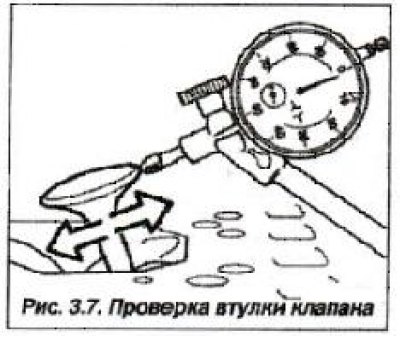
* The measurement technique is shown in Figure 3.7.
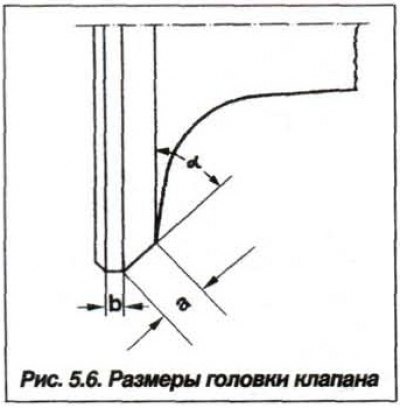
The minimum height of the cylindrical part of the valve plate "b" (Fig. 5.6) is 0.5 mm.
The condition of the valve mechanism is judged by one of the main indicators of engine wear - the compression value in its cylinders, which is checked by a special device - a compression gauge installed in the spark plug hole. The rules for its installation and taking measurements are given in the instructions for the device and described below.
The reading of the device for a new engine is 12–14 bar (kgf/cm²), with minimal valve lift. At maximum wear, this value should be no less than 10.0 bar. The difference in pressure between the cylinders of one engine should not exceed 1.5 bar. If the difference is more than 1.5 bar or the pressure is less than 10.0 bar, this indicates increased wear of the piston rings, cylinder mirrors, and valves. Such an engine is subject to removal and repair.
Valve springs are designed to ensure a tight fit of the valves on the seats. Each intake and exhaust valve has one spring of a complex cylindrical-conical shape. The springs are not identical for intake and exhaust valves, do not confuse them.
(The original text is available on the website «BMWman.ru»)
Table 5.4. Engine valve parameters
| Valve parameters | Valve | |
| inlet | outlet | |
| Engine model "N62B44" | ||
| Valve seat bearing surface | 34,5 | 28,6 |
| Head plate diameter, mm | 35,0 | 29,0 |
| - manufacturing tolerance | +0,10 | |
| Rod diameter, mm | ||
| - nominal | 6,00 | |
| - approval of use. vp. | from -0.025 to -0.040 | |
| – approval of the used version. | from -0.033 to -0.047 | |
| Clearance between valve guides and valve stems, mm* | 0,5 | |
* The measurement technique is shown in Figure 3.7.
The minimum height of the cylindrical part of the valve plate "b" (Fig. 5.6) is 0.5 mm.
The condition of the valve mechanism is judged by one of the main indicators of engine wear - the compression value in its cylinders, which is checked by a special device - a compression gauge installed in the spark plug hole. The rules for its installation and taking measurements are given in the instructions for the device and described below.
The reading of the device for a new engine is 12–14 bar (kgf/cm²), with minimal valve lift. At maximum wear, this value should be no less than 10.0 bar. The difference in pressure between the cylinders of one engine should not exceed 1.5 bar. If the difference is more than 1.5 bar or the pressure is less than 10.0 bar, this indicates increased wear of the piston rings, cylinder mirrors, and valves. Such an engine is subject to removal and repair.
Valve springs
Valve springs are designed to ensure a tight fit of the valves on the seats. Each intake and exhaust valve has one spring of a complex cylindrical-conical shape. The springs are not identical for intake and exhaust valves, do not confuse them.
(The original text is available on the website «BMWman.ru»)
This article is available at russian, bulgarian, belarusian, ukrainian, serbian, croatian, romanian, polish, slovak, hungarian
Article verified: Zhuravleva Isolda
Share information:
Previous articles
БМВ E53: Engine repair
Next articles
Similar articles on other types of BMW cars:
Checking electromagnetic shut-off valves BMW 3 Series E21 (1975-1983)
Removal and installation valves BMW 3 Series E30 (1982-1994)
Appearance and description of the 2BE carburetor BMW 5 Series E12 (1972-1981)
Engine power supply system — general information and design BMW 5 Series E34 (1988-1996)
General description of the car BMW 7 Series E32 (1986-1994)
Fuses — general description BMW X3 E83 (2003-2010)
Checking electromagnetic shut-off valves BMW 3 Series E21 (1975-1983)
Removal and installation valves BMW 3 Series E30 (1982-1994)
Appearance and description of the 2BE carburetor BMW 5 Series E12 (1972-1981)
Engine power supply system — general information and design BMW 5 Series E34 (1988-1996)
General description of the car BMW 7 Series E32 (1986-1994)
Fuses — general description BMW X3 E83 (2003-2010)
Link in different formats to this page
Visitor comments
No comments yet
- General information
- Manual
- Maintenance
- M54 petrol engine
- Engine repair
- Lubrication system
- Cooling system
- Supply system
- Injection system
- Exhaust system
- Engine electrics
- M62 petrol engine
- Engine repair
- Lubrication system
- Cooling system
- Supply system
- Exhaust system
- Engine electrics
- N62 petrol engine
- Engine repair
- Cooling and lubrication system
- Power and exhaust system
- Engine electrics
- Diesel engine M57
- Engine repair
- Lubrication system
- Cooling system
- Power and exhaust system
- Engine electrics
- Turbocharging system
- Transmission
- Clutch
- Mechanical gearbox
- Automatic gearbox
- Transfer case and cardan
- Chassis
- Brake system
- Steering
- Front suspension
- Rear suspension
- Wheels and tires
- Body
- Exterior
- Interior
- Doors and windows
- Repair and maintenance
- Heater and air conditioner
- Electrical equipment
- Equipment and devices
- Levers and switches
- Electrical circuits