
Caution! The troubleshooting process described below by measuring pressure is only possible on vehicles with a non-adjustable air conditioning compressor.
Troubleshooting by measuring pressure should be carried out in the following order. Prepare the MoDiC or DIS tester for operation, connect it to the car and display the temperature value in the evaporator on the display screen. Install a thermometer 5 cm from the ceiling of the passenger compartment, bring its indication outside the passenger compartment (mirror).
Warm up the engine and bring it to partial load mode (rotation speed 2000 min⁻¹). Close all doors and windows, set the recirculation mode. Select the air distribution mode to the footwell and the glass heating mode. Set the temperature and fan supply to maximum. Warm up the air in the cabin to 40°C and turn on the air conditioning compressor.
At an ambient temperature of +20 to +40°C, pressure within the following limits is considered normal:
- at the inlet 1.0–2.2 bar (kgf/cm²);
- at the outlet 12.0–22.0 bar (kgf/cm²).
Possible instrument readings, causes of malfunctions and methods for eliminating them are given below.
Normal inlet pressure (1.0–2.2 bar) and high outlet pressure (23.6–35.0 bar) indicate that the system is overfilled with R134a refrigerant, the condenser is dirty, or the additional fan is faulty (Fig. 17.4).
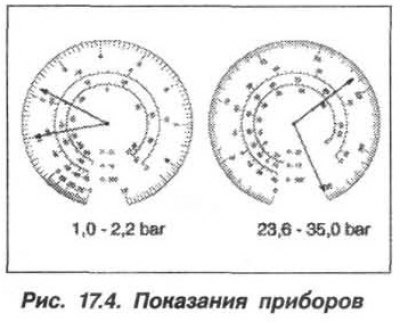
To eliminate it, you need to:
- drain, vacuum and refill the air conditioner;
- clean the outside of the condenser;
- check and, if necessary, replace the additional fan.
High inlet pressure (2.6–3.5 bar) and low outlet pressure (5.0–10.0 bar) indicate a compressor fault (Fig. 17.5). To eliminate the fault, the compressor must be replaced.
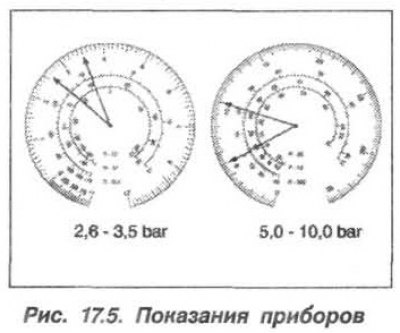
If the pressure at the inlet (2.0 bar) and outlet (2.0 bar) is equal, the compressor does not work (Fig. 17.6).
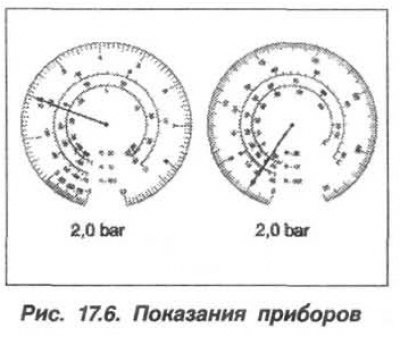
To eliminate the problem, you need to:
- if the compressor icing protection has been triggered, check the air conditioner evaporator sensor and the power supply to the compressor clutch;
- check the compressor clutch by turning it manually.
Normal inlet pressure (1.0–2.2 bar) and low outlet pressure (5.0–10.0 bar) indicate a low level of R134a refrigerant in the system (Fig. 17.7).
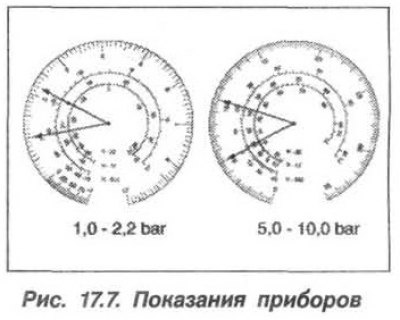
To eliminate the problem, you need to:
- pump out the R134a refrigerant from the system and measure its quantity (440±10 g.);
- if the amount pumped out is within the norm, check the safety valve for patency and, if necessary, replace it;
- after this, vacuum and refill the air conditioner with R134a refrigerant.
- drain, vacuum and refill the air conditioner;
- clean the outside of the condenser;
- check and, if necessary, replace the additional fan.
Low inlet (0.2–0.8 bar) and outlet (5.0–10.0 bar) pressure indicates evaporator icing or clogging on the high-pressure side behind the condenser or on the low-pressure side (Fig. 17.8).
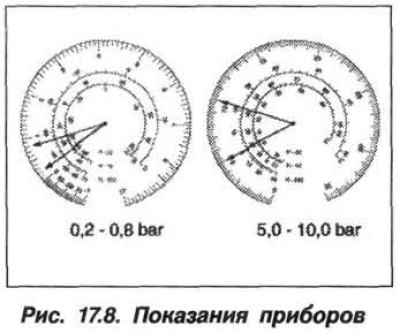
To eliminate it, you need to:
- check and, if necessary, replace the evaporator sensor;
- check the patency of the dryer, safety valve and pipelines in these areas, clean them or replace them if necessary.
Low inlet pressure (0.2–1.0 bar) and high outlet pressure (23.6–35.0 bar) indicate a blockage in the condenser section (Fig. 17.9).
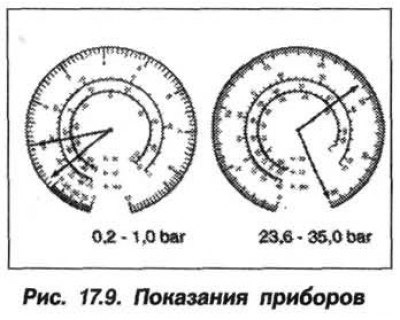
To eliminate this, it is necessary to check the patency of the capacitor and, if necessary, clean it or replace it.