- Home
- BMW X5
- E53
- General information
- Manual
- Electronic braking system
Electronic braking system (BMW X5 E53)
The electronic braking system consists of several systems, such as the anti-lock braking system (ABS), electronic brake force distribution (EBV) and dynamic brake control (DBC), which work together to ensure the safety of the vehicle during braking.
The ABS system prevents the wheels from locking when braking and increases the level of active safety of the car. Even with the brake pedal fully depressed, control over the car is not lost. The ABS system also has the functions of the electronic brake force distribution system (EBV).
The benefits of the ABS system are most evident when the brake pedal is pressed to the maximum. The pulsation of the brake pedal, combined with the noise that the hydraulic system produces during operation, indicate that the braking process is under the control of the ABS system.
The EBV system regulates the pressure in the rear wheel brake cylinders, ensuring stable braking.
The DBC system actively supports the driver when braking in a dangerous situation. When the brake pedal is pressed sharply, the system increases the braking effect even with a slight force on the pedal, which allows you to minimize the braking point. In this case, all braking systems are activated.
As long as braking is required, do not release the brake pedal. When you release the brake pedal, the DBC system is switched off.
The Dynamic Stability Control (DSC) system maintains the vehicle's stability at the required level even in critical situations and is ready to operate immediately after the engine is started. When starting off and accelerating, the system increases the vehicle's stability. It also detects critical situations such as understeer or oversteer. and by reducing engine power and braking the individual wheels, it provides the vehicle with directional stability within its physical limits.
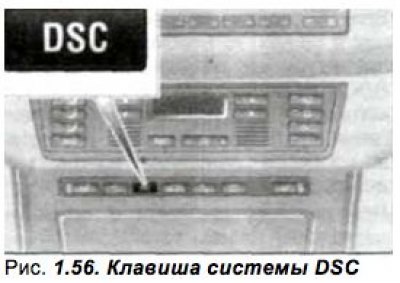
The DSC indicator lights up when the engine is started and goes out almost immediately. Flashing of the DSC indicator indicates that the system is activated and is in the mode of regulating engine torque and brake pressure. The system can be switched off by pressing the button (arrow, Fig. 1.56), in this case, the indicator lights up constantly and the DSC system does not have a stabilizing effect on the car, but the effect on the braking mechanism of the other systems remains.
Briefly disabling the DSC system may be advisable in the following non-standard situations:
The effect on the brake mechanism when the system is on may be an additional load for it. To prevent overheating of the brake discs, the braking effect may be temporarily automatically switched off. To maintain the vehicle's stability at the proper level, it is not recommended to switch off the DSC system. To switch on the DSC system, press the button again.
The xDrive all-wheel drive system is designed to redistribute torque between the front and rear axles and complements the work together with the DSC system. Their interaction leads to increased traction on the wheels and improved driving dynamics. The xDrive all-wheel drive system flexibly distributes traction forces between the axles, taking into account the road situation and the nature of the road surface.
The stability control system (SSS) monitors the vehicle's movement when descending, reducing speed and thus ensuring driving safety.
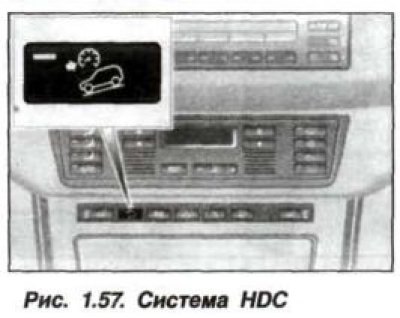
The HDC system is switched on by pressing the HDC button (Fig. 1.57), while the vehicle speed must be less than 35 km/h.
Without any intervention from the driver, the car slows down on the descent and starts moving at a speed of about 8 km/h. This speed can be adjusted in the range from 5 km/h to 25 km/h by pressing the brake or gas pedal. At speeds above 60 km/h, the HDC system automatically switches off and its indicator goes out. The system is reactivated by pressing a button, the system also switches off after the ignition is turned off.
On vehicles equipped with manual transmission, the HDC system should be engaged only in first gear and reverse gear. In higher gears, the engine braking effect is reduced. On vehicles equipped with automatic transmission, the HDC system can be engaged in any situation.
Anti-lock braking system (ABS system)
The ABS system prevents the wheels from locking when braking and increases the level of active safety of the car. Even with the brake pedal fully depressed, control over the car is not lost. The ABS system also has the functions of the electronic brake force distribution system (EBV).
The benefits of the ABS system are most evident when the brake pedal is pressed to the maximum. The pulsation of the brake pedal, combined with the noise that the hydraulic system produces during operation, indicate that the braking process is under the control of the ABS system.
Brake force distribution system
The EBV system regulates the pressure in the rear wheel brake cylinders, ensuring stable braking.
Dynamic Brake Control System
The DBC system actively supports the driver when braking in a dangerous situation. When the brake pedal is pressed sharply, the system increases the braking effect even with a slight force on the pedal, which allows you to minimize the braking point. In this case, all braking systems are activated.
As long as braking is required, do not release the brake pedal. When you release the brake pedal, the DBC system is switched off.
Dynamic Stability Control System
The Dynamic Stability Control (DSC) system maintains the vehicle's stability at the required level even in critical situations and is ready to operate immediately after the engine is started. When starting off and accelerating, the system increases the vehicle's stability. It also detects critical situations such as understeer or oversteer. and by reducing engine power and braking the individual wheels, it provides the vehicle with directional stability within its physical limits.
Please note: The DSC system does not cancel the laws of physics, so the responsibility for choosing the appropriate driving style rests entirely with the driver.
The DSC indicator lights up when the engine is started and goes out almost immediately. Flashing of the DSC indicator indicates that the system is activated and is in the mode of regulating engine torque and brake pressure. The system can be switched off by pressing the button (arrow, Fig. 1.56), in this case, the indicator lights up constantly and the DSC system does not have a stabilizing effect on the car, but the effect on the braking mechanism of the other systems remains.
Briefly disabling the DSC system may be advisable in the following non-standard situations:
- when driving out of deep snow or loose soil;
- when driving on a sandy road;
- when driving on a road with deep ruts;
- when driving through deep mud;
- when driving with snow chains.
The effect on the brake mechanism when the system is on may be an additional load for it. To prevent overheating of the brake discs, the braking effect may be temporarily automatically switched off. To maintain the vehicle's stability at the proper level, it is not recommended to switch off the DSC system. To switch on the DSC system, press the button again.
All-wheel drive system "xDrive"
The xDrive all-wheel drive system is designed to redistribute torque between the front and rear axles and complements the work together with the DSC system. Their interaction leads to increased traction on the wheels and improved driving dynamics. The xDrive all-wheel drive system flexibly distributes traction forces between the axles, taking into account the road situation and the nature of the road surface.
Hill Descent Control
The stability control system (SSS) monitors the vehicle's movement when descending, reducing speed and thus ensuring driving safety.
The HDC system is switched on by pressing the HDC button (Fig. 1.57), while the vehicle speed must be less than 35 km/h.
Without any intervention from the driver, the car slows down on the descent and starts moving at a speed of about 8 km/h. This speed can be adjusted in the range from 5 km/h to 25 km/h by pressing the brake or gas pedal. At speeds above 60 km/h, the HDC system automatically switches off and its indicator goes out. The system is reactivated by pressing a button, the system also switches off after the ignition is turned off.
On vehicles equipped with manual transmission, the HDC system should be engaged only in first gear and reverse gear. In higher gears, the engine braking effect is reduced. On vehicles equipped with automatic transmission, the HDC system can be engaged in any situation.
Attention! If the indicator goes out in HDC mode or does not light up when the button is pressed and the "ABS, DSC and xDrive systems" indicator lights up, the HDC system cannot be used temporarily due to possible brake overheating. You should contact a service station.
This article is available at russian, bulgarian, belarusian, ukrainian, serbian, croatian, romanian, polish, slovak, hungarian
Article verified: Zhuravleva Isolda
Share information:
Previous articles
БМВ E53: Manual
Next articles
Similar articles on other types of BMW cars:
Basic information about the electronic engine management system BMW 3 Series E46 (1998-2006)
Anti-lock Braking System (ABS) — Basic Information BMW 3 Series E46 (1998-2006, petrol)
Checking the air valve of the engine braking system BMW 5 Series E12 (1972-1981)
Digital electronic engine management system BMW 5 Series E34 (1988-1996)
Checking the cooling system for tightness BMW 7 Series E32 (1986-1994)
Removal and installation the electronic unit of the front passenger… BMW X3 E83 (2003-2010)
Basic information about the electronic engine management system BMW 3 Series E46 (1998-2006)
Anti-lock Braking System (ABS) — Basic Information BMW 3 Series E46 (1998-2006, petrol)
Checking the air valve of the engine braking system BMW 5 Series E12 (1972-1981)
Digital electronic engine management system BMW 5 Series E34 (1988-1996)
Checking the cooling system for tightness BMW 7 Series E32 (1986-1994)
Removal and installation the electronic unit of the front passenger… BMW X3 E83 (2003-2010)
Link in different formats to this page
Visitor comments
No comments yet
- General information
- Manual
- Maintenance
- M54 petrol engine
- Engine repair
- Lubrication system
- Cooling system
- Supply system
- Injection system
- Exhaust system
- Engine electrics
- M62 petrol engine
- Engine repair
- Lubrication system
- Cooling system
- Supply system
- Exhaust system
- Engine electrics
- N62 petrol engine
- Engine repair
- Cooling and lubrication system
- Power and exhaust system
- Engine electrics
- Diesel engine M57
- Engine repair
- Lubrication system
- Cooling system
- Power and exhaust system
- Engine electrics
- Turbocharging system
- Transmission
- Clutch
- Mechanical gearbox
- Automatic gearbox
- Transfer case and cardan
- Chassis
- Brake system
- Steering
- Front suspension
- Rear suspension
- Wheels and tires
- Body
- Exterior
- Interior
- Doors and windows
- Repair and maintenance
- Heater and air conditioner
- Electrical equipment
- Equipment and devices
- Levers and switches
- Electrical circuits