
- Home
- BMW X5
- E53
- General information
- Manual
- Air Conditioning Controls
Air Conditioning Controls (BMW X5 E53)
Switches and keys are used to regulate and control the air conditioner (Fig. 1.70). First, the air supply program is set using switches (6, 7, 8), and then the air conditioner is turned on (10).
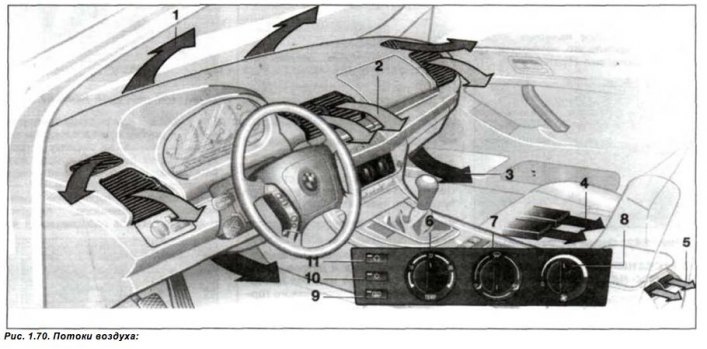
1 - air flows to the windshield and side windows; 2 - air flow into the chest area; 3 - air flow to the feet; 4 - air flow to the rear of the cabin; 5 - air flow to the chest area in the rear of the cabin; 6 - temperature controller; 7 - direction of air flow; 8 - air supply volume regulator; 9 - rear window heating button; 10 - air conditioner on/off button; 11 - recirculation mode key
 The digits on the switch (6) serve as a guide for setting the air temperature in the cabin. A comfortable temperature is considered to be 22°C.
After the start of movement, the system brings the temperature up to the set value (both in summer and winter) and then maintains it at a given level.
 The switch (7) directs the air entering the passenger compartment to the glass
  , in the chest area
  and into the foot space
 .
.
All intermediate positions are also possible. When the regulator is in the position , air is partially supplied to the glass, preventing it from fogging up.
 The switch (8) can be used to regulate the volume of air supplied, the regulation is carried out smoothly. The greater the volume of incoming air (air intake), the more efficient the heating and ventilation work. In the "0" position the fan and air conditioner are turned off and the air supply is completely stopped.
 The rear window heating is switched on by pressing the button (9), the indicator lights up. The rear window heating switches off automatically.
 The air conditioner is switched on by pressing the key (10), and the indicator lights up. The air is cooled (or heated up) depending on the set temperature and the outside air temperature and the thermal state of the engine.
Under certain weather conditions, the windshield may fog up for a while after starting the engine. Fogging can be reduced by turning on the air conditioner.
 Under certain circumstances (unpleasant smell from the street, dust raised by the wind) by pressing the button (11) you can temporarily block the supply of outside air to the car's interior. In this version, the air in the cabin circulates in a closed circle. The recirculation mode can also be set by the button located on the multifunctional steering wheel.
To ensure draft-free ventilation, you can adjust the air supply to the chest area as needed in the following order, see Fig. 1.71.
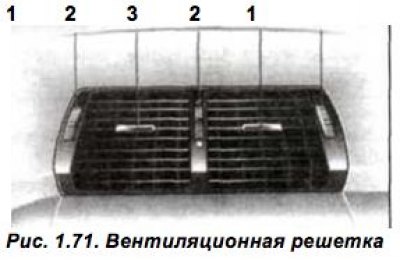
The wheels (1) can be used to smoothly open and close the air ducts. The levers (2) can be used to change the direction of the air flow. The wheel (3) can be used to regulate the temperature of the incoming air; by shifting towards the blue sector, colder air is supplied, and by shifting towards the red sector, warmer air is supplied.
The air conditioning system has a built-in microfilter that cleans incoming and circulating air from dust and pollen. The filter is replaced as part of scheduled maintenance. A noticeable decrease in maximum air supply indicates the need for early filter replacement.
To quickly defrost and defog the glass in the passenger compartment, set the control switches to the following positions:
1 - air flows to the windshield and side windows; 2 - air flow into the chest area; 3 - air flow to the feet; 4 - air flow to the rear of the cabin; 5 - air flow to the chest area in the rear of the cabin; 6 - temperature controller; 7 - direction of air flow; 8 - air supply volume regulator; 9 - rear window heating button; 10 - air conditioner on/off button; 11 - recirculation mode key
Temperature control
The digits on the switch (6) serve as a guide for setting the air temperature in the cabin. A comfortable temperature is considered to be 22°C.
After the start of movement, the system brings the temperature up to the set value (both in summer and winter) and then maintains it at a given level.
Air flow distribution
The switch (7) directs the air entering the passenger compartment to the glass , in the chest area and into the foot space.
All intermediate positions are also possible. When the regulator is in the position
, air is partially supplied to the glass, preventing it from fogging up.
Air supply
The switch (8) can be used to regulate the volume of air supplied, the regulation is carried out smoothly. The greater the volume of incoming air (air intake), the more efficient the heating and ventilation work. In the "0" position the fan and air conditioner are turned off and the air supply is completely stopped.
Rear window heating
The rear window heating is switched on by pressing the button (9), the indicator lights up. The rear window heating switches off automatically.
Turning on the air conditioner
The air conditioner is switched on by pressing the key (10), and the indicator lights up. The air is cooled (or heated up) depending on the set temperature and the outside air temperature and the thermal state of the engine.
Under certain weather conditions, the windshield may fog up for a while after starting the engine. Fogging can be reduced by turning on the air conditioner.
Attention! When the air conditioner is running, condensation forms, which drains under the car and this is a normal phenomenon.
Recirculation mode
Under certain circumstances (unpleasant smell from the street, dust raised by the wind) by pressing the button (11) you can temporarily block the supply of outside air to the car's interior. In this version, the air in the cabin circulates in a closed circle. The recirculation mode can also be set by the button located on the multifunctional steering wheel.
Attention! If the windows fog up in the recirculation mode, you must turn off this mode and increase the air supply.
Draft-free ventilation
To ensure draft-free ventilation, you can adjust the air supply to the chest area as needed in the following order, see Fig. 1.71.
The wheels (1) can be used to smoothly open and close the air ducts. The levers (2) can be used to change the direction of the air flow. The wheel (3) can be used to regulate the temperature of the incoming air; by shifting towards the blue sector, colder air is supplied, and by shifting towards the red sector, warmer air is supplied.
Microfilter
The air conditioning system has a built-in microfilter that cleans incoming and circulating air from dust and pollen. The filter is replaced as part of scheduled maintenance. A noticeable decrease in maximum air supply indicates the need for early filter replacement.
Defrosting and defogging of glass
To quickly defrost and defog the glass in the passenger compartment, set the control switches to the following positions:
- set the temperature in the cabin, for example 22°C;
- set the air flow distribution regulator to the position
 ;
; - set the maximum air supply, regulator to the end, to the right;
- block the ventilation grilles in the rear of the cabin;
- to defrost the rear window, turn on its heating.
This article is available at russian, bulgarian, belarusian, ukrainian, serbian, croatian, romanian, polish, slovak, hungarian
Article verified: Zhuravleva Isolda
Share information:
Previous articles
БМВ E53: Manual
Next articles
Similar articles on other types of BMW cars:
Controls and instrumentation BMW 3 Series E21 (1975-1983)
Tensioning the V-belt of the air conditioning compressor BMW 3 Series E30 (1982-1994)
Controls and instrumentation BMW 5 Series E12 (1972-1981)
Main controls in the cabin BMW 5 Series E34 (1988-1996)
Heating/Air Conditioning Control Unit — Removal and Installation BMW 7 Series E32 (1986-1994)
Controls and operating techniques BMW 7 Series E38 (1994-2001)
Controls BMW X3 E83 (2003-2010)
Controls and instrumentation BMW 3 Series E21 (1975-1983)
Tensioning the V-belt of the air conditioning compressor BMW 3 Series E30 (1982-1994)
Controls and instrumentation BMW 5 Series E12 (1972-1981)
Main controls in the cabin BMW 5 Series E34 (1988-1996)
Heating/Air Conditioning Control Unit — Removal and Installation BMW 7 Series E32 (1986-1994)
Controls and operating techniques BMW 7 Series E38 (1994-2001)
Controls BMW X3 E83 (2003-2010)
Link in different formats to this page
Visitor comments
No comments yet
- General information
- Manual
- Maintenance
- M54 petrol engine
- Engine repair
- Lubrication system
- Cooling system
- Supply system
- Injection system
- Exhaust system
- Engine electrics
- M62 petrol engine
- Engine repair
- Lubrication system
- Cooling system
- Supply system
- Exhaust system
- Engine electrics
- N62 petrol engine
- Engine repair
- Cooling and lubrication system
- Power and exhaust system
- Engine electrics
- Diesel engine M57
- Engine repair
- Lubrication system
- Cooling system
- Power and exhaust system
- Engine electrics
- Turbocharging system
- Transmission
- Clutch
- Mechanical gearbox
- Automatic gearbox
- Transfer case and cardan
- Chassis
- Brake system
- Steering
- Front suspension
- Rear suspension
- Wheels and tires
- Body
- Exterior
- Interior
- Doors and windows
- Repair and maintenance
- Heater and air conditioner
- Electrical equipment
- Equipment and devices
- Levers and switches
- Electrical circuits