
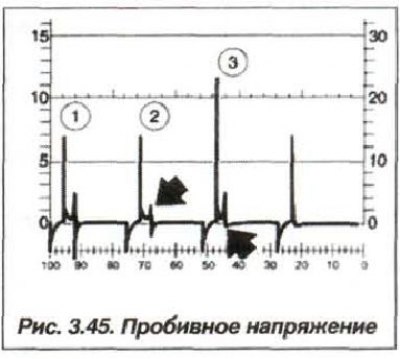
- 1 - the beginning of the attenuation process with normal upper and lower oscillation amplitudes;
- 2 - a strong reduction in the amplitude of oscillations at the beginning of the attenuation process (top arrow), the ignition coil is faulty;
- 3 - the lower amplitude of the beginning of the oscillation damping process is absent (bottom arrow), the coil is faulty.
Note: Increased amplitude (3) of oscillations of the maximum value of breakdown voltage is not always observed.
Analysis of the voltage curve on the spark plug electrodes at idle speed:
- the ignition coil is working properly (fig. 3.46,a).
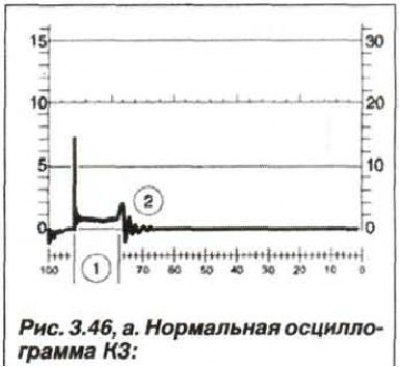
1 - normal duration of spark discharge; 2 - normal damping of oscillations after applying spark discharge voltage to the spark plug electrodes
- the ignition coil is faulty (fig. 3.46.6).
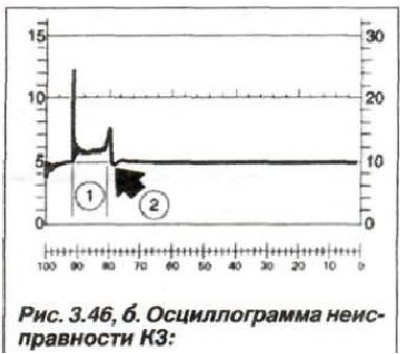
1 - reduced spark discharge duration; 2 - weak attenuation (arrow) of oscillations after applying spark discharge voltage
- the ignition coil is faulty (fig. 3.46,c).
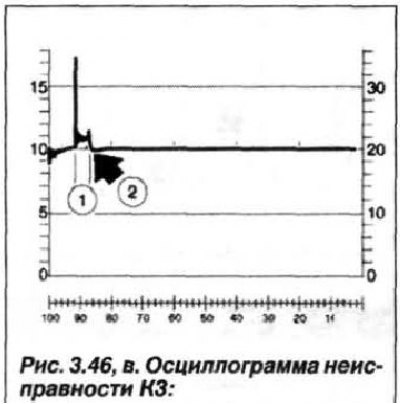
1 - greatly reduced spark discharge duration; 2 - there is no damping (arrow) of oscillations after applying spark discharge voltage
- the ignition coil is faulty (fig. 3.46. g). There are no voltage fluctuations on the spark plug electrodes.
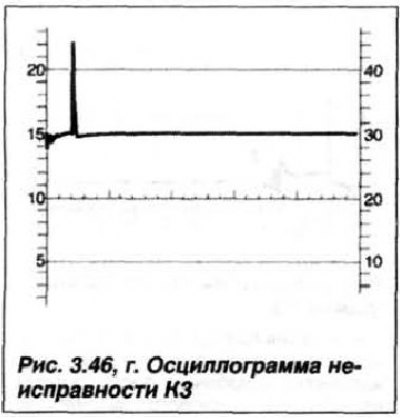
Analysis of the spark plug electrode voltage curve for crankshaft speed at partial loads (1500 min⁻¹):
- the ignition coil is working properly (fig. 3.47,a).
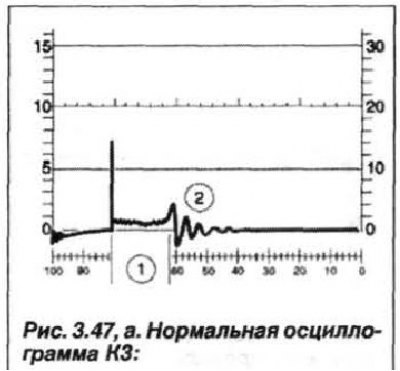
1 - normal duration of spark discharge; 2 - normal damping of oscillations after applying spark discharge voltage to the spark plug electrodes
- the ignition coil is faulty (fig. 3.47.6).
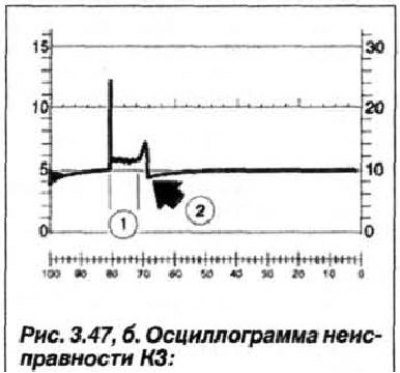
1 - reduced spark discharge duration; 2 - weak attenuation (arrow) of oscillations after applying spark discharge voltage
- the ignition coil is faulty (fig. 3.47,c).
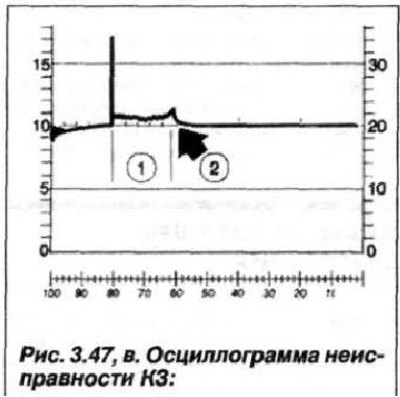
1 - normal duration of spark discharge; 2 - there is no damping (arrow) of oscillations after applying spark discharge voltage
(The text is based on materials from the website: «BMWMAN.ru»)