
Caution! Protect the generator from contamination.
To prevent the engine from starting during the test, disconnect the camshaft position sensor CV joint.
After disconnecting the pressure pipeline, be sure to plug the openings of the high-pressure fuel pump and the hydraulic accumulator with special plug caps.
The device "13.5.455" can be used no more than three times.
The HPS test must be carried out in the following order. Prepare the devices "12.7.420", "13.5.450", "13.5.455", "13.5.456", "13.5.457" and "61.4.390" and remove the intake manifold. Disconnect the camshaft position sensor SS.
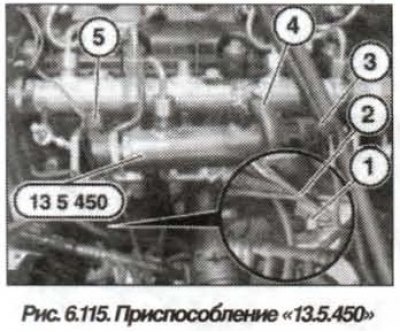
Unscrew the union nut (1, Fig. 6.115) and remove the pressure pipeline between the high-pressure fuel pump and the pressure accumulator, install the "13.5.450" device on the high-pressure fuel pump outlet. Disconnect the SS of the valve (3) for regulating the pressure in the Rail line. Install the "13.5.456" and "13.5.457" devices between the "13.5.450" device and the engine wiring harness. Connect the return pipeline (4). Tighten the union nut on the high-pressure fuel pump to a torque of 23.0 N·m (2.3 kgf·m).
The further process of checking the high pressure fuel pump is described in the section "Troubleshooting the Common Rail system at low pressure - Engine does not start". Using a version earlier than "V42" is not allowed. It is necessary to reprogram according to the "DIS-tester" Manual.
Assemble the engine, install the pressure pipe and tighten the union nuts on the hydraulic accumulator and the high-pressure fuel pump to a torque of 23 N·m (2.3 kgf·m). Start the engine and read the readings. The minimum pressure created by the high-pressure fuel pump at the starter speed must be more than 250 bar (250 kgf/cm²). Remove the fixtures and assemble the engine. Check the fuel supply system for leaks.