



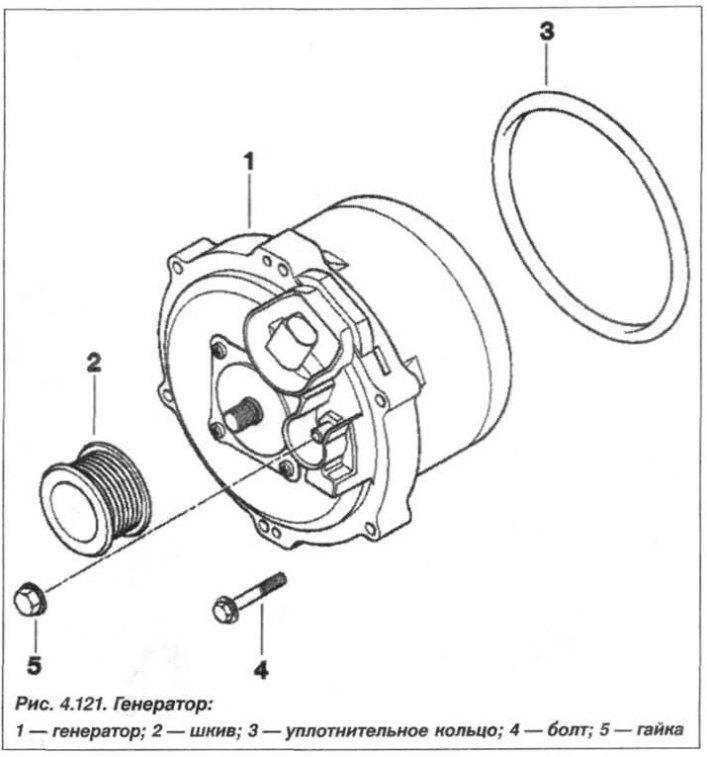
Cooling of the generator is provided by supplying liquid to it from the engine cooling system.
To drive the auxiliary units of the engine, a multi-groove crankshaft hub pulley with seven grooves arranged in parallel, one after the other, is used. The diameter of the alternator belt pulley is 49 mm. To drive the alternator, a belt of the "7Kx1635" type is used, which simultaneously drives the coolant pump and the power steering pump. For simplicity of presentation, this belt will be further referred to as the alternator drive belt.
Warning! Perform alternator replacement work only on a cold engine. There is a risk of steam burns.
The generator must be replaced in the following order.
Read information from the memory device (MD) of faults of the electronic control unit ECU-KSUD. Switch off the ignition, disconnect the "–" terminal from the battery and insulate it.
Remove the alternator drive belt, fan housing, drain the coolant and dispose of it.
Unscrew the nut (1, Fig. 4.122) and disconnect the "+" wire (2) of the battery from the generator, insulate the wire.
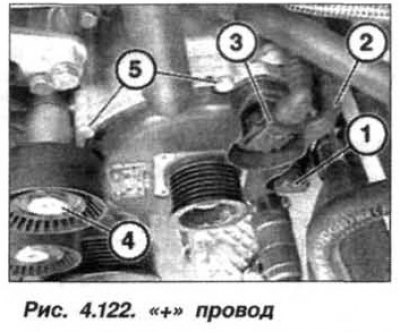
Disconnect the SS (3) from the generator. Unscrew the bolt (4) and remove the tensioner guide roller. Unscrew the generator mounting bolts (5, M6x35).
Prepare a clean rag to collect the remaining coolant. Move the generator forward, collect the remaining coolant and send it for disposal.
The generator should be installed in the reverse order, and the sealing ring must be replaced (3, see Fig. 4.121) generator housing. If necessary, replace the generator belt pulley, fill with coolant and bleed the cooling system, check it for leaks.
Tighten the nut (M6) securing the "+" battery wire to the generator to a torque of 7.0 N·m (0.7 kgf·m). When replacing the generator pulley, tighten its mounting nut to a torque of 70 N·m (7.0 kgf·m).