



Interference caused by, for example, power lines, vehicles with weak interference suppression or not equipped with an interference suppression system at all, as well as buildings or natural obstacles, can cause uncontrollable noise interference during everyday vehicle operation, despite complete suppression in your own vehicle.
Atmospheric phenomena, such as fog, rain or snow, can also interfere with radio reception.
With the increase solar radiation intensity the quality of reception on long, medium and short waves deteriorates. The best reception in this range of waves is achieved at night, since at this time the working waves are reflected in the ionosphere most strongly.
Long-range reception is possible in the LW, MW and HF wave ranges, since the waves propagate not only as terrestrial radio waves along the earth's surface, but also as spatial radio waves reflected from the ionosphere.
For physical reasons, the quality of reproduction in medium wave range not as good as in the ultra-short wave (VHF) range. However, the medium wave range, due to its good long-range reception, especially at night, is used by a large number of transmitters, although interference due to their high concentration cannot be avoided.
Unlike the VHF range, the sound in the MB range is more muffled.
Range of action long-wave radio transmitters exceeds the range of medium-wave radios.
The shortwave range is the longest. The largest number of transmitters and the best sound, with known limitations due to physical reasons, you will find in the 49 meter range.
In the VHF (FM) range, compared to other ranges, the best sound. However, only a small number of stations can be received here, since the range of the transmitters is due to rectilinear propagation of waves is only 80 km. As you move away from it, noise interference occurs and eventually the transmitter will not be heard at all or will be displaced by a more powerful one, in whose range you will find yourself. If natural interference of this kind appears, you should choose another station.
On VHF, it becomes necessary to switch more frequently from one radio station to another.
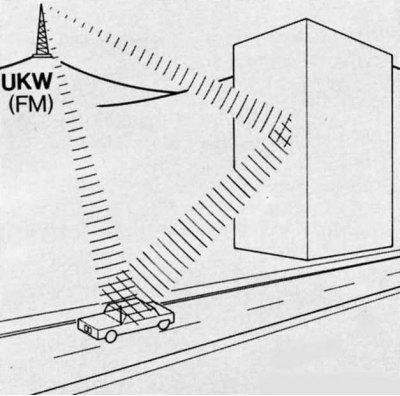
Stereophonic reception is only possible on VHF. Interference that occurs with distance from the transmitter may appear earlier than with monophonic radio reception. In this case, we recommend switching to mono reception or choosing another transmitter with stereophonic transmission.
Hissing, crackling, and sound bursts occur if, as a result of buildings - the car radio receives the same signal from the transmitter two or more times within a fraction of a second. This explains the rapid change in volume.
Long hissing appears mostly after you have left the station's coverage area or in the case of a clearly defined shadow zone. The noise can only be eliminated by tuning to a stronger transmitter.
Sound disappears - especially in the MB (AM) range - occurs as a result of the superposition of ground and spatial waves at the reception location and is often accompanied by distortion of reception.
Vibrating hiss occurs when direct communication from the transmitter to the receiver is obscured due to the presence of large buildings or natural obstacles.
When moving along the alley, the so-called "fence sound effect" occurs.