
- Home
- BMW X5
- E53
- Diesel engine M57
- Power and exhaust system
- Troubleshooting the COMMON-RAIL system at low pressure
Troubleshooting the COMMON-RAIL system at low pressure (BMW X5 E53)
Troubleshooting the system "Common-Rail" at low pressure, when the engine does not start, carry out according to the table below.
First, you need to make sure that the starter turns the engine crankshaft normally and that the battery is fully charged.
The removal of the engine must be preceded by checking the compression value, as one of the main operations determining the degree of engine wear and the need for its repair by removing the engine from the car.
Measuring the compression value allows you to identify the degree of wear of the valves, pistons, cylinder mirror, valve guide bushings, and everything that is associated with the gas distribution mechanism. To perform the test, special devices are required "11.2.236" (adapter) and "11.0.222" (compression meter), with a pressure measurement limit of up to 30 kgf/cm².
The main indicator of compression meter measurements is the pressure value and its difference in values for individual cylinders for one engine. This difference should not be more than 1.5 kgf/cm². If this value is found to be exceeded, it means that the valves or their seats are damaged, piston rings or cylinder liners are worn out. When the wear limit is reached, the engine is subject to removal and repair or replacement.
To install the compression gauge, you need to unscrew the glow plugs. The compression ratio itself is also important, for the M57 engine it should be 20 - 22 kgf/cm².
The engine compression test must be performed with the battery fully charged, on a cold engine and in the following order.
Remove all glow plugs. Turn the engine shaft several times with the starter, which will remove the remaining combustion waste. Install the device "11.0.236" in the glow plug socket (Fig. 6.22). Connect the devices "11.0.222" and "11.0.236".
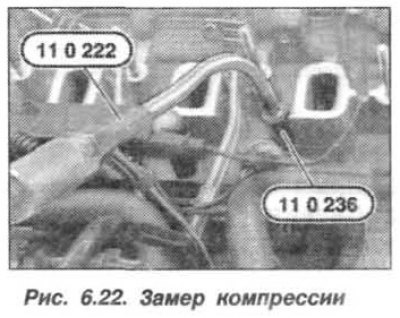
Rotate the engine shaft with the starter (8-10 revolutions) until the pressure increase on the device stops. Fix it in each engine cylinder.
In the future, install the devices sequentially into all the glow plug holes and take measurements. Compare the results obtained and draw conclusions.
Replace the gaskets, screw the glow plugs (4) into place and tighten them to a torque of 18 N·m (1.8 kgf·m). Assemble and start the engine, read the information from the DDE system ECU fault memory.
During long-term operation, as well as with frequent use of the car in extreme conditions (off-road, puddles, mud, sand, deep snow) – excessive wear of the V-belt profiles is possible.
The V-belt should be checked in the following order.
Remove the V-belt and measure the simple thickness (Ho) of the belt (Fig. 6.23).
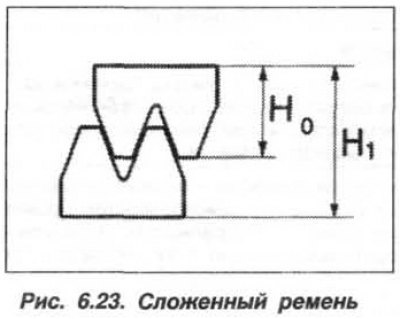
Measure the folded value (H1) of the belt. The belt is subject to replacement if, depending on the value of "Ho", the obtained value of "H1" is less than the value given below:
The tension roller is under spring pressure.
The alternator drive belt must be replaced in the following order: Remove the soundproof casing and fan. Remove the air conditioning compressor drive belt.
Place the fixture vertically on the tensioner hexagon so that its lever points upward.
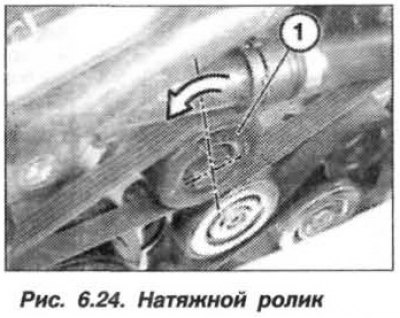
Press the tension roller (1, Fig. 6.24) the generator drive belt counterclockwise and remove the generator drive belt (2).
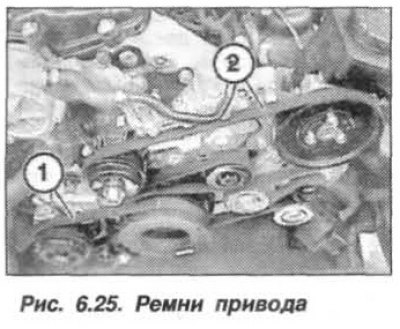
Install the removed drive belts on the pulleys and check that they are positioned correctly (Fig. 6.25). Assemble the engine.
First, you need to make sure that the starter turns the engine crankshaft normally and that the battery is fully charged.
Compression check
The removal of the engine must be preceded by checking the compression value, as one of the main operations determining the degree of engine wear and the need for its repair by removing the engine from the car.
Measuring the compression value allows you to identify the degree of wear of the valves, pistons, cylinder mirror, valve guide bushings, and everything that is associated with the gas distribution mechanism. To perform the test, special devices are required "11.2.236" (adapter) and "11.0.222" (compression meter), with a pressure measurement limit of up to 30 kgf/cm².
The main indicator of compression meter measurements is the pressure value and its difference in values for individual cylinders for one engine. This difference should not be more than 1.5 kgf/cm². If this value is found to be exceeded, it means that the valves or their seats are damaged, piston rings or cylinder liners are worn out. When the wear limit is reached, the engine is subject to removal and repair or replacement.
To install the compression gauge, you need to unscrew the glow plugs. The compression ratio itself is also important, for the M57 engine it should be 20 - 22 kgf/cm².
The engine compression test must be performed with the battery fully charged, on a cold engine and in the following order.
Attention!
- Read information from the DDE system ECU fault memory and eliminate faults if any were detected.
- Set the gearshift lever to neutral position.
- Disconnect the fuel injector connection system.
- The battery voltage and engine speed must be the same during all measurements.
- All air intake channels must be free.
Remove all glow plugs. Turn the engine shaft several times with the starter, which will remove the remaining combustion waste. Install the device "11.0.236" in the glow plug socket (Fig. 6.22). Connect the devices "11.0.222" and "11.0.236".
Rotate the engine shaft with the starter (8-10 revolutions) until the pressure increase on the device stops. Fix it in each engine cylinder.
In the future, install the devices sequentially into all the glow plug holes and take measurements. Compare the results obtained and draw conclusions.
Replace the gaskets, screw the glow plugs (4) into place and tighten them to a torque of 18 N·m (1.8 kgf·m). Assemble and start the engine, read the information from the DDE system ECU fault memory.
Checking the V-belt
During long-term operation, as well as with frequent use of the car in extreme conditions (off-road, puddles, mud, sand, deep snow) – excessive wear of the V-belt profiles is possible.
The V-belt should be checked in the following order.
Remove the V-belt and measure the simple thickness (Ho) of the belt (Fig. 6.23).
Measure the folded value (H1) of the belt. The belt is subject to replacement if, depending on the value of "Ho", the obtained value of "H1" is less than the value given below:
| – | But = 4.6 | H₁ < 7.4 |
| – | But = 4.7 | H₁ < 7.6 |
| – | But = 4.8 | H₁ < 7.8 |
| – | But = 4.9 | H1 < 8.0 |
| – | But = 5.0 | H1 < 8.2 |
| – | But = 5.1 | H1 < 8.4 |
| – | But = 5.2 | H1 < 8.6 |
| – | But = 5.3 | H1 < 8.8 |
| – | But = 5.4 | H1 < 9.0 |
Replacing the alternator drive belt
Caution: When reusing the alternator drive belt, mark its direction of rotation so that it can be installed in the same direction.
The tension roller is under spring pressure.
The alternator drive belt must be replaced in the following order: Remove the soundproof casing and fan. Remove the air conditioning compressor drive belt.
Place the fixture vertically on the tensioner hexagon so that its lever points upward.
Press the tension roller (1, Fig. 6.24) the generator drive belt counterclockwise and remove the generator drive belt (2).
Attention! Check the alternator drive belt for traces of coolant and oil, as well as mechanical damage. If any, replace the alternator belt.
Install the removed drive belts on the pulleys and check that they are positioned correctly (Fig. 6.25). Assemble the engine.
This article is available at russian, bulgarian, belarusian, ukrainian, serbian, croatian, romanian, polish, slovak, hungarian
Article verified: Zhuravleva Isolda
Share information:
Previous articles
БМВ E53: Power and exhaust system
Next articles
Similar articles on other types of BMW cars:
Troubleshooting the cooling system BMW 3 Series E46 (1998-2006, petrol)
Tire Pressure Monitoring System (RDC) BMW 3 Series E46 (1998-2006)
Injection system device with a high-pressure common fuel line… BMW 5 Series E39 (1995-2003)
Control pressure regulator of the K-Jetronic system BMW 5 Series E12 (1972-1981)
Removal and installation the fuel rail pressure sensor BMW 7 Series E38 (1994-2001)
Checking the cooling system for tightness BMW 7 Series E32 (1986-1994)
Daily checks and troubleshooting BMW X3 E83 (2003-2010)
Troubleshooting the cooling system BMW 3 Series E46 (1998-2006, petrol)
Tire Pressure Monitoring System (RDC) BMW 3 Series E46 (1998-2006)
Injection system device with a high-pressure common fuel line… BMW 5 Series E39 (1995-2003)
Control pressure regulator of the K-Jetronic system BMW 5 Series E12 (1972-1981)
Removal and installation the fuel rail pressure sensor BMW 7 Series E38 (1994-2001)
Checking the cooling system for tightness BMW 7 Series E32 (1986-1994)
Daily checks and troubleshooting BMW X3 E83 (2003-2010)
Link in different formats to this page
Visitor comments
No comments yet
- General information
- Manual
- Maintenance
- M54 petrol engine
- Engine repair
- Lubrication system
- Cooling system
- Supply system
- Injection system
- Exhaust system
- Engine electrics
- M62 petrol engine
- Engine repair
- Lubrication system
- Cooling system
- Supply system
- Exhaust system
- Engine electrics
- N62 petrol engine
- Engine repair
- Cooling and lubrication system
- Power and exhaust system
- Engine electrics
- Diesel engine M57
- Engine repair
- Lubrication system
- Cooling system
- Power and exhaust system
- Engine electrics
- Turbocharging system
- Transmission
- Clutch
- Mechanical gearbox
- Automatic gearbox
- Transfer case and cardan
- Chassis
- Brake system
- Steering
- Front suspension
- Rear suspension
- Wheels and tires
- Body
- Exterior
- Interior
- Doors and windows
- Repair and maintenance
- Heater and air conditioner
- Electrical equipment
- Equipment and devices
- Levers and switches
- Electrical circuits