
Remove the engine accessory protection panel, both cylinder head covers and remove all spark plugs.
Remove the chain tensioner plunger. Note that the piston cylinder is under significant spring pressure. Remove the upper timing belt covers, the left cylinder head VANOS actuator unit and the left cylinder head VANOS actuator unit adapter.
Attention! If the camshafts are removed from the cylinder head installed on the engine, it is necessary to set all pistons to an intermediate position. This will eliminate contact between the valves and pistons, since no piston will occupy the TDC position.
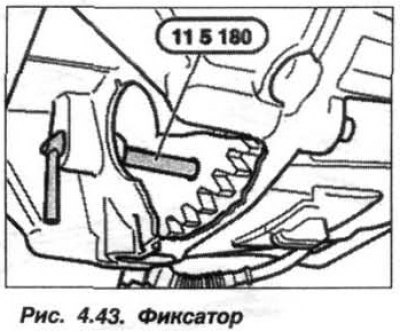
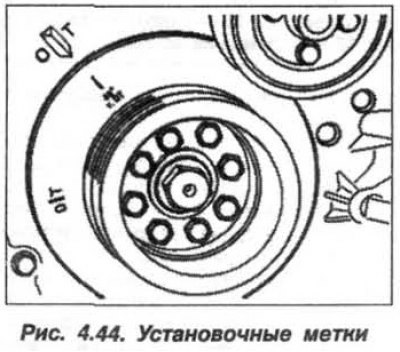
Pull the tool "11.5.180" back enough to release the flywheel (see fig. 4.43). Pull the drive chain up and hold it taut. Turn the engine crankshaft by the central bolt against the direction of rotation to the position 45° before TDC, using the timing marks (see fig. 4.44).
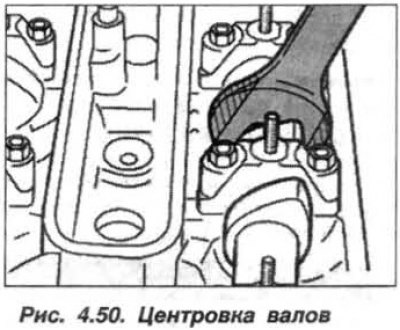
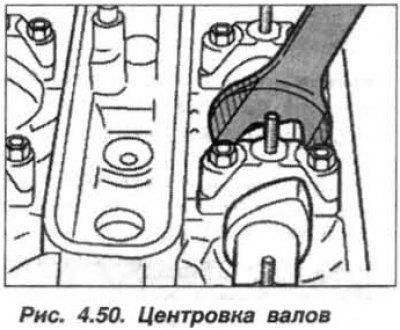
Attention! To adjust and hold the camshafts when removing and installing them, use only a modified wrench with cut jaws (see fig. 4.50), this will prevent damage to the cylinder head.
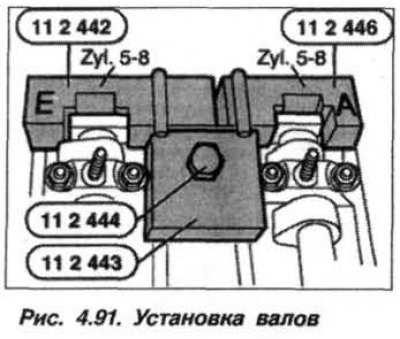
Remove the fixtures "11.2.444", "11.2.443", "11.2.446" and "11.2.442" (see fig. 4.91).
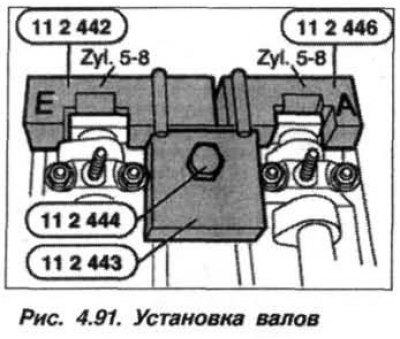
When removing the "11.2.442" tool, hold the intake camshaft of cylinders 5–8 with a wrench.
Prepare the camshafts for removal, for which:
- turn the exhaust camshaft by the hexagon so that the cams of the valves of the 6th cylinder are vertically upwards (lower arrow of the circle, Fig. 4.89):
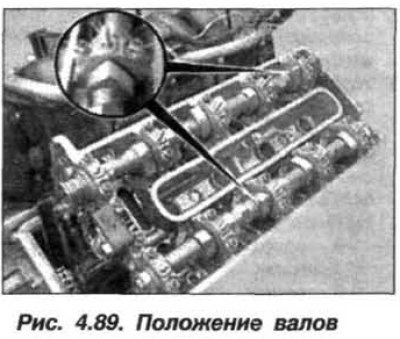
- turn the intake camshaft by the hexagon so that the cams of the 8th cylinder valves are vertically upwards (top arrow of the circle).
Loosen the nuts (M7) securing the bearing caps of the exhaust and intake camshafts on cylinder side 5–8 in several half-turn steps, moving from the edges to the middle.
Caution! The bearing caps of camshafts 1–4 and 5–8 cylinders cannot be interchanged.
Mark the positions of the caps relative to the cylinders and camshafts. Remove the bearing caps on cylinder side 5–8 and stack them in order. They must be installed in their proper places during assembly. Remove the camshafts.
The installation of camshafts should be carried out in the following order.
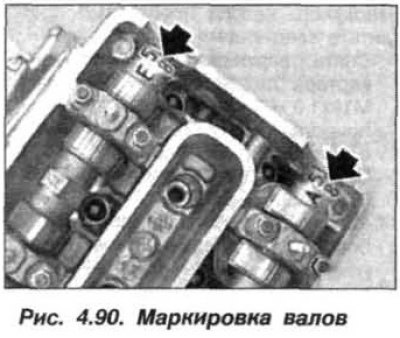
Install the exhaust and intake camshafts on cylinder side 5–8. The exhaust camshafts are marked "A,5–8" (Fig. 4.90), the intake camshaft is marked "E,5–8".
Turn the exhaust camshaft by the hexagon so that the cams of the valves of the 6th cylinder are vertically upwards (lower arrow, see Fig. 4.89).
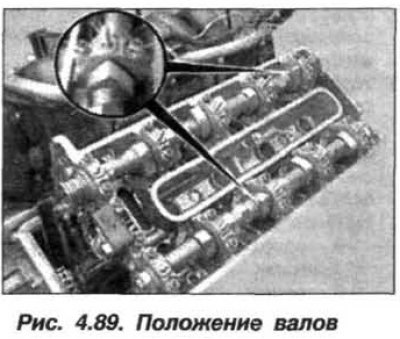
Turn the intake camshaft by the hexagon so that the cams of the 8th cylinder valves are vertically upwards (top arrow).
Install the bearing caps in their places. The bearing caps of the exhaust camshaft are marked from A1 to A5, read from the intake side. The bearing caps of the intake camshaft are marked from E1 to E5, read from the intake side.
Tighten the nuts (M7) securing the bearing caps of the exhaust and intake camshafts on cylinder side 5–8 in several half-turn steps, moving from the middle to the edges, with a final tightening torque of 14 N·m (1.4 kgf·m).
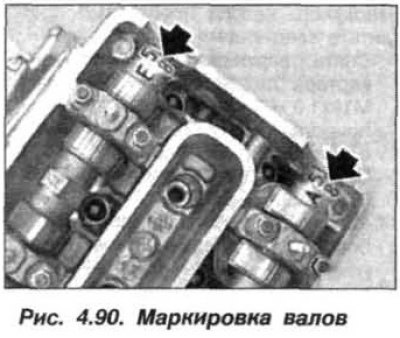
Align the camshafts with the modified wrench until the timing marks on the shafts are facing up (arrows, Fig. 4.90).
Install tools "11.2.446" (A) and "11.2.442" (E) (Fig. 4.91) on the camshafts on cylinder side 5–8.
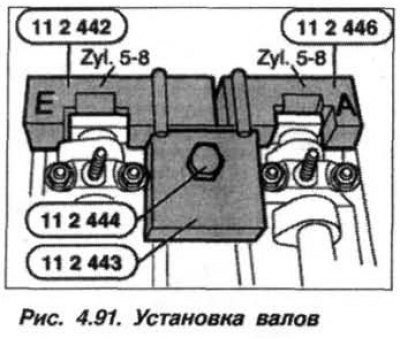
Using the key (see fig. 4.50), adjust the position of the camshafts so that the devices "11.2.442" and "11.2.446" fit tightly to the cylinder head, without any gap.
Install the device "11.2.443" (Fig. 4.91) on the devices "11.2.446" and "11.2.442" and secure it with the bolt "11.2.444" screwed into the spark plug hole.
Return the piston of the first cylinder to the TDC position of the compression stroke by rotating the crankshaft clockwise. Lock the crankshaft in the TDC position of the end of the compression stroke using the device "11.5.180" (see fig. 4.43).
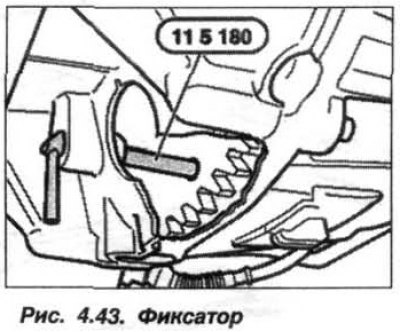
Attention! Before starting the engine, remove the device "11.5.180".
Install the left cylinder head VANOS actuator adapter, VANOS actuator, upper timing belt covers and chain tensioner plunger. Install both cylinder head covers and assemble the engine.