
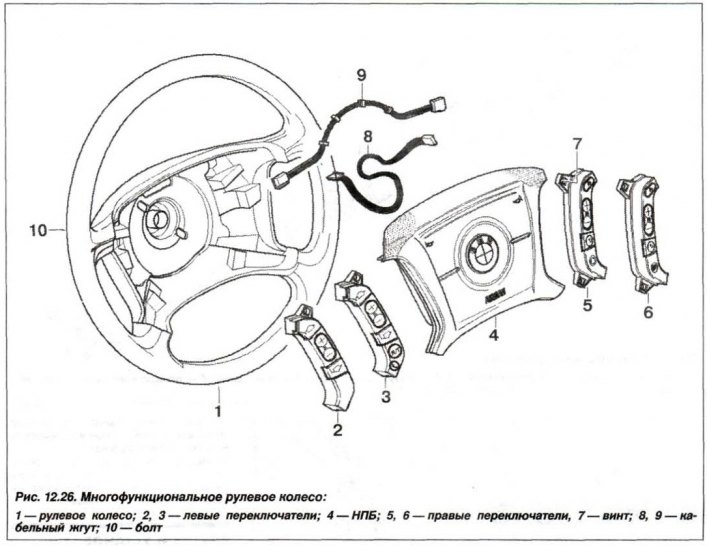
Attention! All work carried out must be coordinated with the fact that there is a fire alarm nearby.
The steering wheel must be removed in the following order. Set the steering wheels to move in a straight-line direction. Disconnect the "-" terminal from the battery and insulate the cable with a rubber boot.
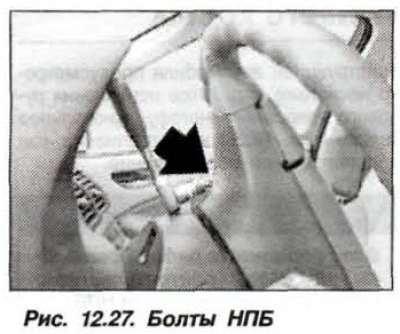
Unscrew two T-30 Torx bolts (arrow, Fig. 12.27) nPB fastenings. Raise the NPB and disconnect the NPB power supply system loop and its control loop. Remove the NPB unit and put it aside (in the trunk), with the open side facing up.
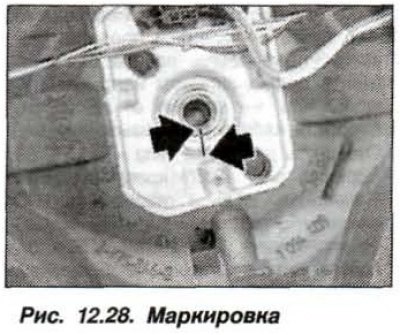
Mark the position of the steering wheel in relation to the steering shaft (arrows and dotted line, Fig. 12.28).
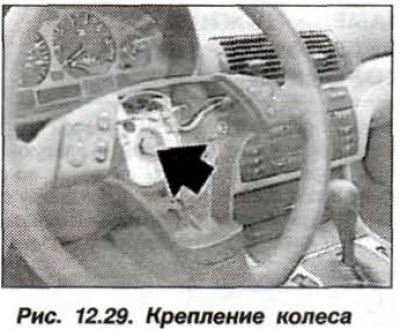
Loosen the bolt (or nut) securing the steering wheel to the steering shaft (arrow, Fig. 12.29). Carefully remove the steering wheel from the shaft splines, using a puller if necessary. Do not damage the cable harnesses.
The steering wheel should be installed in the reverse order, and it is necessary to install it on the splined joint of the shaft so that the marks of the previously applied markings coincide. In this case, make sure that the locking pins enter the groove.
Tighten the steering wheel mounting bolt (M14x1.5) to a torque of 63 N·m (6.3 kgf·m), if a nut is used to secure it, tighten it to a torque of 80 N·m (8.0 kgf·m). Only now can you turn the steering wheel without risking damage to the contact ring.
Install the airbag unit and connect the control unit. When installing the airbag, monitor the wiring to ensure that the wires are not pinched. Bolts (Torx T-30, M6x15) tighten the airbag mounts to a torque of 2.0 N·m (0.2 kgf·m).
Check the correct position of the steering wheel relative to the neutral position, straight-line movement of the car. The upper spoke of the steering wheel should be in a horizontal position.
Take a test drive. If necessary, if the steering wheel is at an angle, reinstall it. Check the operation of the horn and steering column switches.