
Attention! After completing the installation of the steering column, it is necessary to:
- perform steering wheel angle correction for the Dynamic Stability Control (DSC) system;
- check the freedom of movement of the steering column over the entire range of adjustments in relation to adjacent parts and pipelines;
- check the operation of mechanical devices (ignition lock cylinder, steering wheel shaft lock, Interlock system) and electrical systems.
The steering column assembly must be removed in the following order: Disconnect the "–" terminal from the battery.
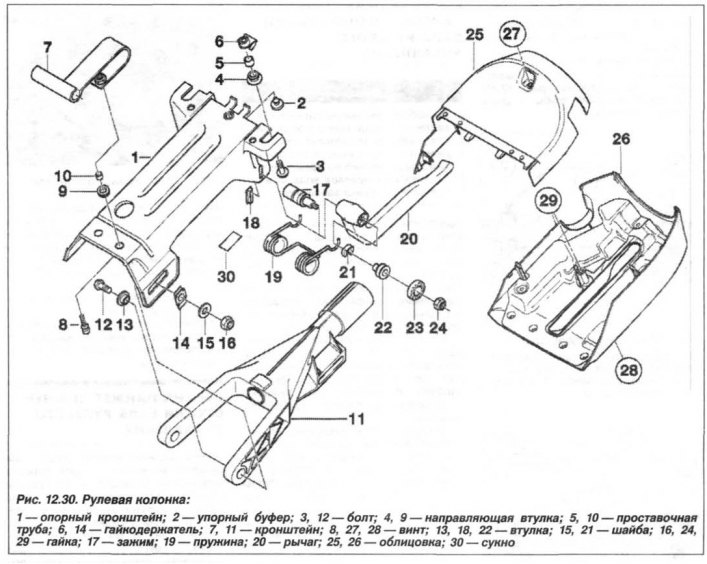
Remove the bolts (28, Fig. 12.30) lower trim panel fasteners (26). Disconnect the horn loop and the on-board diagnostics loop. Remove the instrument panel trim, steering wheel, upper and lower steering column trim.
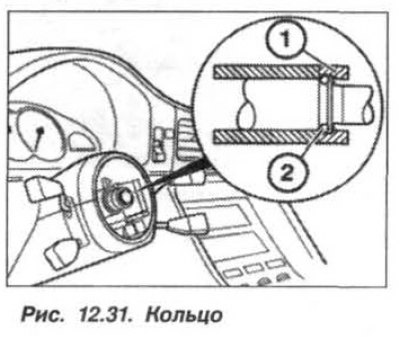
Remove the ring from the groove (1, Fig. 12.31). If necessary, disconnect the Interlock system rod from the steering wheel shaft lock. Loosen the mounting bolts, disconnect the SS and remove the switch brackets from the steering column.
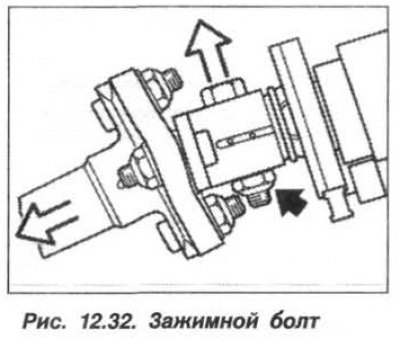
Unscrew the nut (dark arrow, Fig. 12.32) and remove the clamp bolt. Move the steering shaft downwards (left, light arrow).
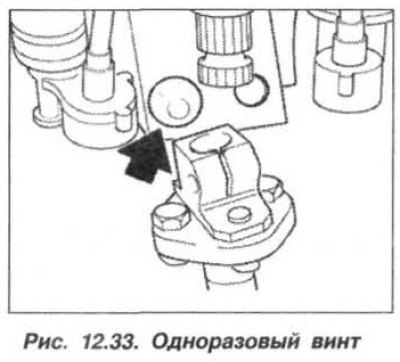
Chisel off the head of a disposable screw (arrows, Fig. 12.33). Disconnect all wires leading to the steering column from the holders. Unscrew the screw and release the retainer, disconnect the steering column from the ignition switch.
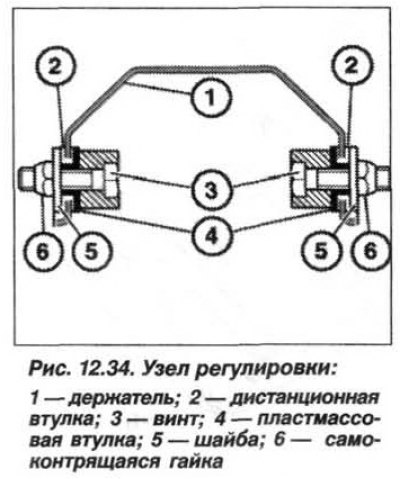
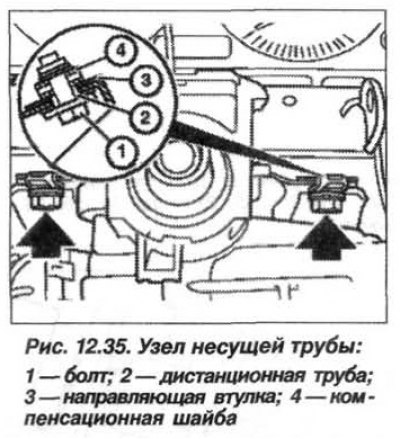
Remove the screws (3, Fig. 12.34) mechanical adjustment unit. Unscrew the bolts (1, arrows, Fig. 12.35) fastening the support pipe and remove the steering column.
 |
 |
The installation of the steering column should be carried out in the reverse order, and it is necessary to replace the self-locking nuts (6, see Fig. 12.34) and tighten them to a torque of 8.0 N·m (0.8 kgf·m). Lightly lubricate the inner surface of the bushing (4).
Install the distance tube, tighten the disposable screw until it breaks off at the neck. The clamping screw should enter the socket on the steering shaft, replace the self-locking nut and tighten it to the torque:
- on steel connection – 24 Nm (2.4 kgf·m);
- on an aluminum alloy connection – 28 N·m (2.8 kgf·m).
Pay attention to the position of the ring (1, see Fig. 12.31) in relation to the spring retaining ring (2).