
Prepare the equipment "11.9.190", "11.9.461" and "11.9.462". Remove the left eccentric shaft drive motor, the left cylinder head cover. Unscrew all spark plugs of cylinders 5–8 and remove the fan shroud.
Screw in the special bolt (15, see Fig. 5.13). Release the oil line (12) from the clamps and remove it.
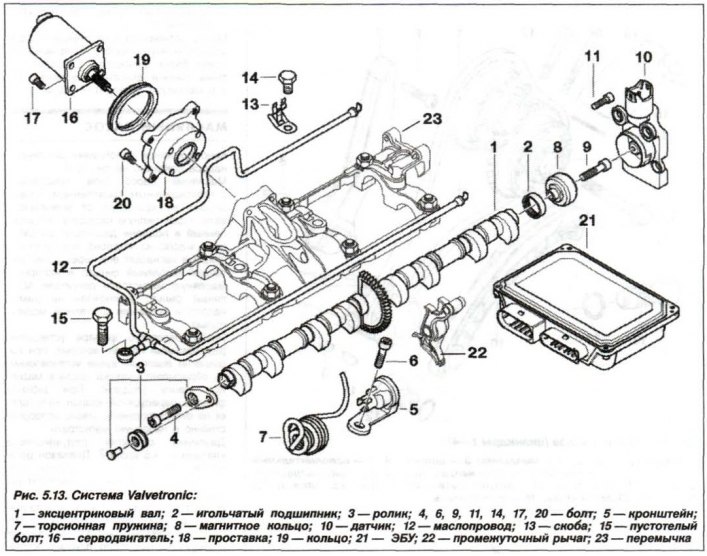
Turn the crankshaft by the central bolt in the direction of rotation until the piston of the 1st cylinder is at the top dead center (TDC) of the end of the compression stroke. In the TDC position of the end of the compression stroke of the 1st cylinder, the camshaft cams of the intake and exhaust valves of the 5th cylinder are inclined upward, as shown in Figure 5.121.
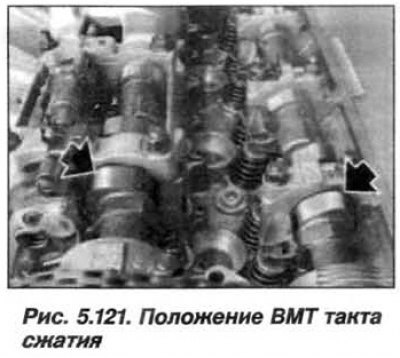
In the TDC position, fix the torsional vibration damper using the device "11.9.190" (pin), which is installed in the hole located on the timing belt cover (see fig. 5.130).
Caution! When the engine is stopped normally, the intake and exhaust actuators are locked in their original position. In some cases, this original position may not be reached and the camshaft rotates within the unit's adjustment range.
To avoid incorrect adjustment of the valve timing, it is necessary to check the locking of the actuator and, if necessary, lock it by turning the camshafts.
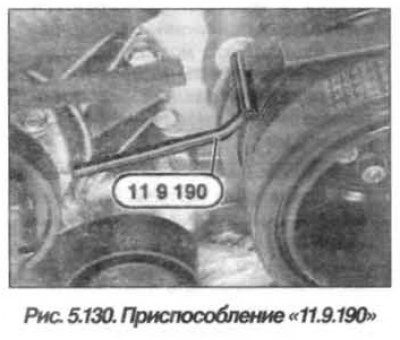
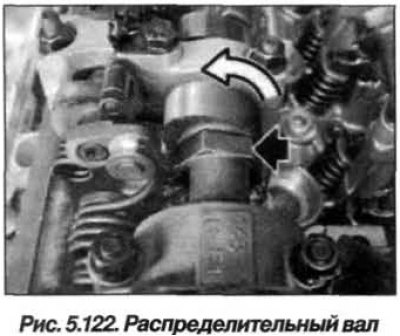
Check the locking of the intake actuator in the initial position. Take hold of the Allen key (dark arrow, Fig. 5.122) intake camshaft and carefully try to turn the intake camshaft against the direction of rotation (light arrow).
If there is no reliable connection between the intake camshaft and the intake actuator, turn the intake camshaft counterclockwise until it stops.
The intake actuator is locked in its original position if the intake camshaft is securely connected to the intake actuator.
Check the locking of the exhaust actuator in the initial position. To do this, take the hexagon of the exhaust camshaft and carefully try to turn the exhaust camshaft in the direction of its rotation. If there is no reliable connection between the exhaust camshaft and the exhaust actuator, turn the exhaust camshaft against the direction of rotation until it stops.
The exhaust actuator is locked in its original position if the exhaust camshaft is securely connected to the exhaust actuator.
Attention! If the intake or exhaust actuator "does not allow" the camshafts to be locked in the manner described, then the actuator is faulty and must be replaced.
Install the device "11.9.461" (fig. 5.123) on the intake camshaft and check the valve timing adjustment.
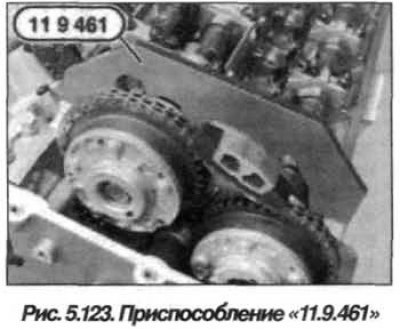
The valve timing is adjusted correctly if the "11.9.461" tool fits onto the cylinder head without gaps or is raised relative to the exhaust side by a maximum of 0.5 mm.
Remove the "11.9.461" tool from the intake camshaft and install the "11.9.462" tool on the exhaust camshaft and check the valve timing adjustment.
The valve timing is adjusted correctly if the "11.9.462" tool fits onto the cylinder head without gaps or is raised relative to the exhaust side by a maximum of 0.5 mm.
If necessary, adjust the valve timing on the left side. Remove all tools.
Bolt (15, see Fig. 5.13) is a special bolt and cannot be replaced with a regular M8 bolt. Clamp the oil line (12) with clamps. Insert the bolt (15) and tighten it. Assemble the engine.