- S, serial;
- B, 1st repair size;
- C, 2nd repair size.
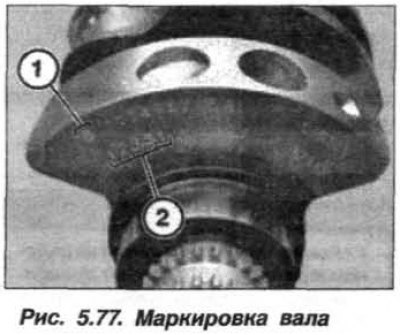
The numbers (2) shown in the figure indicate the classification of the liners for the corresponding bearing beds 1–5 (main bearing caps), where 1 is yellow, 2 is green, 3 is purple.
Note: When replacing main bearing shells or the crankshaft, the classification for the main bearing shells in the cylinder block is retained.
According to the diameter of the main journals, the crankshaft has a yellow ("Y"), green ("G") or purple ("V") marking.
The color marking of the liners in the main bearing caps must correspond to the marking of the crankshaft.
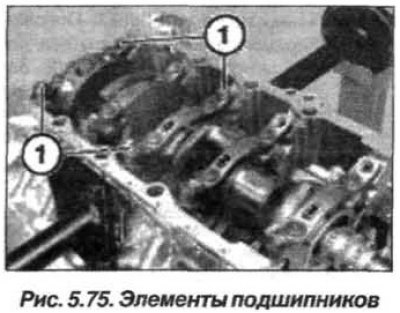
The main bearing caps (1–3) are marked with stamped numbers. The caps of bearings 4 and 5 are not marked.
The main bearing cap No.5 can be distinguished by the surface for the thrust bearing half ring.
The letters shown in the picture (1, Fig. 5.78) designate the classification of bearing shells for bearing beds 1–5 in the crankcase and are located on the gearbox side in the space between the cylinder rows.
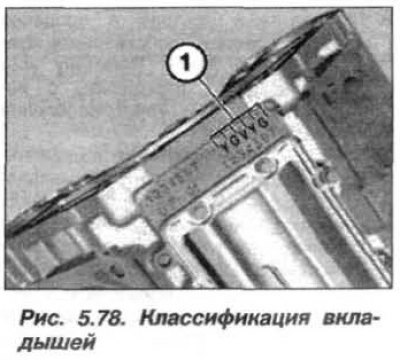
The first letter on the left indicates the first bearing bed from the front – yellow ("Y"), green ("G") or purple ("V") marking.
Remove the old main bearing shells from the cylinder block housing. Install the main bearing shells with oil supply grooves into the cylinder block housing. Unscrew the support threaded pins (arrows, Fig. 5.79) from the main bearing caps.

Insert the liners without the oil supply groove into the main bearing caps. Screw the installation bushings with the internal hexagon into the main bearing cap lugs. The thrust bearing half rings are installed in the cylinder block housing and in the main bearing cap. The half rings have grooves for oil supply.
Attention! Make sure that the grooves of the thrust half rings are facing the crankshaft.
Install the thrust bearing half rings so that the oil supply grooves face the crankshaft cheeks. Align the thrust half rings on the side of the main bearing cap. The cover of thrust bearing No.5 of the crankshaft has a groove. Install the liners with a thrust flange (protrusions) in the grooves of the main bearing cap No.5. Place the crankshaft in the bed of the cylinder block crankcase.
When tightening the covers, use the old (removed) bolts during the gap check. Determine the bolt rotation angle using the "00.9.120" device.
Remove the main bearing caps and measure the radial clearance in the main bearings directly on the shaft journal (arrow, see Fig. 5.80) by the width of the flattened calibrated wire. In this case, use the measuring scale of the wire packaging. The value of the radial clearance of the crankshaft bearings should be within 0.024–0.052 mm.
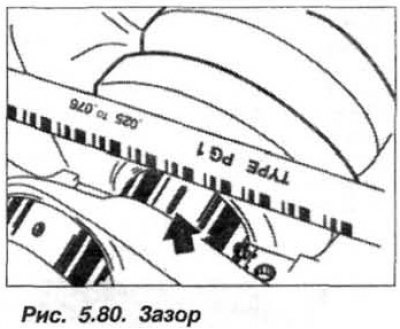
If necessary, to adjust the bearing clearance, use new liners with a different color marking. Remove the calibration wire from the crankshaft journal using alcohol.
Lubricate the crankshaft journals and main bearing shells with engine oil. Install the main bearing caps (1–5) so that the bearing guides are on one side. Align the bearing caps with the bed along the lateral plane.
Blow out blind holes with compressed air; moisture and dirt are not allowed. Use new main bearing cap mounting bolts; do not wash off their coating. Install and tighten the main bearing cap mounting bolts by hand. Tighten the new main bearing cap mounting bolts to 20 N·m (2.0 kgf·m).
Loosen the fasteners of the thrust main bearing cap No.5. Tap the end of the crankshaft at the back and front with a mallet or plastic hammer to center the thrust bearing. Tighten the bolts fastening the thrust main bearing cap (No. 5) to a torque of 20 N·m (2.0 kgf·m). Tighten all the bolts (M11) fastening the main bearing caps to a specified angle of 100°, using the "00.9.120" tool.
Check the crankshaft axial clearance (see fig. 5.80), which should be within 0.080 – 0.246 mm. If the permissible axial clearance is exceeded, check and, if necessary, replace the thrust bearing shell, crankshaft and engine block.
Tighten the threaded bushings (M8) to 6.0 N·m (0.6 kgf·m). Tighten all the bolts (M10) securing the main bearing caps to an angle of 100°. Replace the bolts (1, see Fig. 5.75) with a flange head and tighten them to a torque of 34 N·m (3.4 kgf·m).