
Secure the flywheel of a 6-cylinder engine with the tool "11.9.260" or the flywheel of an 8-cylinder engine with the tool "11.9.263". Mark the relative position of the clutch basket on the flywheel with a marker.
Caution! Abruptly releasing the basket mounting bolts may result in breakage of the diaphragm spring and mounting pins.
The basket must be removed manually.
A contaminated driven disk must be replaced.
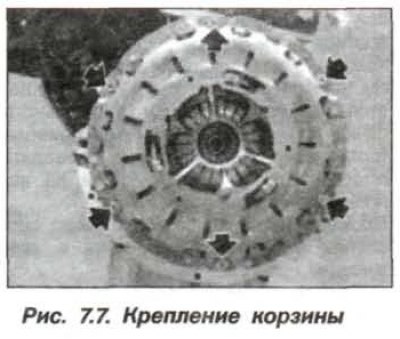
Bolts (arrows, Fig. 7.7) loosen the clutch basket fastenings sequentially, by 1–1.5 turns crosswise, until the pressure plate tension is relieved. Loosen the bolts by two or three turns and check that the casing is not stuck on the mounting pins. Unscrew the basket fastening bolts completely and remove it.
Remove the driven clutch disc from the flywheel and wipe the end (working) surface of the flywheel.
Caution! Only wipe the clutch release bearing, do not wash it.
The clutch check must be carried out in the following order.
Remove wear products from the linings from the surfaces of the casing, disks and flywheel using only a special cleaner or methyl alcohol. Work should be carried out in a respirator, since dust from the lining material is harmful to health.
Inspect the surfaces of the clutch pressure plate and flywheel for unevenness, cracks and spots from overheating.
Check the driven clutch disc for damage, wear and rust on the splines; replace the driven disc if necessary.
Pay special attention to the riveted connections of the spring between the pressure plate and the casing. Clutch with damaged or loose rivets must be replaced.
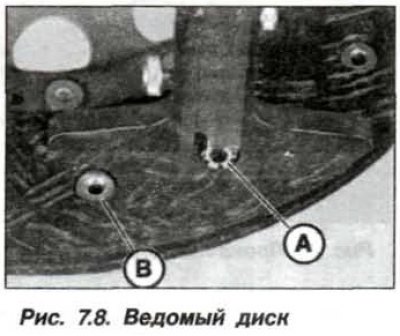
Measure the protrusion of the friction lining above the rivets for its fastening along the closing head (A, Fig. 7.8), which must be at least 1.0 mm. The driven clutch disc with traces of grease and oils, with reduced lining thickness, as well as with mechanical damage in the form of cracks is subject to replacement.
The surface of the pressure plate is subject to inspection for warping using a metal ruler (bar) and a feeler gauge. A pressure plate with an inward deflection of less than 0.3 mm can be used in further operation.
When installing a previously used driven disk, it must be checked for lateral runout, which should not exceed 0.5 mm. This is very important if there were any comments on the clutch disengaging during its operation.
Inspect the flywheel surface for scratches, cracks and discoloration (appeared due to local overheating). If necessary, grind the flywheel or replace it. Fasten the flywheel with bolts crosswise, with a torque of 120 N·m (12.0 kgf·m).
Caution! Do not clean the SAC clutch in high pressure washers or washing machines.
When installing the driven disk on the primary (input) shaft of the manual transmission, check the grooves of the splined connection for signs of wear and the absence of traces of corrosion.
Inspect the diaphragm spring for signs of damage. Signs of wear on the ends of the diaphragm spring petals to a depth of up to half its thickness are acceptable.
Check the primary shaft bearing for ease of rotation and absence of runout. If necessary, remove the bearing with the puller "11.2.010" and install a new one.
Clean the friction linings of the pressure plate and the working surfaces of the pressure plate and flywheel with fine sandpaper.
Check the clutch release bearing by hand. It should rotate easily and not make noise. Particular attention should be paid to the bearing that was noted to be noisy when the clutch was released (pressing the pedal). Replace the defective bearing.
The installation of the removed basket and the driven clutch disc should be carried out in the reverse order, while it is necessary.
Remove traces of dust and oil from the working surface of the flywheel.
Clean the hub grooves from traces of wear and apply a thin layer of high-temperature antifriction grease such as "Molykote-Longterm²".
Check the presence and tightness of the guide pins on the flywheel.
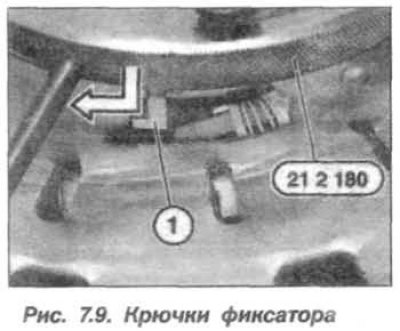
Note: Hooks (1, Fig. 7.9) the locking pins of the "21.2.180" device must enter the clutch sockets.
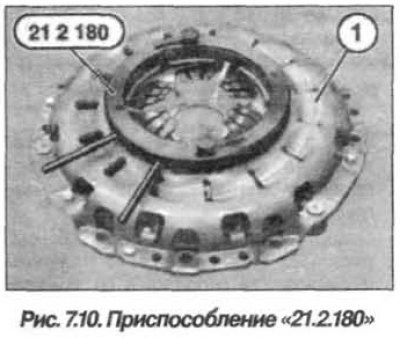
Place the clutch on a clean surface and install the "21.2.180" device (Fig. 7.10) on it. Fix the clutch adjustment ring in its original position by squeezing the handles (1) until they stop and, holding them in this position, tighten the knurled-head bolts (2). This operation should only be performed on a previously installed clutch. The clutch adjustment ring is fixed in its original position.
Note: Insert the "21.2.170" tool only into the holes (arrows, Fig. 7.11) for centering pins.
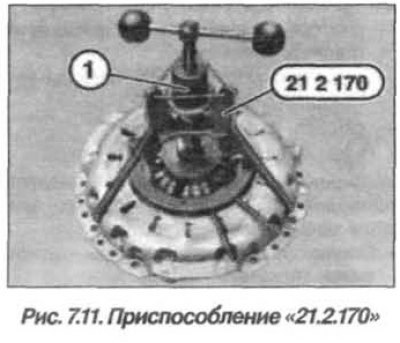
Install the "21.2.170" tool into the holes for the guide pins and tighten the nut (1, Fig. 7.11) with knurled head.
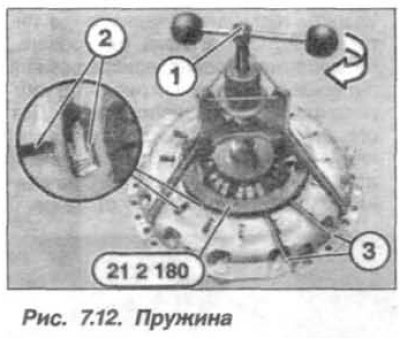
Screw in the spindle (1, Fig. 7.12) device "21.2.170" until the diaphragm spring (2) is fully compressed, and the handles (3) will begin to rotate.
Attention! The driven disk is marked "Motorseit" (engine side) and "Getriebeseite" (rCPP side). Inscription "Getriebeseite" must be visible during installation.
Do not touch the surface of the friction linings.
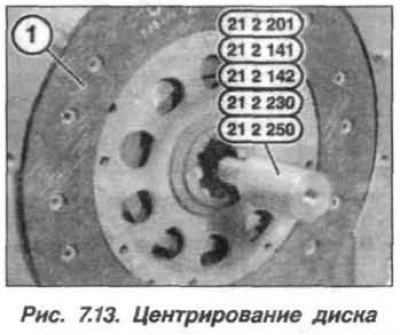
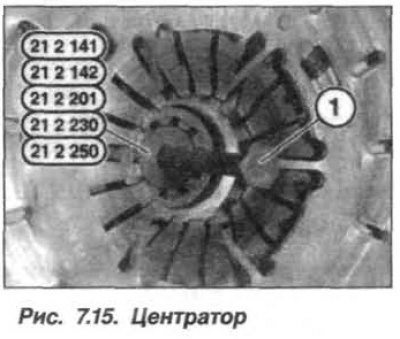
Install the clutch driven disc onto the flywheel surface and center it using the tool "21.2.141" (S5D390Z), "21.2.201" (GS6–37BZ), "21.2.230" (GS6 53DZ/BZ) or "21.2.250" (GS6–17BG) (Fig. 7.13).
When replacing the diaphragm spring, make sure that its petals are facing away from the flywheel.
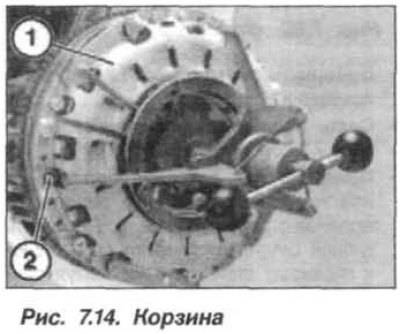
Install basket (1, Fig. 7.14) clutch to the flywheel. It should sit on the guide pins (2) and the alignment marks should match. Tighten the clutch mounting bolts by hand, holding the basket from shifting so that the pressure plate is evenly pressed against the flywheel.
Caution! The pressure plate must be in full contact with the flywheel surface.
Remove excess antifriction grease from the driven disk hub. Tighten the clutch housing mounting bolts in a crisscross pattern, 1–1.5 turns each time, until the basket bolts are fully tightened to a torque of 25 N·m (2.5 kgf·m) for M8 bolts (8.8) or a torque of 34 N·m (3.4 kgf·m) for M8 bolts (10.9).
Remove the compression force from the diaphragm spring by unscrewing the spindle of the "21.2.170" tool. Unscrew the knurled head nut and remove the tool from the clutch. Unscrew the knurled head screws and remove the "21.2.180" tool from the clutch. Remove the centering tool (centralizer) from the clutch driven disc using the supplied bolt (1, Fig. 7.15) and flywheel lock.
Lubricate the splined joints of the primary shaft of the manual transmission with a thin layer of grease such as "Microlube GL 261".
Check the condition of the release bearing and install it on the transmission.
Install the manual transmission as described in the section "Transmission".