
Caution! Due to the risk of damage to the engine vacuum system seals and the lack of brake booster function, make sure that all vacuum lines are connected correctly before starting the engine.
Since the vacuum in the intake system is not sufficient for reliable operation of the brake booster, the vehicle is equipped with a vacuum pump driven directly by the engine.
Vacuum pump (1, Fig. 5.173) installed on the head of cylinders 1–4, in front on the exhaust camshaft.
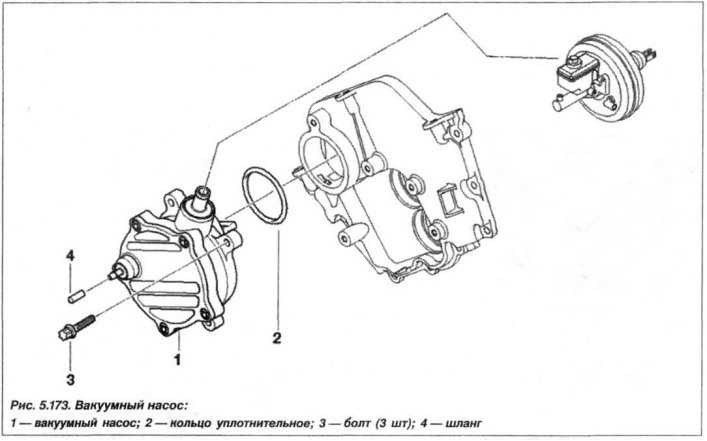
Attention! Before starting work on replacing the vacuum pump, it is necessary to relieve the vacuum in the brake booster, for which it is necessary to press the brake pedal several times.
The vacuum pump must be replaced in the following order: Remove the decorative and soundproof engine casing. Remove the suction hose with the flow meter (flow meter) air and the upper part of the air filter.
Loosen the clamp (1, Fig. 5.174) and disconnect the vacuum line.
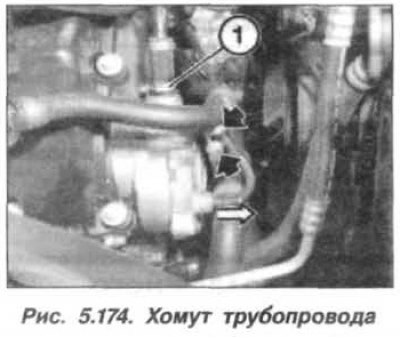
Loosen the hose holder nuts and disconnect the vacuum hose. You can return the bolts, remove the vacuum pump holder and the pump itself.
When installing the pump, it is necessary to replace the sealing ring (1, Fig. 5.175) and fix it with grease.
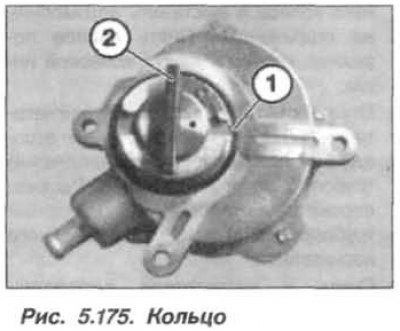
Set the drive mechanism (2) to its original position, with its projection on the pump in a vertical position. The pump drive spline on the shaft should also be in a vertical position. Set the spline position by turning the crankshaft by the central bolt.